Martin Amanda L, Hickey Jennifer L, Ablack Amber L, Lewis John D, Luyt Leonard G, Gillies Elizabeth R
Department of Chemistry, The University of Western Ontario, 1151 Richmond St., London, ON N6A 5B7, Canada.
J Nanopart Res. 2009 Jun 23;12(5):1599-1608. doi: 10.1007/s11051-009-9681-3.
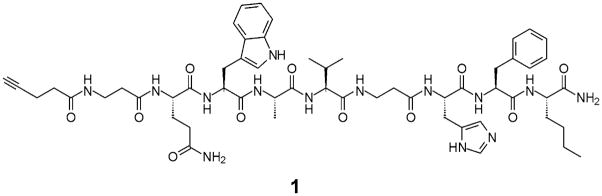
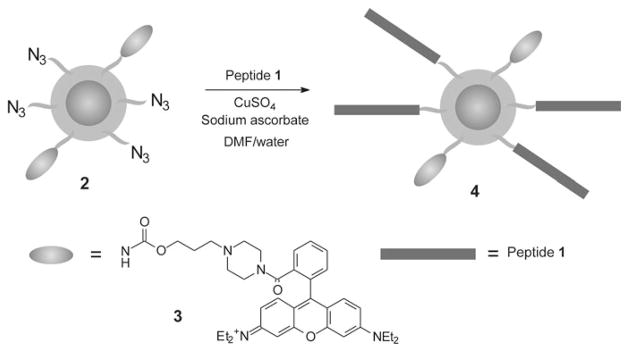
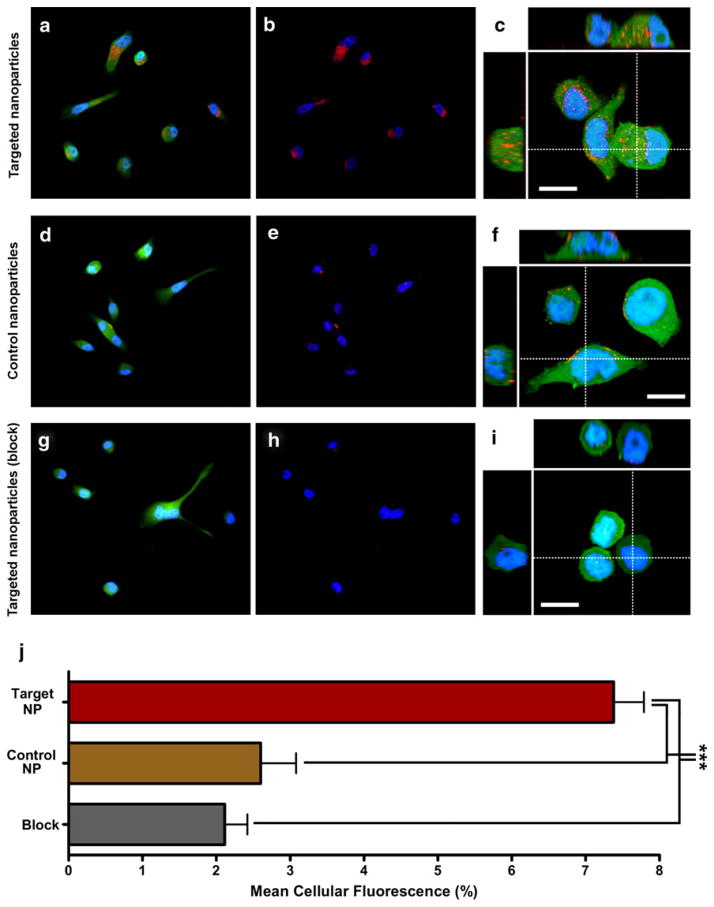
The imaging of molecular markers associated with disease offers the possibility for earlier detection and improved treatment monitoring. Receptors for gastrin-releasing peptide are overexpressed on prostate cancer cells offering a promising imaging target, and analogs of bombesin, an amphibian tetradecapeptide have been previously demonstrated to target these receptors. Therefore, the pan-bombesin analog [β-Ala11, Phe13, Nle14]bombesin-(7-14) was conjugated through a linker to dye-functionalized superparamagnetic iron oxide nanoparticles for the development of a new potential magnetic resonance imaging probe. The peptide was conjugated via click chemistry, demonstrating a complementary alternative methodology to conventional peptide-nanoparticle conjugation strategies. The peptide-functionalized nanoparticles were then demonstrated to be selectively taken up by PC-3 prostate cancer cells relative to unfunctionalized nanoparticles and this uptake was inhibited by the presence of free peptide, confirming the specificity of the interaction. This study suggests that these nanoparticles have the potential to serve as magnetic resonance imaging probes for the detection of prostate cancer.
与疾病相关的分子标志物成像为早期检测和改善治疗监测提供了可能性。胃泌素释放肽受体在前列腺癌细胞上过度表达,是一个很有前景的成像靶点,此前已证明蛙皮素(一种两栖类十四肽)的类似物可靶向这些受体。因此,泛蛙皮素类似物[β-丙氨酸11,苯丙氨酸13,正亮氨酸14]蛙皮素-(7-14)通过连接子与染料功能化的超顺磁性氧化铁纳米颗粒偶联,用于开发一种新的潜在磁共振成像探针。该肽通过点击化学进行偶联,展示了一种与传统肽-纳米颗粒偶联策略互补的替代方法。然后证明肽功能化的纳米颗粒相对于未功能化的纳米颗粒能被PC-3前列腺癌细胞选择性摄取,并且这种摄取会因游离肽的存在而受到抑制,证实了相互作用的特异性。这项研究表明,这些纳米颗粒有潜力作为磁共振成像探针用于检测前列腺癌。