Department of Brain and Cognitive Sciences, University of Rochester, NY, USA.
Cogn Neuropsychol. 2012;29(1-2):7-33. doi: 10.1080/02643294.2012.654773. Epub 2012 Feb 13.
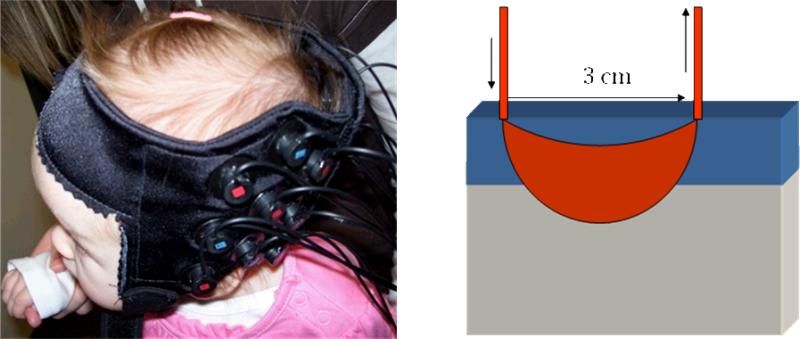
Near-infrared spectroscopy (NIRS) is a noninvasive diffuse optical-imaging technique that can measure local metabolic demand in the surface of the cortex due to differential absorption of light by oxygenated and deoxygenated blood. Over the past decade, NIRS has become increasingly used as a complement to other neuroimaging techniques, such as electroencephalography (EEG), magnetoencephalography (MEG), and functional magnetic resonance imaging (fMRI), particularly in paediatric populations who cannot easily be tested using fMRI and MEG. In this review of empirical findings from human infants, ranging in age from birth to 12 months of age, a number of interpretive concerns are raised about what can be concluded from NIRS data. In addition, inconsistencies across studies are highlighted, and strategies are proposed for enhancing the reliability of NIRS data gathered from infants. Finally, a variety of new and promising advances in NIRS techniques are highlighted.
近红外光谱(NIRS)是一种非侵入性的漫射光学成像技术,可通过测量氧合和去氧血红蛋白对光的不同吸收来测量皮质表面的局部代谢需求。在过去的十年中,NIRS 已越来越多地被用作其他神经影像学技术(如脑电图(EEG)、脑磁图(MEG)和功能磁共振成像(fMRI))的补充,特别是在无法使用 fMRI 和 MEG 对其进行测试的儿科人群中。在对从出生到 12 个月大的人类婴儿的实证研究进行综述时,提出了一些关于从 NIRS 数据中可以得出什么结论的解释性关注。此外,还突出了研究之间的不一致性,并提出了从婴儿收集 NIRS 数据的增强可靠性的策略。最后,突出了 NIRS 技术的各种新的有前途的进展。