Kao Chieh, Zhang Yang
Department of Speech-Language-Hearing Sciences, University of Minnesota, Minneapolis, MN 55455, USA.
Center for Neurobehavioral Development, University of Minnesota, Minneapolis, MN 55455, USA.
Brain Sci. 2019 Jul 27;9(8):181. doi: 10.3390/brainsci9080181.
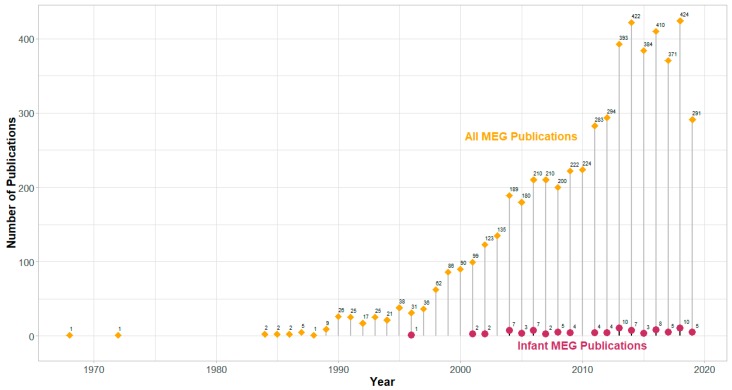
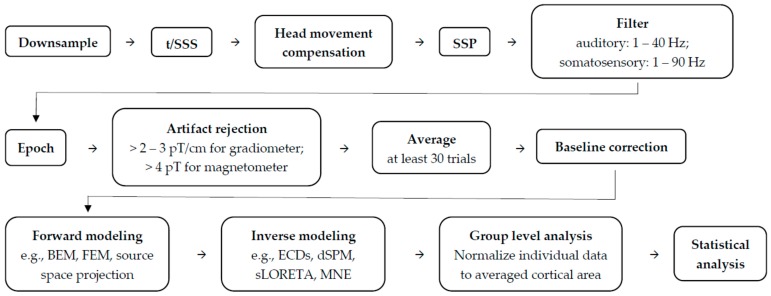
Magnetoencephalography (MEG) is known for its temporal precision and good spatial resolution in cognitive brain research. Nonetheless, it is still rarely used in developmental research, and its role in developmental cognitive neuroscience is not adequately addressed. The current review focuses on the source analysis of MEG measurement and its potential to answer critical questions on neural activation origins and patterns underlying infants' early cognitive experience. The advantages of MEG source localization are discussed in comparison with functional magnetic resonance imaging (fMRI) and functional near-infrared spectroscopy (fNIRS), two leading imaging tools for studying cognition across age. Challenges of the current MEG experimental protocols are highlighted, including measurement and data processing, which could potentially be resolved by developing and improving both software and hardware. A selection of infant MEG research in auditory, speech, vision, motor, sleep, cross-modality, and clinical application is then summarized and discussed with a focus on the source localization analyses. Based on the literature review and the advancements of the infant MEG systems and source analysis software, typical practices of infant MEG data collection and analysis are summarized as the basis for future developmental cognitive research.
脑磁图(MEG)在认知脑研究中以其时间精度和良好的空间分辨率而闻名。尽管如此,它在发育研究中的应用仍然很少,其在发育认知神经科学中的作用也未得到充分探讨。本综述聚焦于MEG测量的源分析及其回答有关婴儿早期认知体验背后神经激活起源和模式的关键问题的潜力。与功能磁共振成像(fMRI)和功能近红外光谱(fNIRS)这两种研究各年龄段认知的主要成像工具相比,讨论了MEG源定位的优势。强调了当前MEG实验方案面临的挑战,包括测量和数据处理,这可能通过开发和改进软件及硬件来解决。然后总结并讨论了一系列关于婴儿MEG在听觉、言语、视觉、运动、睡眠、跨模态及临床应用方面的研究,重点是源定位分析。基于文献综述以及婴儿MEG系统和源分析软件的进展,总结了婴儿MEG数据收集和分析的典型做法,作为未来发育认知研究的基础。