Setor de Provas de Função Respiratória, Universidade do Estado do Rio de Janeiro, Rua Araguaia 1266, Rio de Janeiro, RJ, Brazil.
Braz J Med Biol Res. 2012 Mar;45(3):256-63. doi: 10.1590/s0100-879x2012007500018. Epub 2012 Feb 16.
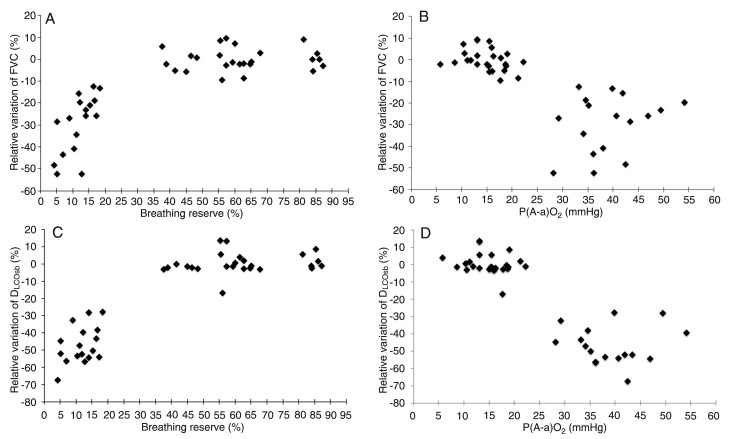
Cardiopulmonary exercise testing (CPET) plays an important role in the assessment of functional capacity in patients with interstitial lung disease. The aim of this study was to identify CPET measures that might be helpful in predicting the vital capacity and diffusion capacity outcomes of patients with thoracic sarcoidosis. A longitudinal study was conducted on 42 nonsmoking patients with thoracic sarcoidosis (median age = 46.5 years, 22 females). At the first evaluation, spirometry, the measurement of single-breath carbon monoxide diffusing capacity (D LCOsb) and CPET were performed. Five years later, the patients underwent a second evaluation consisting of spirometry and D LCOsb measurement. After 5 years, forced vital capacity (FVC)% and D LCOsb% had decreased significantly [95.5 (82-105) vs 87.5 (58-103) and 93.5 (79-103) vs 84.5 (44-102), respectively; P < 0.0001 for both]. In CPET, the peak oxygen uptake, maximum respiratory rate, breathing reserve, alveolar-arterial oxygen pressure gradient at peak exercise (P(A-a)O2), and Δ SpO2 values showed a strong correlation with the relative differences for FVC% and D LCOsb% (P < 0.0001 for all). P(A-a)O2 ≥22 mmHg and breathing reserve ≤40% were identified as significant independent variables for the decline in pulmonary function. Patients with thoracic sarcoidosis showed a significant reduction in FVC% and D LCOsb% after 5 years of follow-up. These data show that the outcome measures of CPET are predictors of the decline of pulmonary function.
心肺运动测试(CPET)在评估间质性肺疾病患者的功能能力方面发挥着重要作用。本研究旨在确定 CPET 指标,这些指标可能有助于预测胸型结节病患者的肺活量和弥散能力的结果。对 42 名非吸烟的胸型结节病患者进行了一项纵向研究(中位年龄=46.5 岁,22 名女性)。在第一次评估时,进行了肺量测定、单口气一氧化碳弥散量(D LCOsb)测量和 CPET。5 年后,患者接受了第二次评估,包括肺量测定和 D LCOsb 测量。5 年后,用力肺活量(FVC)%和 D LCOsb%显著下降[95.5(82-105)与 87.5(58-103)和 93.5(79-103)与 84.5(44-102);均 P<0.0001]。在 CPET 中,峰值摄氧量、最大呼吸频率、呼吸储备、峰值运动时肺泡-动脉氧分压差(P(A-a)O2)和 ΔSpO2 值与 FVC%和 D LCOsb%的相对差异具有很强的相关性(均 P<0.0001)。P(A-a)O2≥22mmHg 和呼吸储备≤40%被确定为肺功能下降的显著独立变量。在 5 年的随访后,胸型结节病患者的 FVC%和 D LCOsb%显著下降。这些数据表明 CPET 的结果测量是预测肺功能下降的指标。