Oxford Centre for Functional Magnetic Resonance Imaging of the Brain (FMRIB), University of Oxford, Oxford, United Kingdom.
Magn Reson Med. 2012 Dec;68(6):1846-55. doi: 10.1002/mrm.24204. Epub 2012 Feb 14.
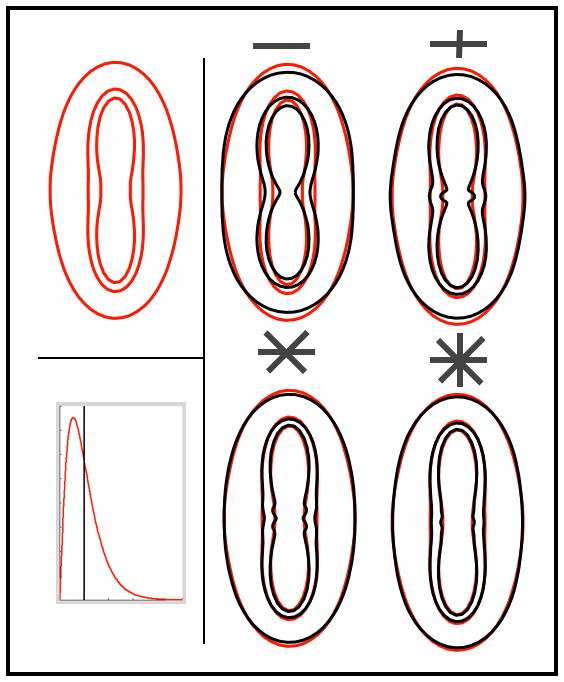
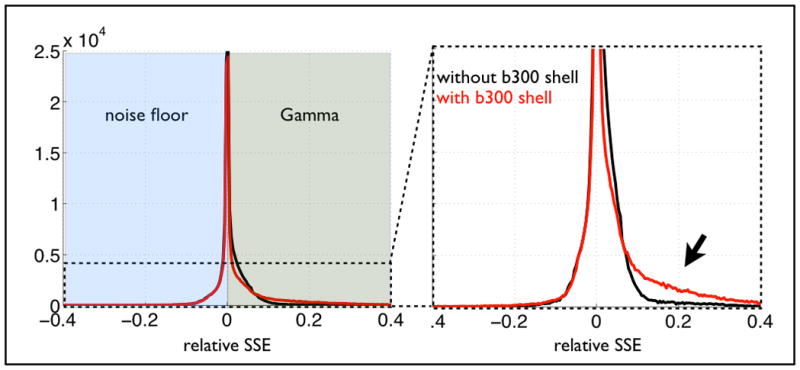
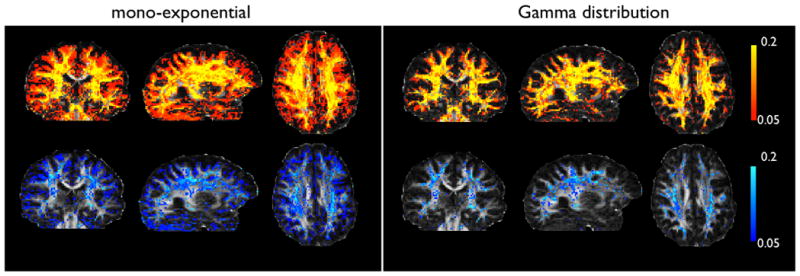
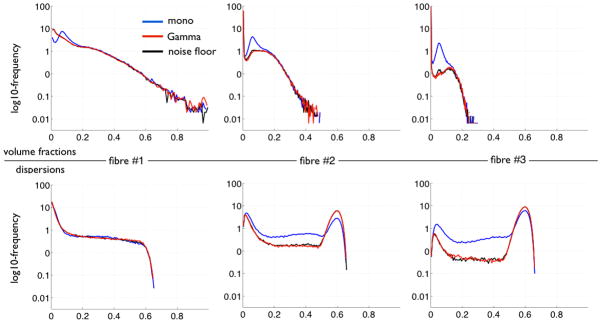
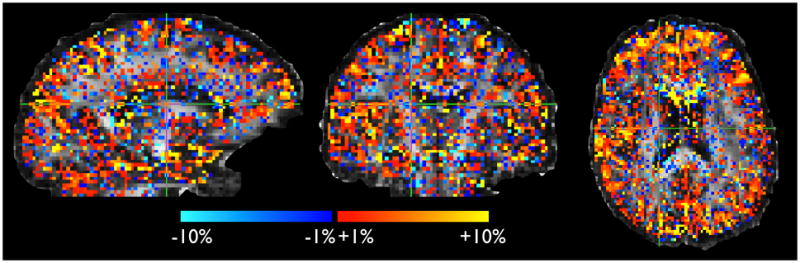
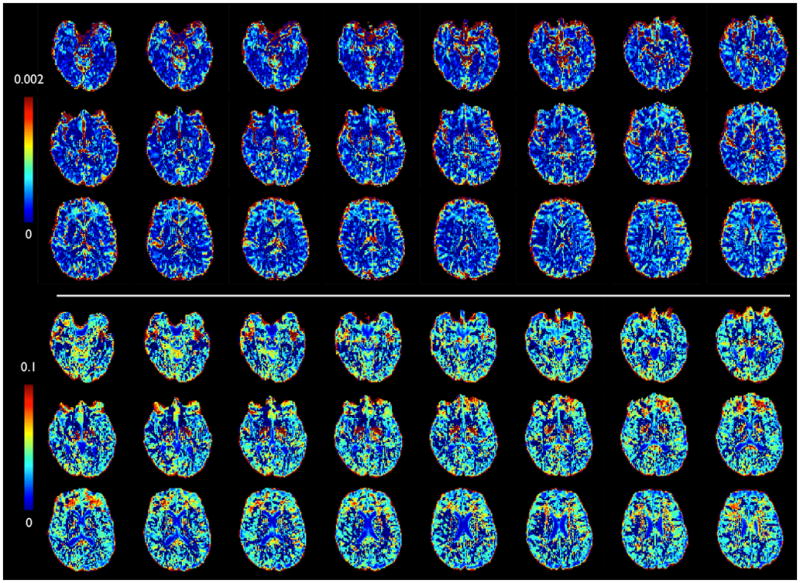
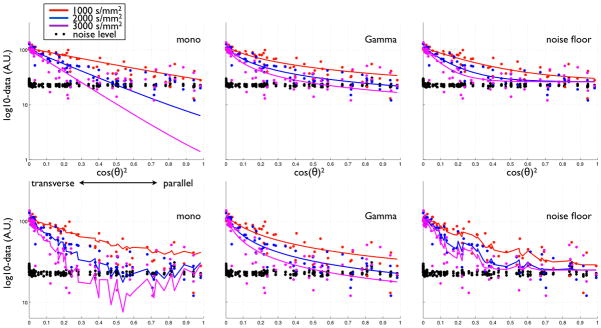
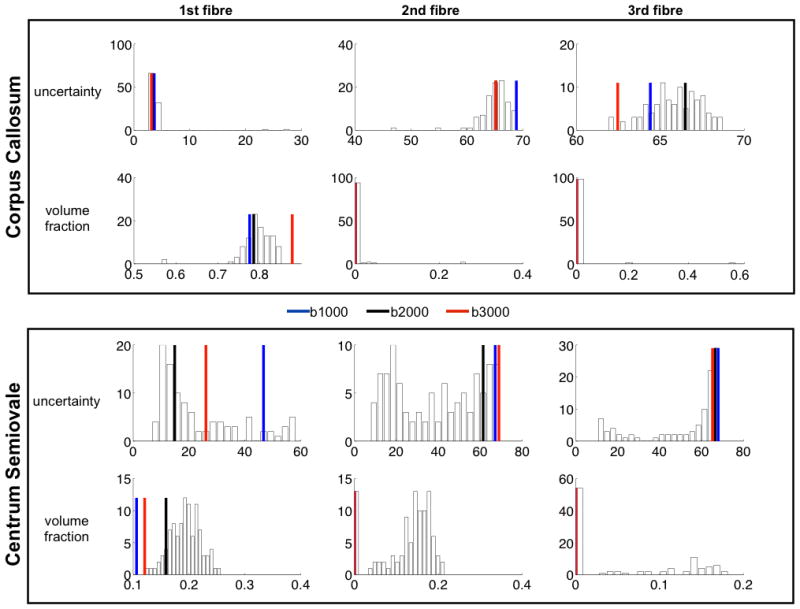
In this article, we highlight an issue that arises when using multiple b-values in a model-based analysis of diffusion MR data for tractography. The non-monoexponential decay, commonly observed in experimental data, is shown to induce overfitting in the distribution of fiber orientations when not considered in the model. Extra fiber orientations perpendicular to the main orientation arise to compensate for the slower apparent signal decay at higher b-values. We propose a simple extension to the ball and stick model based on a continuous gamma distribution of diffusivities, which significantly improves the fitting and reduces the overfitting. Using in vivo experimental data, we show that this model outperforms a simpler, noise floor model, especially at the interfaces between brain tissues, suggesting that partial volume effects are a major cause of the observed non-monoexponential decay. This model may be helpful for future data acquisition strategies that may attempt to combine multiple shells to improve estimates of fiber orientations in white matter and near the cortex.
在本文中,我们强调了在基于模型的扩散磁共振数据轨迹分析中使用多个 b 值时出现的问题。实验数据中常见的非单指数衰减被证明会导致在模型中不考虑时纤维方向分布的过拟合。当更高 b 值时出现的表观信号衰减较慢,会产生额外的与主方向垂直的纤维方向来进行补偿。我们提出了一种基于连续伽马扩散分布的球棒模型的简单扩展,这显著改善了拟合并减少了过拟合。使用体内实验数据,我们表明该模型优于更简单的噪声底模型,尤其是在脑组织之间的界面处,这表明部分容积效应是观察到的非单指数衰减的主要原因。该模型可能有助于未来的一些数据采集策略,这些策略可能试图结合多个壳层来改善白质和皮层附近纤维方向的估计。