Department of Microbiology, Tumor and Cell Biology (MTC), Karolinska Institutet, Nobelsväg 16, SE 17182 Solna, Sweden.
BMC Infect Dis. 2012 Feb 15;12:41. doi: 10.1186/1471-2334-12-41.
Tuberculosis (TB) is an enduring health problem worldwide and the emerging threat of multidrug resistant (MDR) TB and extensively drug resistant (XDR) TB is of particular concern. A better understanding of biomarkers associated with TB will aid to guide the development of better targets for TB diagnosis and for the development of improved TB vaccines.
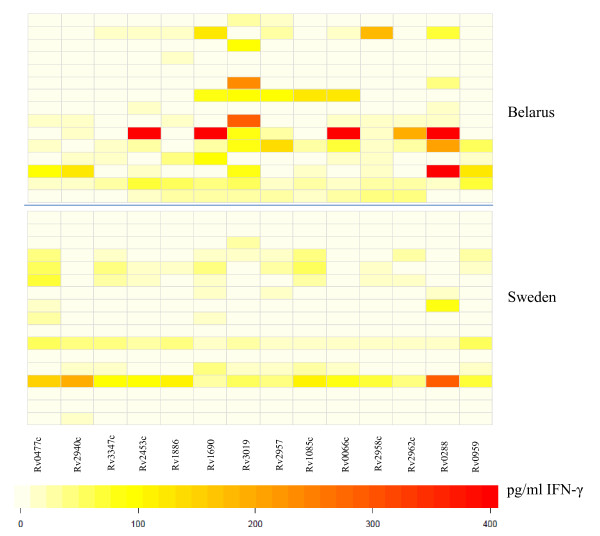
Recombinant proteins (n = 7) and peptide pools (n = 14) from M. tuberculosis (M.tb) antigens associated with M.tb pathogenicity, modification of cell lipids or cellular metabolism, were used to compare T cell immune responses defined by IFN-γ production using a whole blood assay (WBA) from i) patients with TB, ii) individuals recovered from TB and iii) individuals exposed to TB without evidence of clinical TB infection from Minsk, Belarus.
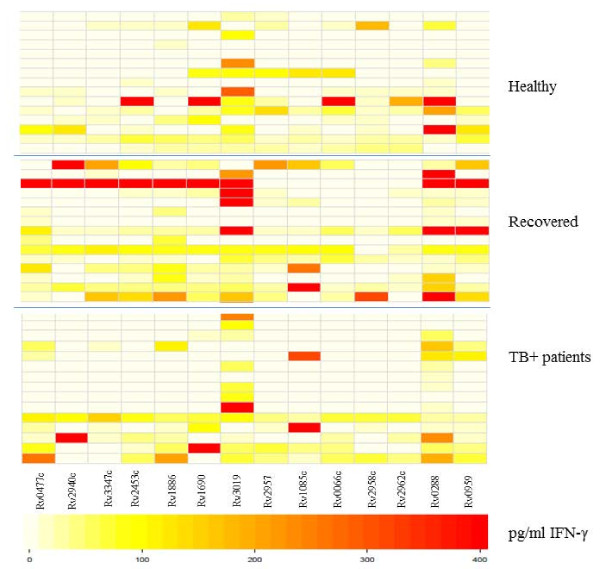
We identified differences in M.tb target peptide recognition between the test groups, i.e. a frequent recognition of antigens associated with lipid metabolism, e.g. cyclopropane fatty acyl phospholipid synthase. The pattern of peptide recognition was broader in blood from healthy individuals and those recovered from TB as compared to individuals suffering from pulmonary TB. Detection of biologically relevant M.tb targets was confirmed by staining for intracellular cytokines (IL-2, TNF-α and IFN-γ) in T cells from non-human primates (NHPs) after BCG vaccination.
PBMCs from healthy individuals and those recovered from TB recognized a broader spectrum of M.tb antigens as compared to patients with TB. The nature of the pattern recognition of a broad panel of M.tb antigens will devise better strategies to identify improved diagnostics gauging previous exposure to M.tb; it may also guide the development of improved TB-vaccines.
结核病(TB)是全球范围内长期存在的健康问题,耐多药(MDR)结核病和广泛耐药(XDR)结核病的出现是一个特别令人关注的问题。更好地了解与结核病相关的生物标志物将有助于指导更好的结核病诊断靶点的开发,并开发出改进的结核病疫苗。
使用来自与结核分枝杆菌(M.tb)致病性、细胞脂质修饰或细胞代谢相关的 M.tb 抗原的重组蛋白(n = 7)和肽池(n = 14),通过全血分析(WBA)比较 i)结核病患者、ii)从结核病中恢复的个体和 iii)来自白俄罗斯明斯克的没有临床结核病感染证据的结核病接触者产生的 IFN-γ产生定义的 T 细胞免疫反应。
我们在测试组之间发现了 M.tb 靶肽识别的差异,即经常识别与脂质代谢相关的抗原,例如环丙烷脂肪酸磷酰化酶。与患有肺结核的个体相比,来自健康个体和从结核病中恢复的个体的血液中肽识别的模式更广泛。在接种卡介苗后,对来自非人类灵长类动物(NHPs)的 T 细胞进行细胞内细胞因子(IL-2、TNF-α 和 IFN-γ)染色,证实了对生物相关 M.tb 靶标的检测。
与结核病患者相比,来自健康个体和从结核病中恢复的个体的 PBMC 识别出更广泛的 M.tb 抗原谱。对广泛的 M.tb 抗原进行模式识别的性质将制定出更好的策略来识别以前接触过 M.tb 的改进诊断方法;它也可能指导改进的结核病疫苗的开发。