DST/NRF Centre of Excellence for Biomedical Tuberculosis Research, Division of Molecular Biology and Human Genetics, Department of Biomedical Sciences, Faculty of Medicine and Health Sciences, Stellenbosch University, Tygerberg, South Africa.
PLoS One. 2013 May 15;8(5):e64226. doi: 10.1371/journal.pone.0064226. Print 2013.
The diagnosis of childhood tuberculosis (TB) disease remains a challenge especially in young and HIV-infected children. Recent studies have identified potential host markers which, when measured in Quantiferon (QFT-IT) supernatants, show promise in discriminating between Mycobacterium tuberculosis (M.tb) infection states. In this study, the utility of such markers was investigated in children screened for TB in a setting with high TB incidence.
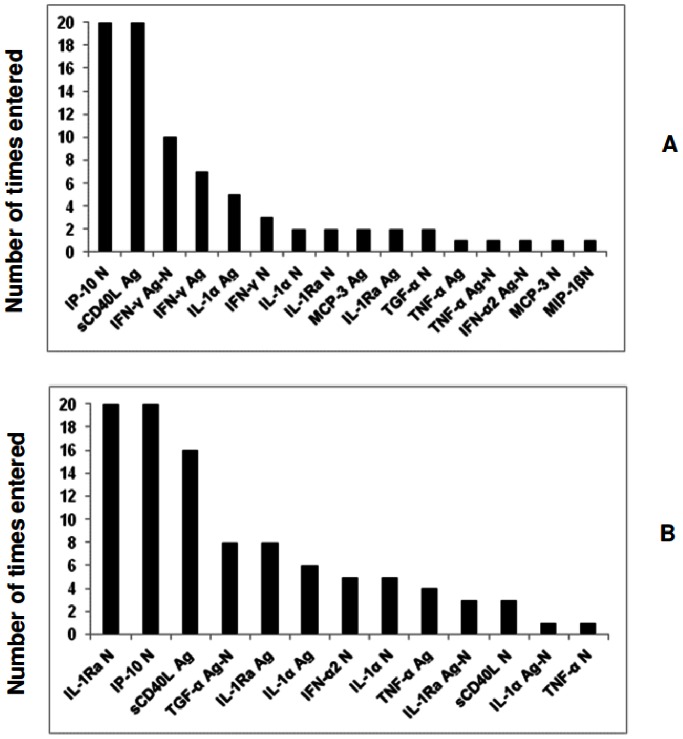
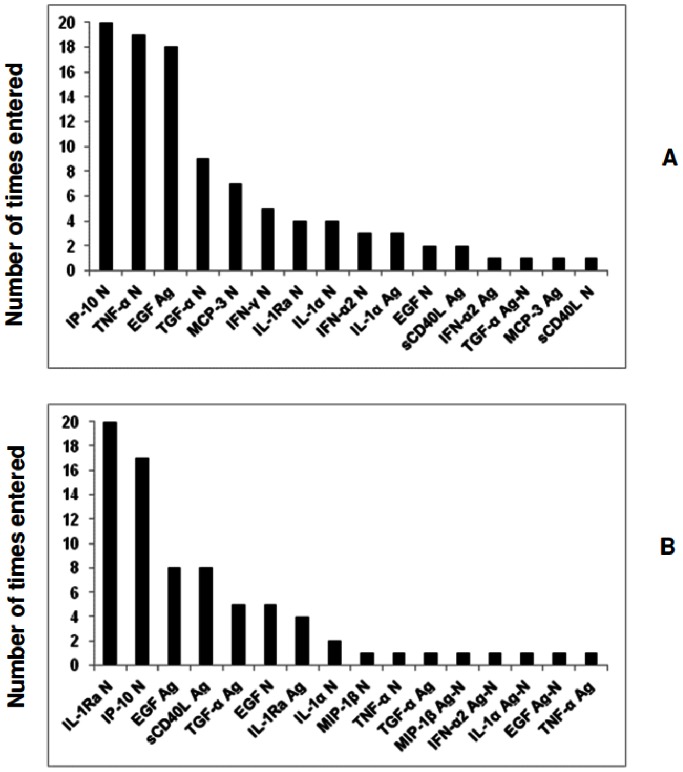
76 children (29% HIV-infected) with or without active TB provided blood specimens collected directly into QFT-IT tubes. After overnight incubation, culture supernatants were harvested, aliquoted and frozen for future immunological research purposes. Subsequently, the levels of 12 host markers previously identified as potential TB diagnostic markers were evaluated in these supernatants for their ability to discriminate between M.tb infection and disease states using the Luminex platform. Of the 76 children included, 19 (25%) had culture confirmed TB disease; 26 (46%) of the 57 without TB had positive markers of M.tb infection defined by a positive QFT-IT test. The potentially most useful analytes for diagnosing TB disease included IFN-α2, IL-1Ra, sCD40L and VEGF and the most useful markers for discriminating between QFT-IT positive children as TB or latent infection included IL-1Ra, IP-10 and VEGF. When markers were used in combinations of four, 84% of all children were accurately classified into their respective groups (TB disease or no TB), after leave-one-out cross validation.
Measurement of the levels of IFN-α2, IL-1Ra, sCD40L, IP-10 and VEGF in QFT-IT supernatants may be a useful method for diagnosing TB disease and differentiating between active TB disease and M.tb infection in children. Our observations warrant further investigation in larger well-characterized clinical cohorts.
儿童结核病(TB)的诊断仍然是一个挑战,尤其是在年幼和感染艾滋病毒的儿童中。最近的研究已经确定了一些潜在的宿主标志物,当在 Quantiferon(QFT-IT)上清液中测量时,这些标志物在区分结核分枝杆菌(M.tb)感染状态方面显示出了一定的前景。在这项研究中,在结核病发病率较高的环境中对 TB 进行筛查的儿童中,研究了这些标志物的效用。
76 名儿童(29%感染 HIV)提供了直接放入 QFT-IT 管中的血液样本,这些儿童无论是否患有活动性 TB。孵育过夜后,收获培养上清液,分装并冷冻,以备将来进行免疫学研究。随后,使用 Luminex 平台评估这些上清液中 12 种先前被确定为潜在 TB 诊断标志物的宿主标志物的水平,以区分 M.tb 感染和疾病状态。在纳入的 76 名儿童中,有 19 名(25%)患有培养确诊的 TB 疾病;57 名无 TB 的儿童中有 26 名(46%)的 QFT-IT 检测结果为阳性,表明存在 M.tb 感染。用于诊断 TB 疾病的最有用的分析物包括 IFN-α2、IL-1Ra、sCD40L 和 VEGF,用于区分 QFT-IT 阳性儿童为 TB 或潜伏感染的最有用的标志物包括 IL-1Ra、IP-10 和 VEGF。当使用四个标志物的组合时,经过留一法交叉验证,84%的儿童被准确地分类到各自的组别(TB 疾病或无 TB)。
在 QFT-IT 上清液中测量 IFN-α2、IL-1Ra、sCD40L、IP-10 和 VEGF 的水平可能是诊断 TB 疾病和区分儿童活动性 TB 疾病与 M.tb 感染的有用方法。我们的观察结果需要在更大的、特征明确的临床队列中进一步研究。