Department of Biology and the Huck Institutes of the Life Sciences, the Pennsylvania State University, University Park, PA 16802, USA.
BMC Plant Biol. 2012 Feb 15;12:23. doi: 10.1186/1471-2229-12-23.
In flowering plants, the development of male reproductive organs is controlled precisely to achieve successful fertilization and reproduction. Despite the increasing knowledge of genes that contribute to anther development, the regulatory mechanisms controlling this process are still unclear.
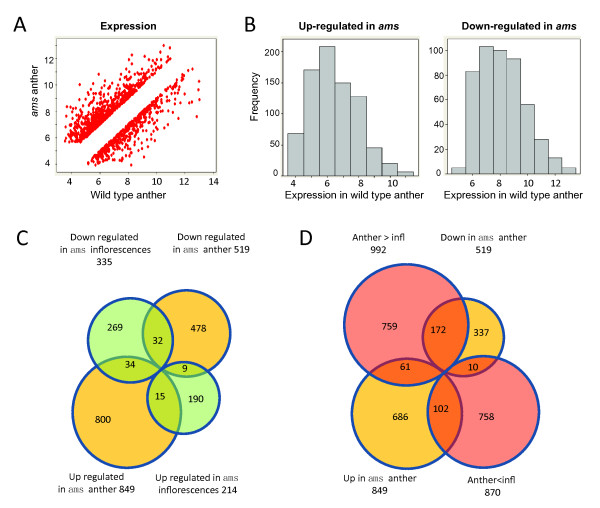
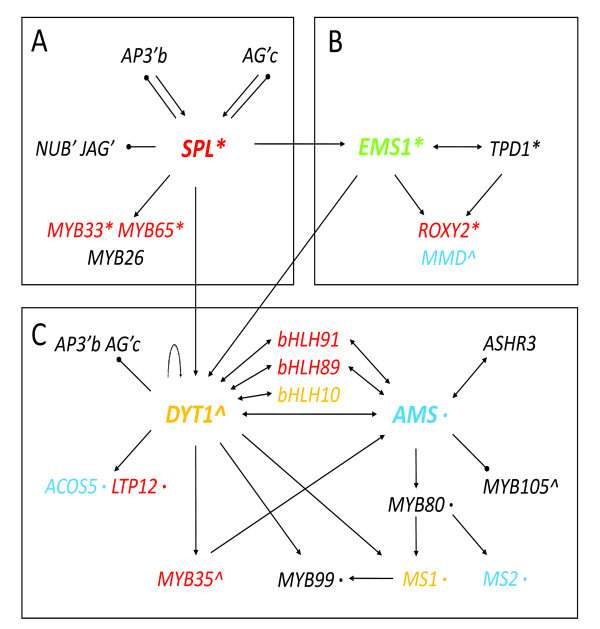
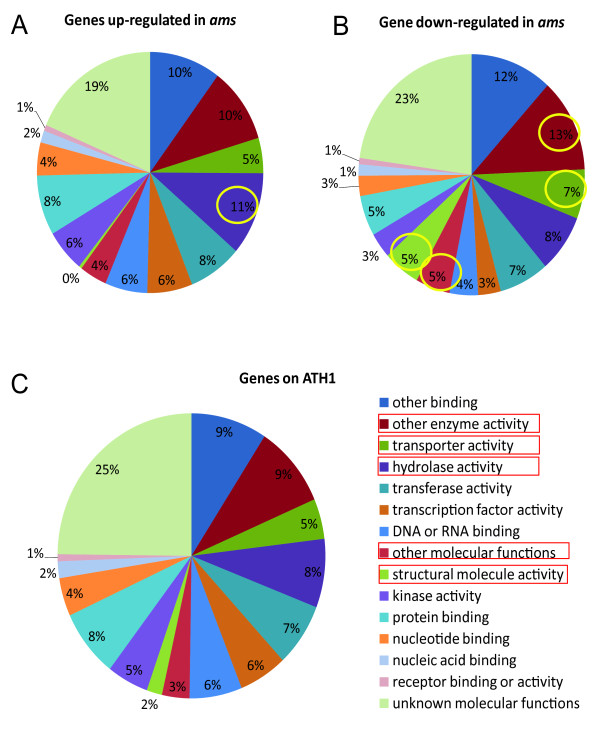
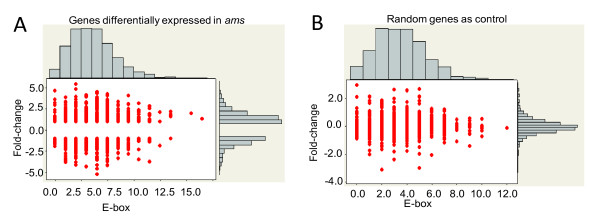
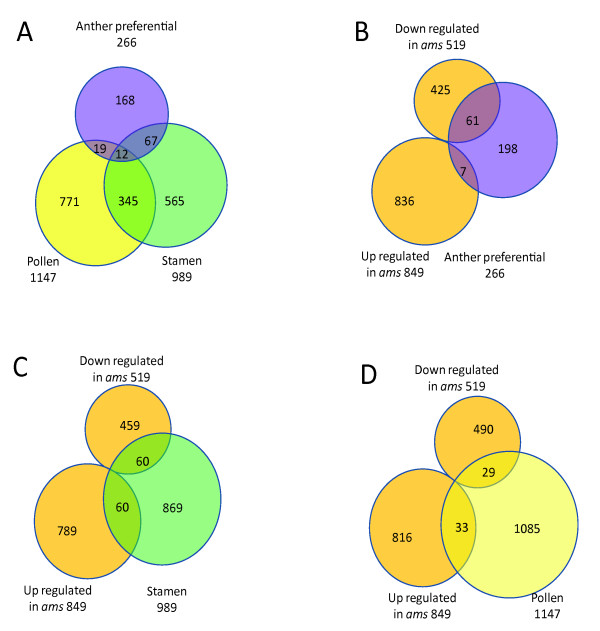
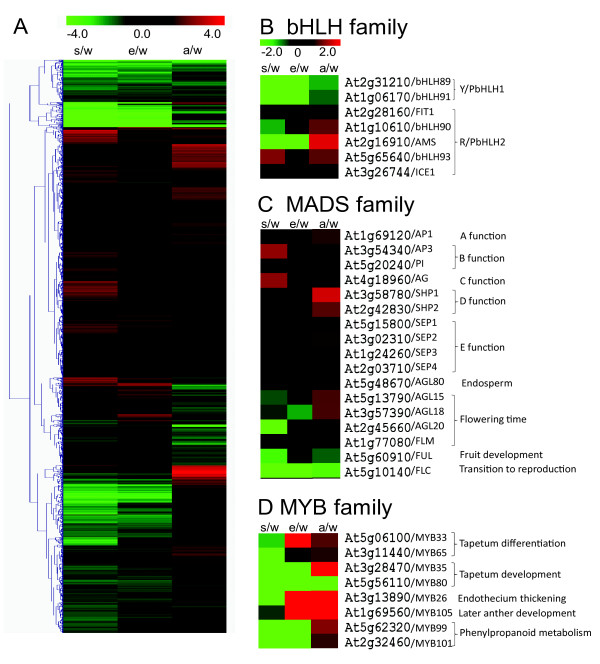
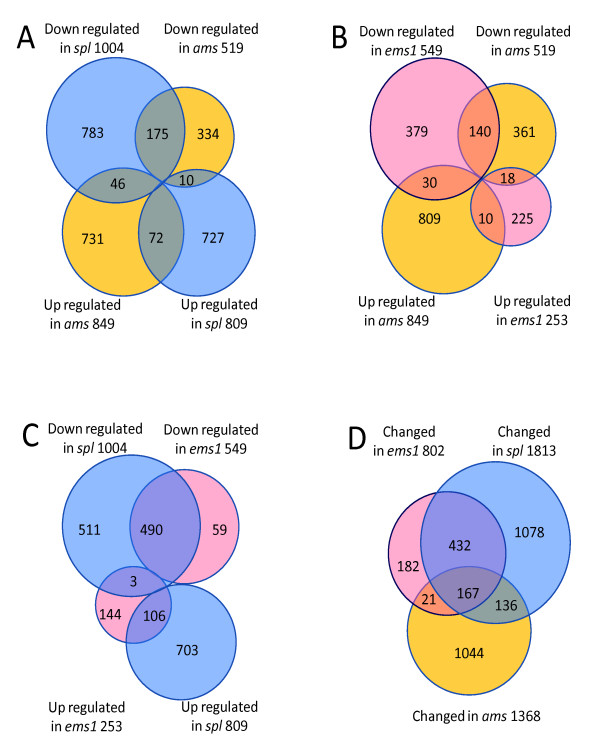
In this study, we analyzed the transcriptome profiles of early anthers of sterile mutants aborted microspores (ams) and found that 1,368 genes were differentially expressed in ams compared to wild type anthers, affecting metabolism, transportation, ubiquitination and stress response. Moreover, the lack of significant enrichment of potential AMS binding sites (E-box) in the promoters of differentially expressed genes suggests both direct and indirect regulation for AMS-dependent regulation of anther transcriptome involving other transcription factors. Combining ams transcriptome profiles with those of two other sterile mutants, spl/nzz and ems1/exs, expression of 3,058 genes were altered in at least one mutant. Our investigation of expression patterns of major transcription factor families, such as bHLH, MYB and MADS, suggested that some closely related homologs of known anther developmental genes might also have similar functions. Additionally, comparison of expression levels of genes in different organs suggested that anther-preferential genes could play important roles in anther development.
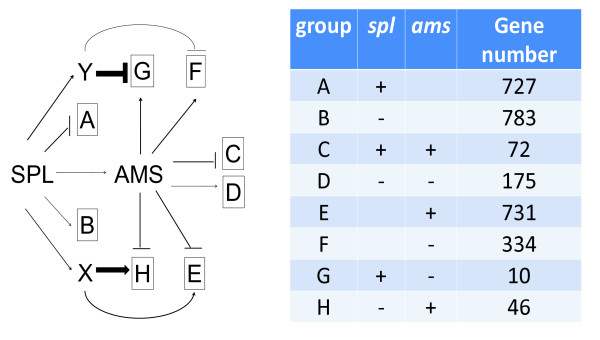
Analysis of ams anther transcriptome and its comparison with those of spl/nzz and ems1/exs anthers uncovered overlapping and distinct sets of regulated genes, including those encoding transcription factors and other proteins. These results support an expanded regulatory network for early anther development, providing a series of hypotheses for future experimentation.
在开花植物中,雄性生殖器官的发育被精确控制,以实现成功的受精和繁殖。尽管越来越多的基因参与花药发育,但控制这一过程的调控机制仍不清楚。
在这项研究中,我们分析了不育突变体败育花粉(ams)早期花药的转录组谱,发现与野生型花药相比,1368 个基因在 ams 中差异表达,这些基因影响代谢、运输、泛素化和应激反应。此外,在差异表达基因的启动子中,没有发现明显富集的潜在 AMS 结合位点(E-box),这表明 AMS 对花药转录组的直接和间接调控涉及其他转录因子。将 ams 转录组谱与另外两种不育突变体 spl/nzz 和 ems1/exs 的转录组谱相结合,至少有 3058 个基因在一种或多种突变体中发生改变。我们对主要转录因子家族(如 bHLH、MYB 和 MADS)的表达模式进行了研究,表明一些已知的花药发育基因的密切相关同源物可能也具有类似的功能。此外,比较不同器官中基因的表达水平表明,花药偏好基因可能在花药发育中发挥重要作用。
对 ams 花药转录组的分析及其与 spl/nzz 和 ems1/exs 花药的比较揭示了重叠和独特的调节基因集,包括编码转录因子和其他蛋白质的基因。这些结果支持早期花药发育的调控网络的扩展,为未来的实验提供了一系列假设。