Division of Nephrology, Department of Medicine, Taipei Veterans General Hospital, Taipei, Taiwan.
Diabetes Care. 2012 Apr;35(4):803-8. doi: 10.2337/dc11-1955. Epub 2012 Feb 14.
The current study aimed to investigate whether microalbuminuria or moderately decreased glomerular filtration rate (GFR) is a better predictor for the development and progression of retinopathy in type 2 diabetic patients.
Type 2 diabetic patients without cardiovascular diseases, malignancy, pregnancy, and acute intercurrent illness were enrolled between 1 August 2001 and 31 December 2002. All participants provided their detailed medical history and underwent an eye fundus examination. They were followed up in outpatient clinics, and serum creatinine, urinary albumin-to-creatinine ratio (UACR), and retinal photographs were followed up annually until 31 December 2009. The primary outcomes were development and progression of diabetic retinopathy and nephropathy. The secondary outcomes were cardiovascular events and all-cause mortality.
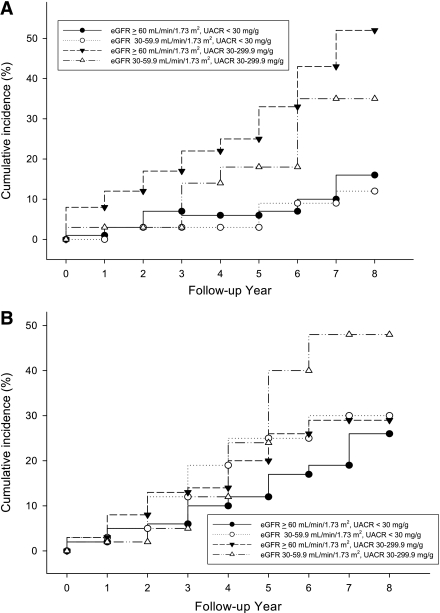
Among 487 participants, 81 subjects had normoalbuminuria and moderate renal impairment (baseline eGFR 30-59.9 mL/min/1.73 m(2)), and 106 subjects had microalbuminuria and baseline eGFR ≥60 mL/min/1.73 m(2). Patients with microalbuminuria and eGFR ≥60 mL/min/1.73 m(2) had a significantly greater risk for development and progression of diabetic retinopathy (HR 3.34 [95% CI 1.04-10.70]) compared with those with moderate renal impairment and normoalbuminuria after multivariate adjustment. Risks for renal outcome, cardiovascular events, and all-cause mortality were not significantly different between the two groups.
Microalbuminuria has a greater impact on predicting the development and progression of diabetic retinopathy compared with moderate decline in GFR among type 2 diabetic patients.
本研究旨在探讨微量白蛋白尿或中度肾小球滤过率(GFR)下降是否是 2 型糖尿病患者视网膜病变发展和进展的更好预测指标。
2001 年 8 月 1 日至 2002 年 12 月 31 日期间,纳入无心血管疾病、恶性肿瘤、妊娠和急性并发疾病的 2 型糖尿病患者。所有参与者均提供详细的病史并接受眼底检查。他们在门诊接受随访,每年随访血清肌酐、尿白蛋白与肌酐比值(UACR)和视网膜照片,直至 2009 年 12 月 31 日。主要结局是糖尿病视网膜病变和肾病的发展和进展。次要结局是心血管事件和全因死亡率。
在 487 名参与者中,81 名受试者有正常白蛋白尿和中度肾功能损害(基线 eGFR 为 30-59.9 mL/min/1.73 m²),106 名受试者有微量白蛋白尿和基线 eGFR≥60 mL/min/1.73 m²。经过多变量调整后,微量白蛋白尿和 eGFR≥60 mL/min/1.73 m²的患者发生糖尿病视网膜病变发展和进展的风险明显高于中度肾功能损害和正常白蛋白尿的患者(HR 3.34 [95%CI 1.04-10.70])。两组间肾脏结局、心血管事件和全因死亡率的风险无显著差异。
与 2 型糖尿病患者 GFR 中度下降相比,微量白蛋白尿对预测糖尿病视网膜病变的发展和进展具有更大的影响。