
全基因组测序揭示编码无致病性变异可标记 C9orf72 中非编码六核苷酸重复扩增,为肌萎缩侧索硬化症的病因。
Whole-genome sequencing reveals a coding non-pathogenic variant tagging a non-coding pathogenic hexanucleotide repeat expansion in C9orf72 as cause of amyotrophic lateral sclerosis.
机构信息
Department of Neurology, University of Leuven, Leuven, Belgium.
出版信息
Hum Mol Genet. 2012 Jun 1;21(11):2412-9. doi: 10.1093/hmg/dds055. Epub 2012 Feb 17.
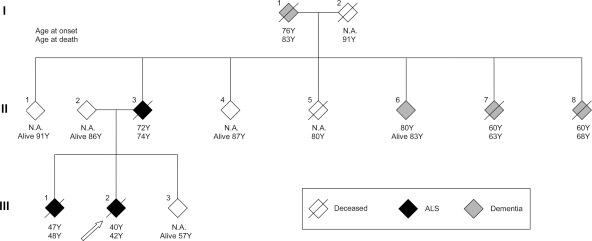
Motor neuron degeneration in amyotrophic lateral sclerosis (ALS) has a familial cause in 10% of patients. Despite significant advances in the genetics of the disease, many families remain unexplained. We performed whole-genome sequencing in five family members from a pedigree with autosomal-dominant classical ALS. A family-based elimination approach was used to identify novel coding variants segregating with the disease. This list of variants was effectively shortened by genotyping these variants in 2 additional unaffected family members and 1500 unrelated population-specific controls. A novel rare coding variant in SPAG8 on chromosome 9p13.3 segregated with the disease and was not observed in controls. Mutations in SPAG8 were not encountered in 34 other unexplained ALS pedigrees, including 1 with linkage to chromosome 9p13.2-23.3. The shared haplotype containing the SPAG8 variant in this small pedigree was 22.7 Mb and overlapped with the core 9p21 linkage locus for ALS and frontotemporal dementia. Based on differences in coverage depth of known variable tandem repeat regions between affected and non-affected family members, the shared haplotype was found to contain an expanded hexanucleotide (GGGGCC)(n) repeat in C9orf72 in the affected members. Our results demonstrate that rare coding variants identified by whole-genome sequencing can tag a shared haplotype containing a non-coding pathogenic mutation and that changes in coverage depth can be used to reveal tandem repeat expansions. It also confirms (GGGGCC)n repeat expansions in C9orf72 as a cause of familial ALS.
肌萎缩侧索硬化症(ALS)中,10%的患者存在家族性病因。尽管在疾病遗传学方面取得了重大进展,但仍有许多家族无法解释。我们对一个具有常染色体显性经典 ALS 的家系中的五名家族成员进行了全基因组测序。使用基于家族的排除方法来鉴定与疾病共分离的新编码变异。通过对另外两名无病家族成员和 1500 名无关人群特异性对照进行这些变异的基因分型,有效地缩短了变异列表。9p13.3 染色体上 SPAG8 的一个新的罕见编码变异与疾病共分离,在对照中未观察到。在其他 34 个未解释的 ALS 家系中未发现 SPAG8 突变,包括一个与 9p13.2-23.3 染色体连锁的家系。这个小家系中含有 SPAG8 变异的共享单倍型为 22.7 Mb,与 ALS 和额颞叶痴呆的核心 9p21 连锁位点重叠。基于受影响和未受影响家庭成员之间已知可变串联重复区域的覆盖深度差异,发现共享单倍型包含 C9orf72 中扩展的六核苷酸(GGGGCC)(n)重复。我们的结果表明,全基因组测序鉴定的罕见编码变异可以标记包含非编码致病性突变的共享单倍型,并且覆盖深度的变化可用于揭示串联重复扩展。它还证实了 C9orf72 中的(GGGGCC)n 重复扩展是家族性 ALS 的原因。


 Zotero 插件