BGI Genomics, BGI-Shenzhen, Shenzhen, 518083, China.
Tianjin Medical Laboratory, BGI-Tianjin, BGI-Shenzhen, Tianjin, 300308, China.
BMC Med Genomics. 2021 Apr 13;14(1):102. doi: 10.1186/s12920-021-00948-5.
Due to its reduced cost and incomparable advantages, WGS is likely to lead to changes in clinical diagnosis of rare and undiagnosed diseases. However, the sensitivity and breadth of coverage of clinical WGS as a diagnostic test for genetic disorders has not been fully evaluated.
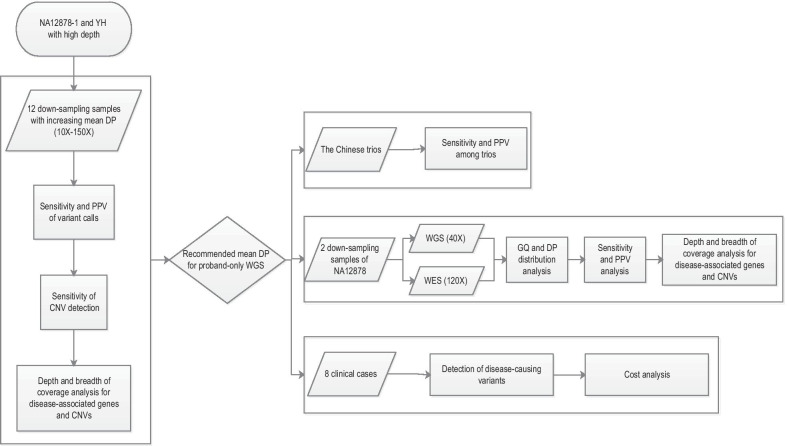
Here, the performance of WGS in NA12878, the YH cell line, and the Chinese trios were measured by assessing their sensitivity, PPV, depth and breadth of coverage using MGISEQ-2000. We also compared the performance of WES and WGS using NA12878. The sensitivity and PPV were tested using the family-based trio design for the Chinese trios. We further developed a systematic WGS pipeline for the analysis of 8 clinical cases.
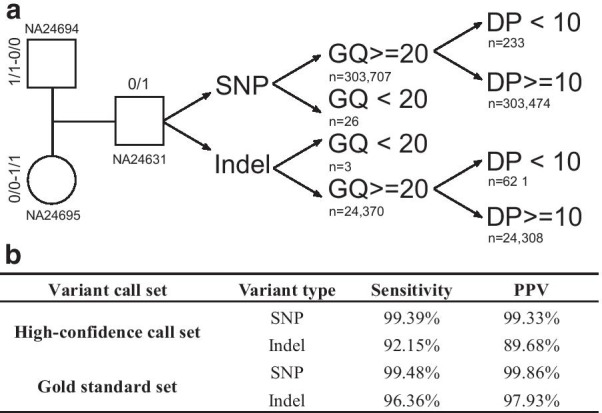
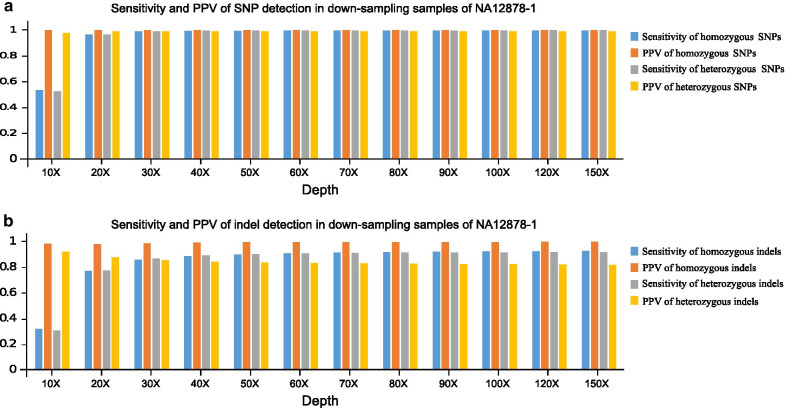
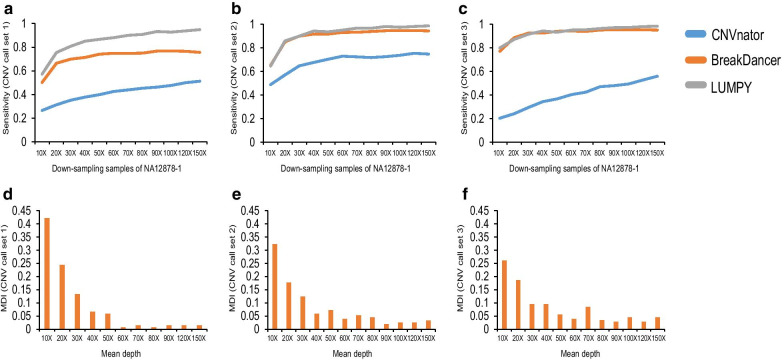
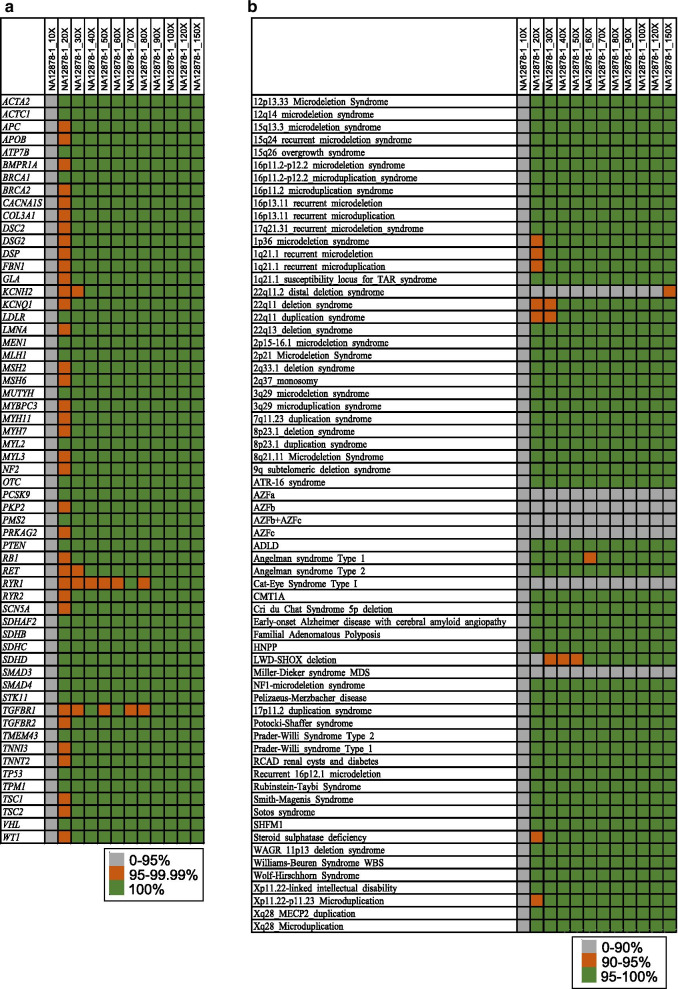
In general, the sensitivity and PPV for SNV/indel detection increased with mean depth and reached a plateau at an ~ 40X mean depth using down-sampling samples of NA12878. With a mean depth of 40X, the sensitivity of homozygous and heterozygous SNPs of NA12878 was > 99.25% and > 99.50%, respectively, and the PPV was 99.97% and 98.96%. Homozygous and heterozygous indels showed lower sensitivity and PPV. The sensitivity and PPV were still not 100% even with a mean depth of ~ 150X. We also observed a substantial variation in the sensitivity of CNV detection across different tools, especially in CNVs with a size less than 1 kb. In general, the breadth of coverage for disease-associated genes and CNVs increased with mean depth. The sensitivity and coverage of WGS (~ 40X) was better than WES (~ 120X). Among the Chinese trios with an ~ 40X mean depth, the sensitivity among offspring was > 99.48% and > 96.36% for SNP and indel detection, and the PPVs were 99.86% and 97.93%. All 12 previously validated variants in the 8 clinical cases were successfully detected using our WGS pipeline.
The current standard of a mean depth of 40X may be sufficient for SNV/indel detection and identification of most CNVs. It would be advisable for clinical scientists to determine the range of sensitivity and PPV for different classes of variants for a particular WGS pipeline, which would be useful when interpreting and delivering clinical reports.
由于成本降低和无与伦比的优势,WGS 可能会导致对罕见和未确诊疾病的临床诊断发生变化。然而,WGS 作为遗传疾病诊断测试的灵敏度和覆盖范围尚未得到充分评估。
在这里,通过使用 MGISEQ-2000 评估其灵敏度、PPV、深度和覆盖范围,测量了 WGS 在 NA12878、YH 细胞系和中国三家中的性能。我们还使用 NA12878 比较了 WES 和 WGS 的性能。使用基于家庭的三人群设计测试了 SNV/indel 检测的灵敏度和 PPV。我们进一步为 8 例临床病例开发了系统的 WGS 分析管道。
总体而言,使用 down-sampling 的 NA12878 样本,随着平均深度的增加,SNV/indel 检测的灵敏度和 PPV 也随之增加,并且在平均深度约为 40X 时达到平台。在平均深度为 40X 时,NA12878 的纯合和杂合 SNP 的灵敏度分别>99.25%和>99.50%,PPV 分别为 99.97%和 98.96%。纯合和杂合插入缺失显示出较低的灵敏度和 PPV。即使平均深度约为 150X,灵敏度和 PPV 仍未达到 100%。我们还观察到不同工具在检测 CNV 时的灵敏度存在很大差异,尤其是在大小小于 1kb 的 CNV 中。总体而言,与疾病相关的基因和 CNV 的覆盖范围随平均深度的增加而增加。WGS(40X)的灵敏度和覆盖范围优于 WES(120X)。在平均深度约为 40X 的中国三家中,后代的 SNP 和 indel 检测灵敏度分别>99.48%和>96.36%,PPV 分别为 99.86%和 97.93%。使用我们的 WGS 管道成功检测到 8 例临床病例中 12 个先前验证的变异。
目前,平均深度为 40X 的标准可能足以检测 SNV/indel 并识别大多数 CNV。临床科学家确定特定 WGS 管道中不同类别的变异的灵敏度和 PPV 范围是明智的,这在解释和提供临床报告时将很有用。