Barca-Mayo Olga, Lu Q Richard
Department of Developmental Biology, Kent Waldrep Foundation Center for Basic Neuroscience Research on Nerve Growth and Regeneration, University of Texas Southwestern Medical Center Dallas, TX, USA.
Front Neurosci. 2012 Feb 6;6:13. doi: 10.3389/fnins.2012.00013. eCollection 2012.
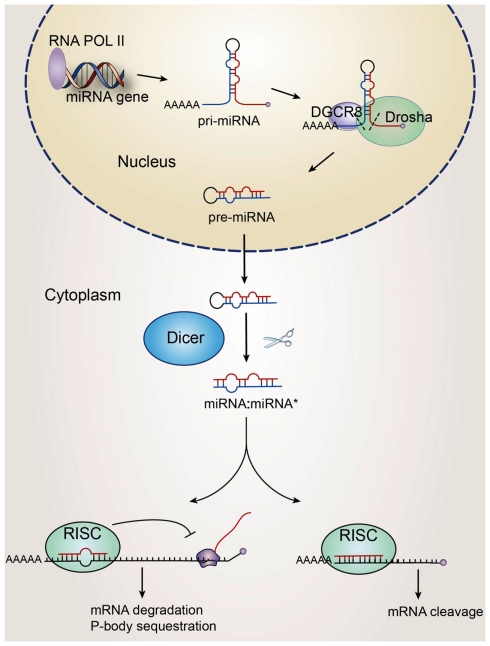
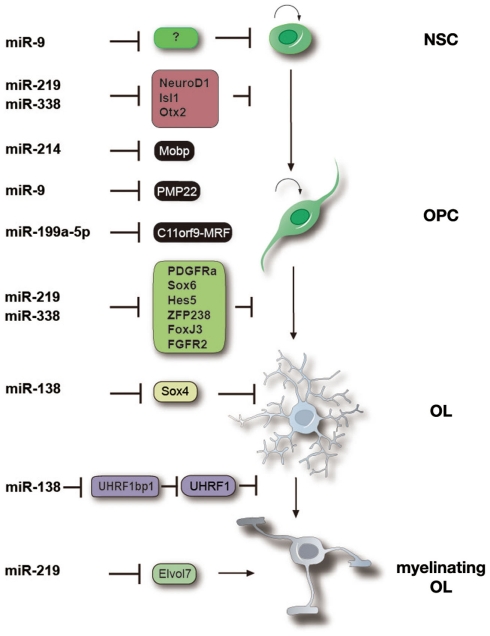
Myelination of axons by oligodendrocytes in the central nervous system is essential for normal neuronal functions. The failure of remyelination due to injury or pathological insults results in devastating demyelinating diseases. Oligodendrocytes originate in restricted regions of the embryonic ventral neural tube. After migration to populate all areas of the brain and spinal cord, oligodendrocyte precursors undergo a temporally well-defined series of molecular and structural changes, ultimately culminating in the cessation of proliferation, and the elaboration of a highly complex myelin sheath. The emergence of microRNAs (miRNAs) as potent regulators of gene expression at the posttranscriptional level has broad implications in all facets of cell biology. Recent studies have demonstrated a critical role of miRNAs in oligodendrocyte development, including cell proliferation, differentiation, and myelin formation. In this review, we will highlight and discuss the recent understanding of functional links of miRNAs to regulatory networks for central myelination, as well as perspectives on the role of miRNAs in demyelinating diseases.
在中枢神经系统中,少突胶质细胞对轴突进行髓鞘形成对于正常神经元功能至关重要。因损伤或病理损害导致的髓鞘再生失败会引发严重的脱髓鞘疾病。少突胶质细胞起源于胚胎腹侧神经管的特定区域。迁移至大脑和脊髓的所有区域后,少突胶质细胞前体细胞会经历一系列在时间上定义明确的分子和结构变化,最终导致增殖停止,并形成高度复杂的髓鞘。微小RNA(miRNA)作为转录后水平基因表达的有效调节因子,在细胞生物学的各个方面都具有广泛影响。最近的研究表明,miRNA在少突胶质细胞发育中起关键作用,包括细胞增殖、分化和髓鞘形成。在本综述中,我们将重点介绍并讨论对miRNA与中枢髓鞘形成调控网络功能联系的最新认识,以及miRNA在脱髓鞘疾病中作用的观点。