Levin Irwin P, Xue Gui, Weller Joshua A, Reimann Martin, Lauriola Marco, Bechara Antoine
Department of Psychology, University of Iowa Iowa City, IA, USA.
Front Neurosci. 2012 Feb 7;6:15. doi: 10.3389/fnins.2012.00015. eCollection 2012.
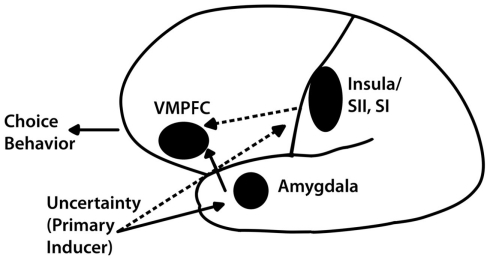
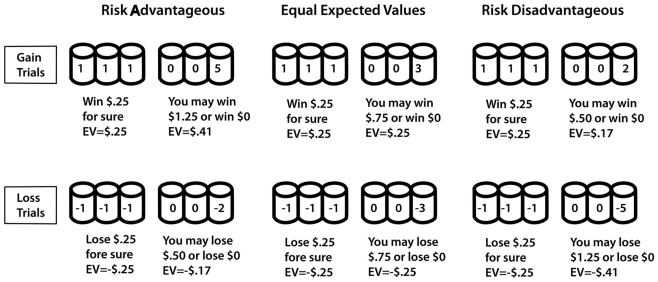
Affective neuroscience has helped guide research and theory development in judgment and decision-making by revealing the role of emotional processes in choice behavior, especially when risk is involved. Evidence is emerging that qualitatively and quantitatively different processes may be involved in risky decision-making for gains and losses. We start by reviewing behavioral work by Kahneman and Tversky (1979) and others, which shows that risk-taking differs for potential gains and potential losses. We then turn to the literature in decision neuroscience to support the gain versus loss distinction. Relying in part on data from a new task that separates risky decision-making for gains and losses, we test a neural model that assigns unique mechanisms for risky decision-making involving potential losses. Included are studies using patients with lesions to brain areas specified as important in the model and studies with healthy individuals whose brains are scanned to reveal activation in these and other areas during risky decision-making. In some cases, there is evidence that gains and losses are processed in different regions of the brain, while in other cases the same region appears to process risk in a different manner for gains and losses. At a more general level, we provide strong support for the notion that decisions involving risk-taking for gains and decisions involving risk-taking for losses represent different psychological processes. At a deeper level, we present mounting evidence that different neural structures play different roles in guiding risky choices in these different domains. Some structures are differentially activated by risky gains and risky losses while others respond uniquely in one domain or the other. Taken together, these studies support a clear functional dissociation between risk-taking for gains and risk-taking for losses, and further dissociation at the neural level.
情感神经科学通过揭示情绪过程在选择行为中的作用,特别是在涉及风险时,帮助指导了判断和决策方面的研究及理论发展。越来越多的证据表明,在涉及收益和损失的风险决策中,可能涉及质和量上不同的过程。我们首先回顾了卡尼曼和特沃斯基(1979年)等人的行为学研究,这些研究表明,对潜在收益和潜在损失的冒险行为是不同的。然后我们转向决策神经科学文献,以支持收益与损失的区分。部分基于一项新任务的数据,该任务将涉及收益和损失的风险决策区分开来,我们测试了一个神经模型,该模型为涉及潜在损失的风险决策分配了独特的机制。其中包括对大脑特定区域受损患者的研究,这些区域在模型中被指定为重要区域,以及对健康个体的研究,在风险决策过程中对他们的大脑进行扫描,以揭示这些区域和其他区域的激活情况。在某些情况下,有证据表明收益和损失在大脑的不同区域进行处理,而在其他情况下,同一区域似乎以不同的方式处理收益和损失的风险。在更一般的层面上,我们为以下观点提供了有力支持:涉及获取收益的冒险决策和涉及损失的冒险决策代表了不同的心理过程。在更深的层面上,我们提出越来越多的证据表明,不同的神经结构在指导这些不同领域的风险选择中发挥着不同的作用。一些结构对风险收益和风险损失有不同的激活,而另一些结构则在一个领域或另一个领域有独特的反应。综上所述,这些研究支持了获取收益的冒险行为和遭受损失的冒险行为之间存在明显的功能分离,以及在神经层面上的进一步分离。