Brudzynski Katrina, Lannigan Robert
API-Medicals, Brock University St. Catharines, ON, Canada.
Front Microbiol. 2012 Feb 7;3:36. doi: 10.3389/fmicb.2012.00036. eCollection 2012.
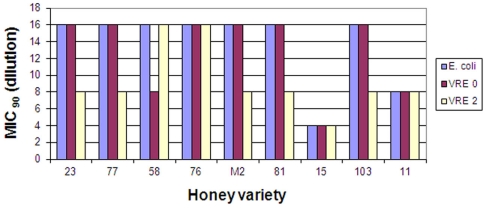
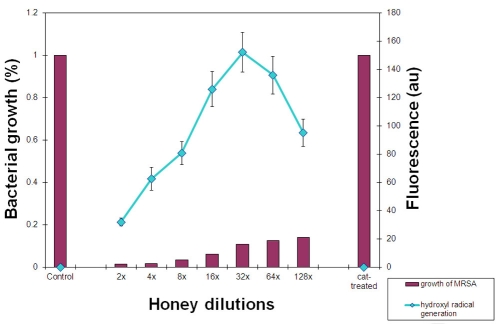
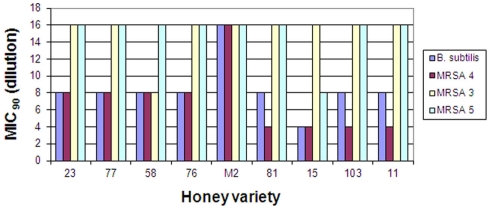
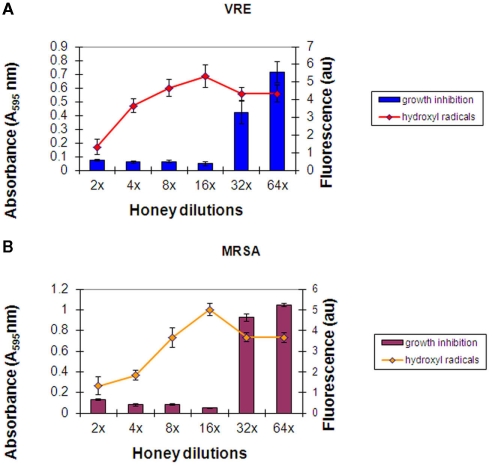
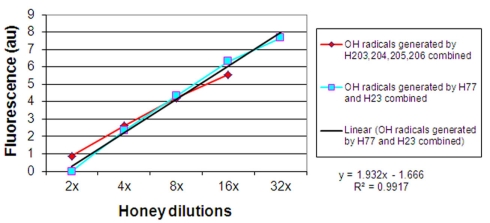
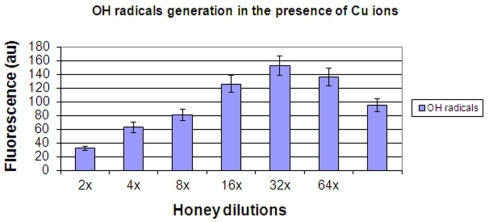
It has been recently reported that honey hydrogen peroxide in conjunction with unknown honey components produced cytotoxic effects resulting in bacterial growth inhibition and DNA degradation. The objective of this study was twofold: (a) to investigate whether the coupling chemistry involving hydrogen peroxide is responsible for a generation of hydroxyl radicals and (b) whether (•)OH generation affects growth of multi-drug resistant clinical isolates. The susceptibility of five different strains of methicillin-resistant Staphylococcus aureus (MRSA) and four strains of vancomycin-resistant Enterococcus faecium (VRE) isolates from infected wounds to several honeys was evaluated using broth microdilution assay. Isolates were identified to genus and species and their susceptibility to antibiotics was confirmed using an automated system (Vitek(®), Biomérieux(®)). The presence of the mec(A) gene, nuc gene and van(A) and (B) genes were confirmed by polymerase chain reaction. Results showed that no clinical isolate was resistant to selected active honeys. The median difference in honeys MICs against these strains ranged between 12.5 and 6.25% v/v and was not different from the MIC against standard Escherichia coli and Bacillus subtilis. Generation of (•)OH during bacteria incubation with honeys was analyzed using 3'-(p-aminophenyl) fluorescein (APF) as the (•)OH trap. The (•)OH participation in growth inhibition was monitored directly by including APF in broth microdilution assay. The growth of MRSA and VRE was inhibited by (•)OH generation in a dose-dependent manner. Exposure of MRSA and VRE to honeys supplemented with Cu(II) augmented production of (•)OH by 30-fold and increased honey bacteriostatic potency from MIC(90) 6.25 to MIC(90)< 0.78% v/v. Pretreatment of honeys with catalase prior to their supplementation with Cu ions fully restored bacterial growth indicating that hydroxyl radicals were produced from H(2)O(2) via the Fenton-type reaction. In conclusion, we have demonstrated for the first time that bacteriostatic effect of honeys on MRSA and VRE was dose-dependently related to generation of (•)OH from honey H(2)O(2).
最近有报道称,蜂蜜中的过氧化氢与未知的蜂蜜成分共同产生了细胞毒性作用,导致细菌生长受到抑制和DNA降解。本研究的目的有两个:(a)研究涉及过氧化氢的偶联化学是否导致羟基自由基的产生;(b)羟基自由基的产生是否影响多重耐药临床分离株的生长。使用肉汤微量稀释法评估了从感染伤口分离出的五种不同的耐甲氧西林金黄色葡萄球菌(MRSA)菌株和四种耐万古霉素粪肠球菌(VRE)菌株对几种蜂蜜的敏感性。通过自动化系统(Vitek(®),Biomérieux(®))鉴定分离株的属和种,并确认它们对抗生素的敏感性。通过聚合酶链反应确认mec(A)基因、nuc基因以及van(A)和(B)基因的存在。结果表明,没有临床分离株对选定的活性蜂蜜耐药。这些菌株的蜂蜜最低抑菌浓度(MIC)的中位数差异在12.5%至6.25%(v/v)之间,与对标准大肠杆菌和枯草芽孢杆菌的MIC没有差异。使用3'-(对氨基苯基)荧光素(APF)作为羟基自由基捕获剂,分析了细菌与蜂蜜孵育过程中羟基自由基的产生情况。通过在肉汤微量稀释法中加入APF直接监测羟基自由基对生长抑制的参与情况。MRSA和VRE的生长受到羟基自由基产生的剂量依赖性抑制。将MRSA和VRE暴露于添加了Cu(II)的蜂蜜中,使羟基自由基的产生增加了30倍,并将蜂蜜的抑菌效力从MIC(90) 6.25提高到MIC(90)< 0.78%(v/v)。在添加铜离子之前用过氧化氢酶预处理蜂蜜,可完全恢复细菌生长,这表明羟基自由基是通过芬顿型反应由H(2)O(2)产生的。总之,我们首次证明了蜂蜜对MRSA和VRE的抑菌作用与蜂蜜H(2)O(2)产生羟基自由基呈剂量依赖性相关。