Abbasian F, Tabatabaie H, Sarijloo M, Shahmahmoodi S, Yousefi A, Saberbaghi T, Mokhtari Azad T, Nategh R
Virology Division, Pathobiology Department, School of Public Health, Tehran University of Medical Sciences, Tehran, Iran.
Iran J Microbiol. 2011 Jun;3(2):75-9.
Each year, Enteroviruses infect millions of people and cause different diseases. The agents are usually detected using cell culture. RD (Rhabdomyosarcoma) and L20B (L cells) are among the recommended cells by the World Health Organisation (WHO) for this purpose. Even though cell culture is the most common method used in diagnosing Enteroviruses in stool specimens, this particular method poses some problems, which include false positive or negative results, lack of a unique cell line for diagnosing all Enterovirus types in addition to being time consuming. For these reasons, an attempt was made to find better techniques of Enterovirus detection. RT-PCR (Reverse Transcriptase Polymerase Chain Reaction) is a technique used in place of the cell culture method. In this study, the cell culture method was compared with RT-PCR for detection of Enteroviruses in stool specimens.
First, the chloroform treated stool samples were inoculated onto five cell lines, including RD, L20B, Hep-2 (Human Epidermoid carcinoma cell line), Vero (Verde Reno) and GMK (Green Monkey Kidney). The results were then compared with data from Enterovirus detection using the RT-PCR technique.
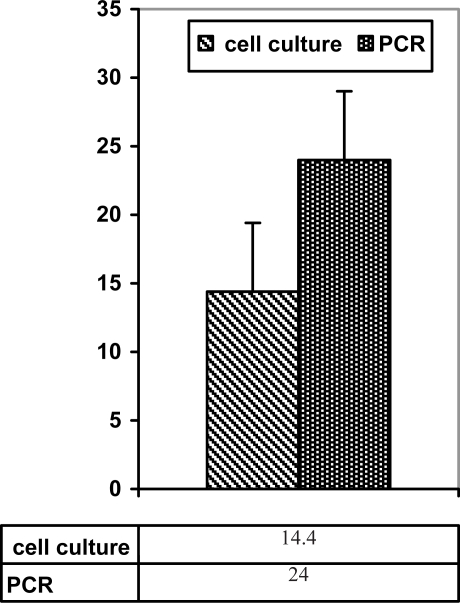
The difference between RT-PCR and cell culture results was significant. Enteroviruses were detected in 24% of specimens using RT-PCR while cell lines could isolate Enteroviruses in just 14.4% of the samples.
每年,肠道病毒感染数百万人并引发不同疾病。通常使用细胞培养来检测这些病原体。横纹肌肉瘤(RD)细胞和L20B(L细胞)是世界卫生组织(WHO)为此推荐的细胞系。尽管细胞培养是粪便标本中诊断肠道病毒最常用的方法,但这种特定方法存在一些问题,包括假阳性或假阴性结果、缺乏用于诊断所有肠道病毒类型的独特细胞系,此外还很耗时。出于这些原因,人们尝试寻找更好的肠道病毒检测技术。逆转录聚合酶链反应(RT-PCR)是一种用于替代细胞培养方法的技术。在本研究中,将细胞培养方法与RT-PCR用于检测粪便标本中的肠道病毒进行了比较。
首先,将经氯仿处理的粪便样本接种到五种细胞系上,包括RD、L20B、人表皮癌细胞系(Hep-2)、非洲绿猴肾细胞系(Vero)和绿猴肾细胞系(GMK)。然后将结果与使用RT-PCR技术进行肠道病毒检测的数据进行比较。
RT-PCR与细胞培养结果之间的差异显著。使用RT-PCR在24%的标本中检测到肠道病毒,而细胞系仅在14.4%的样本中分离出肠道病毒。