Tasmanian Institute of Agriculture/School of Agricultural Science, University of Tasmania, Hobart, Tasmania, Australia.
PLoS One. 2012;7(2):e32003. doi: 10.1371/journal.pone.0032003. Epub 2012 Feb 14.
Mathematical models exist that quantify the effect of temperature on poikilotherm growth rate. One family of such models assumes a single rate-limiting 'master reaction' using terms describing the temperature-dependent denaturation of the reaction's enzyme. We consider whether such a model can describe growth in each domain of life.
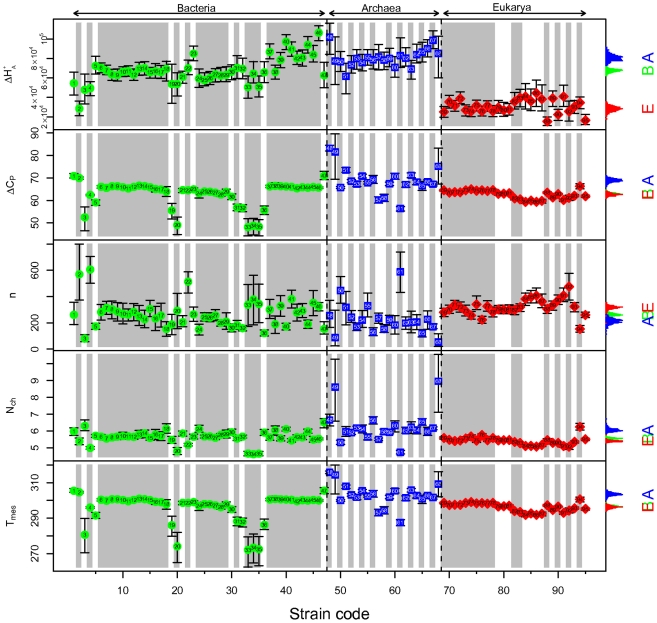
METHODOLOGY/PRINCIPAL FINDINGS: A new model based on this assumption and using a hierarchical Bayesian approach fits simultaneously 95 data sets for temperature-related growth rates of diverse microorganisms from all three domains of life, Bacteria, Archaea and Eukarya. Remarkably, the model produces credible estimates of fundamental thermodynamic parameters describing protein thermal stability predicted over 20 years ago.
CONCLUSIONS/SIGNIFICANCE: The analysis lends support to the concept of universal thermodynamic limits to microbial growth rate dictated by protein thermal stability that in turn govern biological rates. This suggests that the thermal stability of proteins is a unifying property in the evolution and adaptation of life on earth. The fundamental nature of this conclusion has importance for many fields of study including microbiology, protein chemistry, thermal biology, and ecological theory including, for example, the influence of the vast microbial biomass and activity in the biosphere that is poorly described in current climate models.
现已有数学模型可以量化温度对变温动物生长率的影响。这类模型中的一类采用单一限速“主反应”,使用描述反应酶的温度依赖性变性的术语。我们考虑这种模型是否可以描述生命各个领域的生长。
方法/主要发现:一个基于此假设并采用分层贝叶斯方法的新模型,同时拟合了来自生命的三个领域——细菌、古菌和真核生物的 95 个不同微生物与温度相关的生长率数据。值得注意的是,该模型产生了对 20 多年前预测的描述蛋白质热稳定性的基本热力学参数的可信估计。
结论/意义:该分析支持了由蛋白质热稳定性决定的微生物生长率的普遍热力学限制的概念,而蛋白质热稳定性反过来又控制着生物速率。这表明,蛋白质的热稳定性是地球生命进化和适应的一个统一特性。这一结论的基本性质对包括微生物学、蛋白质化学、热生物学和生态理论在内的许多研究领域都具有重要意义,例如,目前气候模型对生物圈内大量微生物生物量和活动的影响描述得很差。