College of Public Health, The Ohio State University, Columbus, Ohio, United States of America.
PLoS Negl Trop Dis. 2012;6(2):e1483. doi: 10.1371/journal.pntd.0001483. Epub 2012 Feb 14.
Water plays an important role in the transmission of many infectious diseases, which pose a great burden on global public health. However, the global distribution of these water-associated infectious diseases and underlying factors remain largely unexplored.
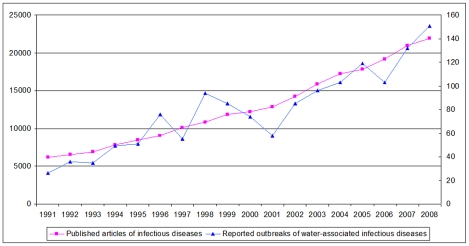
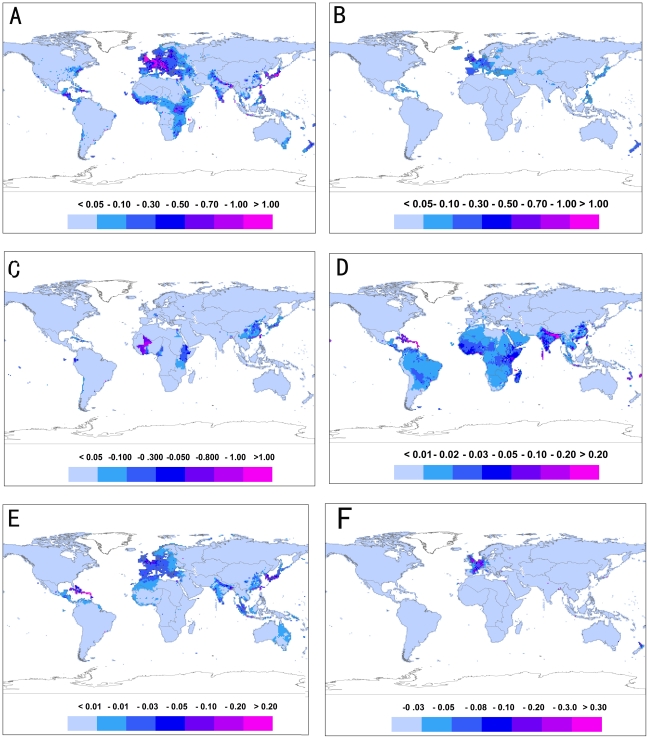
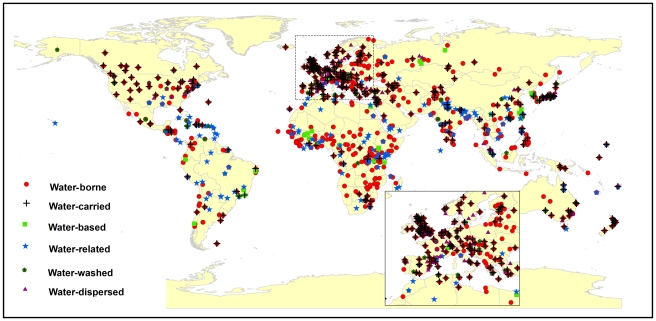
Based on the Global Infectious Disease and Epidemiology Network (GIDEON), a global database including water-associated pathogens and diseases was developed. In this study, reported outbreak events associated with corresponding water-associated infectious diseases from 1991 to 2008 were extracted from the database. The location of each reported outbreak event was identified and geocoded into a GIS database. Also collected in the GIS database included geo-referenced socio-environmental information including population density (2000), annual accumulated temperature, surface water area, and average annual precipitation. Poisson models with Bayesian inference were developed to explore the association between these socio-environmental factors and distribution of the reported outbreak events. Based on model predictions a global relative risk map was generated. A total of 1,428 reported outbreak events were retrieved from the database. The analysis suggested that outbreaks of water-associated diseases are significantly correlated with socio-environmental factors. Population density is a significant risk factor for all categories of reported outbreaks of water-associated diseases; water-related diseases (e.g., vector-borne diseases) are associated with accumulated temperature; water-washed diseases (e.g., conjunctivitis) are inversely related to surface water area; both water-borne and water-related diseases are inversely related to average annual rainfall. Based on the model predictions, "hotspots" of risks for all categories of water-associated diseases were explored.
At the global scale, water-associated infectious diseases are significantly correlated with socio-environmental factors, impacting all regions which are affected disproportionately by different categories of water-associated infectious diseases.
水在许多传染病的传播中起着重要作用,这给全球公共卫生带来了巨大负担。然而,这些与水有关的传染病的全球分布及其潜在因素在很大程度上仍未得到探索。
本研究基于全球传染病和流行病学网络(GIDEON),开发了一个包含与水有关的病原体和疾病的全球数据库。在这项研究中,从数据库中提取了 1991 年至 2008 年与相应的与水有关的传染病有关的报告暴发事件。确定了每个报告暴发事件的位置,并将其地理编码到 GIS 数据库中。GIS 数据库中还收集了包括人口密度(2000 年)、年累计温度、地表水面积和年平均降水量在内的与地理位置有关的社会环境信息。采用贝叶斯推断的泊松模型来探讨这些社会环境因素与报告暴发事件分布之间的关系。根据模型预测生成了全球相对风险图。从数据库中检索到 1428 次报告暴发事件。分析表明,与水有关的疾病暴发与社会环境因素显著相关。人口密度是所有报告的与水有关的疾病暴发类别的重要危险因素;与水有关的疾病(如媒介传播疾病)与累计温度有关;水洗性疾病(如结膜炎)与地表水面积成反比;水传播疾病和与水有关的疾病均与年平均降水量成反比。根据模型预测,探讨了所有与水有关的疾病类别的风险“热点”。
在全球范围内,与水有关的传染病与社会环境因素显著相关,所有受不同类别与水有关的传染病影响不成比例的地区都受到影响。