College of Medicine, King Saud bin Abdulaziz University for Health Sciences, Riyadh, Saudi Arabia.
Med Educ Online. 2012;17:11204. doi: 10.3402/meo.v17i0.11204. Epub 2012 Feb 17.
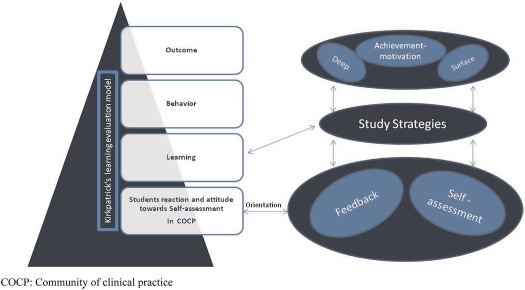
Self-assessment is recognized as a necessary skill for lifelong learning. It is widely reported to offer numerous advantages to the learner. The research evaluated the impact of students' and supervisors' self-assessment and feedback training on students' perceptions and practices of self-assessment. Moreover, it evaluated the effect of self-assessment process on students' study strategies within a community of clinical practice.
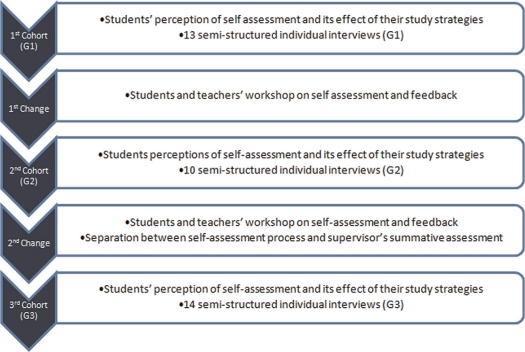
We conducted a qualitative phenomenological study from May 2008 to December 2009. We held 37 semi-structured individual interviews with three different cohorts of undergraduate medical students until we reached data saturation. The cohorts were exposed to different contexts while experiencing their clinical years' assessment program. In the interviews, students' perceptions and interpretations of 'self-assessment practice' and 'supervisor-provided feedback' within different contexts and the resulting study strategies were explored.
The analysis of interview data with the three cohorts of students yielded three major themes: strategic practice of self-assessment, self-assessment and study strategies, and feedback and study strategies. It appears that self-assessment is not appropriate within a summative context, and its implementation requires cultural preparation. Despite education and orientation on the two major components of the self-assessment process, feedback was more effective in enhancing deeper study strategies.
This research suggests that the theoretical advantages linked to the self-assessment process are a result of its feedback component rather than the practice of self-assessment isolated from feedback. Further research exploring the effects of different contextual and personal factors on students' self-assessment is needed.
自我评估被认为是终身学习的必要技能。它被广泛认为对学习者有许多好处。本研究评估了学生和导师自我评估和反馈培训对学生自我评估的看法和实践的影响。此外,它评估了自我评估过程对学生在临床实践共同体中学习策略的影响。
我们于 2008 年 5 月至 2009 年 12 月进行了一项定性现象学研究。我们对三个不同批次的本科医学生进行了 37 次半结构化的个体访谈,直到达到数据饱和。这些批次在经历临床评估项目时处于不同的背景下。在访谈中,学生们探讨了不同背景下自我评估实践和导师提供的反馈的看法和解释,以及由此产生的学习策略。
对三个批次学生的访谈数据分析得出了三个主要主题:自我评估的策略实践、自我评估和学习策略以及反馈和学习策略。自我评估在总结性背景下并不合适,其实施需要文化准备。尽管对自我评估过程的两个主要组成部分进行了教育和指导,但反馈在增强更深入的学习策略方面更为有效。
本研究表明,与自我评估过程相关的理论优势是其反馈组成部分的结果,而不是与反馈分离的自我评估实践的结果。需要进一步研究探索不同背景和个人因素对学生自我评估的影响。