Max Planck Institute for Demographic Research, Konrad-Zuse-Strasse 1, 18057, Rostock, Germany.
Sci Rep. 2011;1:56. doi: 10.1038/srep00056. Epub 2011 Aug 5.
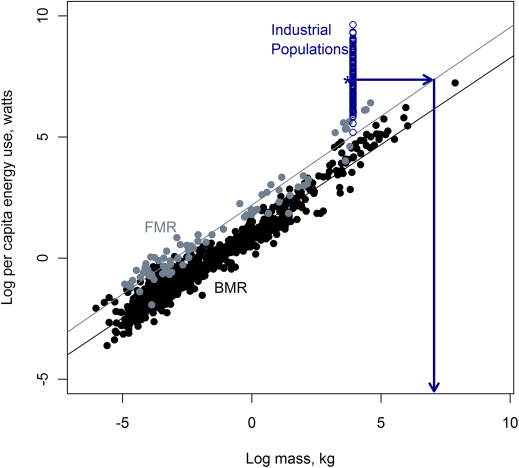
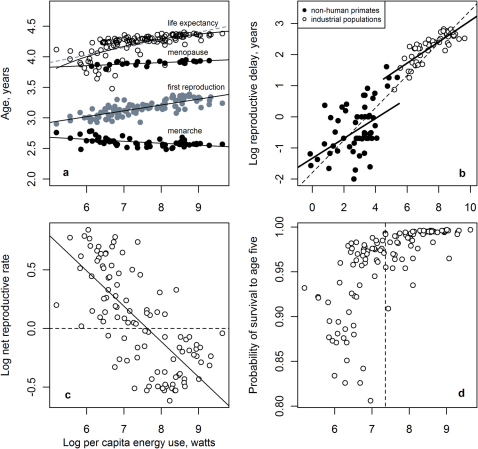
The demographic rates of most organisms are supported by the consumption of food energy, which is used to produce new biomass and fuel physiological processes. Unlike other species, modern humans use 'extra-metabolic' energy sources acquired independent of physiology, which also influence demographics. We ask whether the amount of extra-metabolic energy added to the energy budget affects demographic and life history traits in a predictable way. Currently it is not known how human demographics respond to energy use, and we characterize this response using an allometric approach. All of the human life history traits we examine are significant functions of per capita energy use across industrialized populations. We find a continuum of traits from those that respond strongly to the amount of extra-metabolic energy used, to those that respond with shallow slopes. We also show that the differences in plasticity across traits can drive the net reproductive rate to below-replacement levels.
大多数生物体的人口增长率都依赖于食物能量的消耗,这些能量用于产生新的生物量并为生理过程提供燃料。与其他物种不同,现代人类使用“代谢外”的能量来源,这些能量来源独立于生理机能获得,也会影响人口动态。我们想知道代谢外能量的摄入量是否会以可预测的方式影响人口和生活史特征。目前尚不清楚人类的人口动态如何对能量使用做出反应,我们使用一种异速生长的方法来描述这种反应。我们研究的所有人类生活史特征都是人口在工业化过程中人均能量使用的重要函数。我们发现,从对代谢外能量使用量反应强烈的特征,到反应平缓的特征,存在一个连续体。我们还表明,不同特征之间的可塑性差异可以将净生殖率降低到低于替代水平。