Szekely Pablo, Korem Yael, Moran Uri, Mayo Avi, Alon Uri
Department of Molecular Cell Biology, The Weizmann Institute of Science, Rehovot, Israel.
Department of Plant Science, The Weizmann Institute of Science, Rehovot, Israel.
PLoS Comput Biol. 2015 Oct 14;11(10):e1004524. doi: 10.1371/journal.pcbi.1004524. eCollection 2015 Oct.
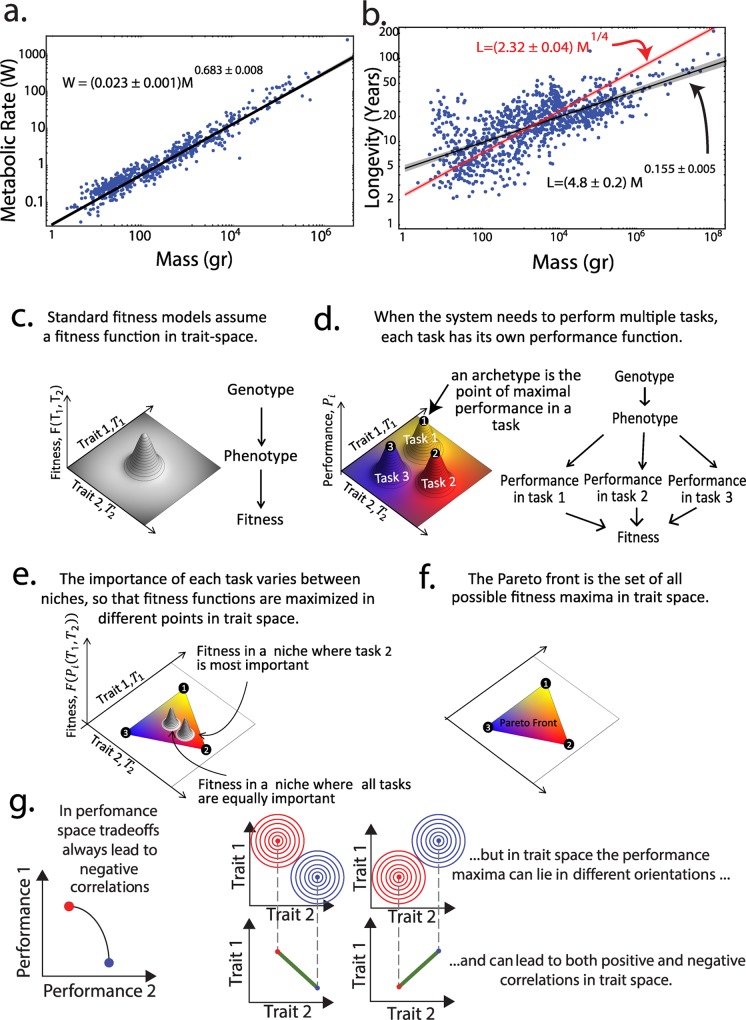
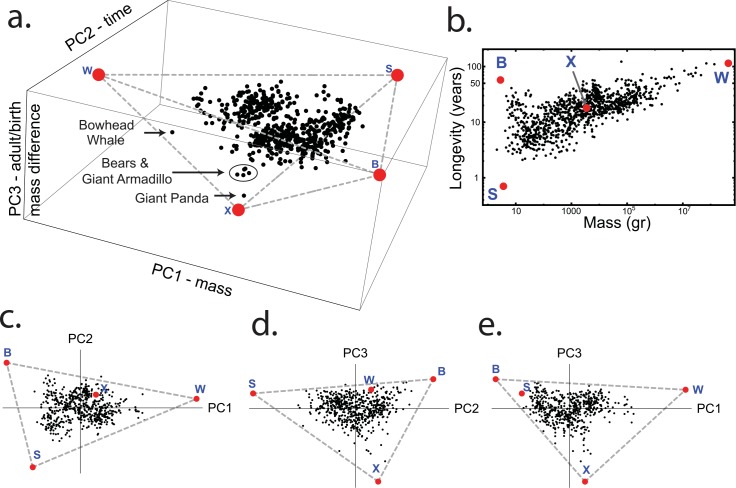
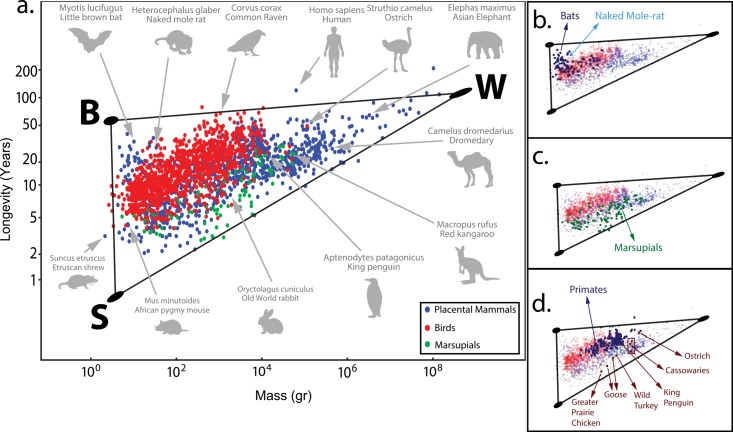
When organisms need to perform multiple tasks they face a fundamental tradeoff: no phenotype can be optimal at all tasks. This situation was recently analyzed using Pareto optimality, showing that tradeoffs between tasks lead to phenotypes distributed on low dimensional polygons in trait space. The vertices of these polygons are archetypes--phenotypes optimal at a single task. This theory was applied to examples from animal morphology and gene expression. Here we ask whether Pareto optimality theory can apply to life history traits, which include longevity, fecundity and mass. To comprehensively explore the geometry of life history trait space, we analyze a dataset of life history traits of 2105 endothermic species. We find that, to a first approximation, life history traits fall on a triangle in log-mass log-longevity space. The vertices of the triangle suggest three archetypal strategies, exemplified by bats, shrews and whales, with specialists near the vertices and generalists in the middle of the triangle. To a second approximation, the data lies in a tetrahedron, whose extra vertex above the mass-longevity triangle suggests a fourth strategy related to carnivory. Each animal species can thus be placed in a coordinate system according to its distance from the archetypes, which may be useful for genome-scale comparative studies of mammalian aging and other biological aspects. We further demonstrate that Pareto optimality can explain a range of previous studies which found animal and plant phenotypes which lie in triangles in trait space. This study demonstrates the applicability of multi-objective optimization principles to understand life history traits and to infer archetypal strategies that suggest why some mammalian species live much longer than others of similar mass.
当生物体需要执行多项任务时,它们面临着一个基本的权衡:没有一种表型能在所有任务上都达到最优。最近使用帕累托最优对这种情况进行了分析,结果表明任务之间的权衡导致表型分布在性状空间的低维多边形上。这些多边形的顶点是原型——在单一任务上最优的表型。该理论已应用于动物形态学和基因表达的实例。在这里,我们探讨帕累托最优理论是否适用于生活史性状,生活史性状包括寿命、繁殖力和体重。为了全面探索生活史性状空间的几何形状,我们分析了2105个恒温物种的生活史性状数据集。我们发现,初步近似来看,生活史性状落在对数体重-对数寿命空间的一个三角形上。三角形的顶点暗示了三种原型策略,以蝙蝠、鼩鼱和鲸鱼为例,顶点附近是 specialists(此处原文未明确给出准确对应中文,暂保留英文),三角形中间是通才。进一步近似来看,数据位于一个四面体中,其在体重-寿命三角形上方的额外顶点暗示了与食肉习性相关的第四种策略。因此,每个动物物种都可以根据其与原型的距离放置在一个坐标系中,这可能有助于对哺乳动物衰老和其他生物学方面进行基因组规模的比较研究。我们进一步证明,帕累托最优可以解释一系列先前的研究,这些研究发现动植物表型位于性状空间的三角形中。这项研究证明了多目标优化原则在理解生活史性状以及推断原型策略方面的适用性,这些策略揭示了为什么一些哺乳动物物种比其他体重相似的物种寿命长得多。