Department of Chemistry and Biochemistry, University of California Los Angeles , 607 Charles E Young Dr East, CA 90095, USA.
Sci Rep. 2012;2:277. doi: 10.1038/srep00277. Epub 2012 Feb 20.
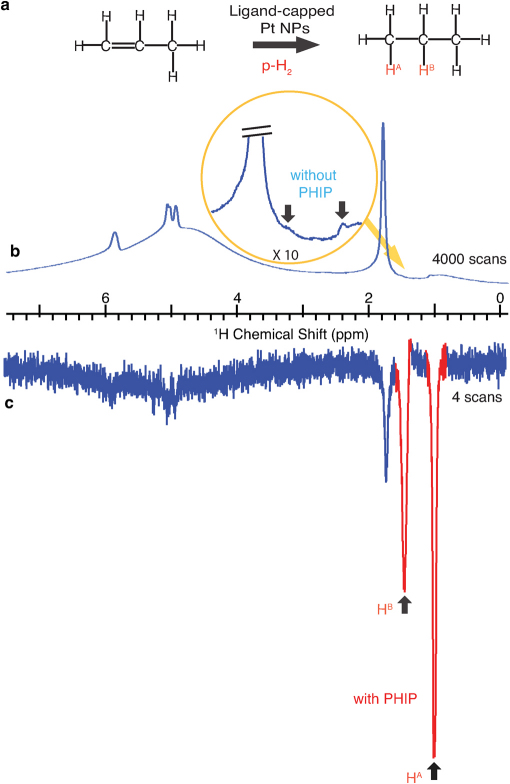
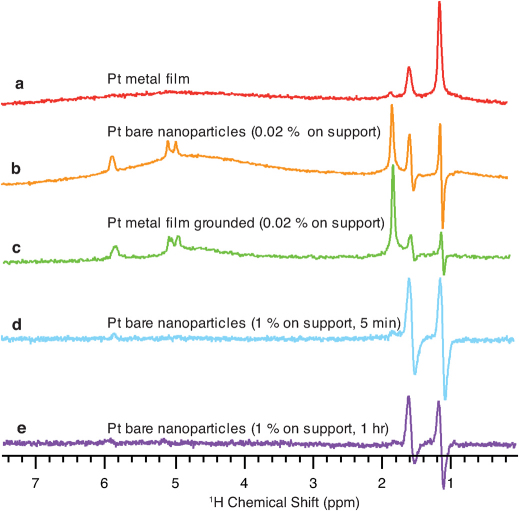
The production of hyperpolarized fluids in continuous mode would broaden substantially the range of applications in chemistry, materials science, and biomedicine. Here we show that the rational design of a heterogeneous catalyst based on a judicious choice of metal type, nanoparticle size and surface decoration with appropriate ligands leads to highly efficient pairwise addition of dihydrogen across an unsaturated bond. This is demonstrated in a parahydrogen-induced polarization (PHIP) experiment by a 508-fold enhancement (±78) of a CH(3) proton signal and a corresponding 1219-fold enhancement (±187) of a CH(2) proton signal using nuclear magnetic resonance (1H-NMR). In contrast, bulk metal catalyst does not show this effect due to randomization of reacting dihydrogen. Our approach results in the largest gas-phase NMR signal enhancement by PHIP known to date. Sensitivity-enhanced NMR with this technique could be used to image microfluidic reactions in-situ, to probe nonequilibrium thermodynamics or for the study of metabolic reactions.
连续模式下的极化液体制备将大大拓宽其在化学、材料科学和生物医学领域的应用范围。在这里,我们展示了基于金属类型、纳米颗粒大小和表面配体的合理设计的多相催化剂,通过适当的配体,可以高效地实现不饱和键的双氢加成。这在一个氘诱导极化(PHIP)实验中得到了证明,通过核磁共振(1H-NMR),CH(3)质子信号增强了 508 倍(±78),CH(2)质子信号增强了 1219 倍(±187)。相比之下,由于反应氢气的随机化,块状金属催化剂没有表现出这种效果。我们的方法导致了迄今为止通过 PHIP 获得的最大气相 NMR 信号增强。该技术的灵敏度增强 NMR 可用于原位微流反应成像、探测非平衡热力学或研究代谢反应。