Bonn Stephanie Erika, Trolle Lagerros Ylva, Christensen Sara Elisabeth, Möller Elisabeth, Wright Antony, Sjölander Arvid, Bälter Katarina
Department of Medical Epidemiology and Biostatistics, Karolinska Institutet, Stockholm, Sweden.
J Med Internet Res. 2012 Feb 15;14(1):e29. doi: 10.2196/jmir.1974.
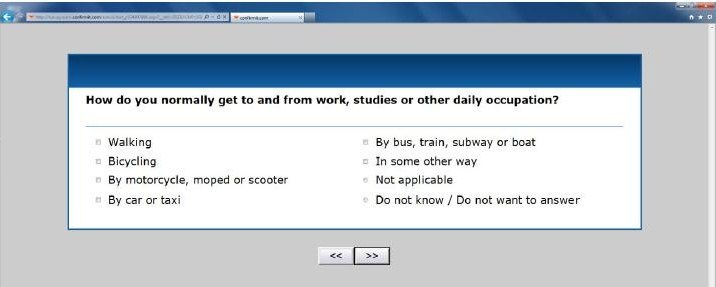
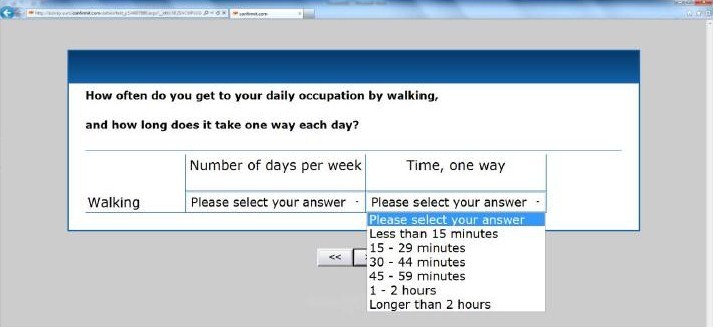
Increased use of the Internet provides new opportunities for collecting data in large studies. The aim of our new Web-based questionnaire, Active-Q, is to assess total physical activity and inactivity in adults. Active-Q assesses habitual activity during the past year via questions in four different domains: (1) daily occupation, (2) transportation to and from daily occupation, (3) leisure time activities, and (4) sporting activities.
The objective of our study is to validate Active-Q's energy expenditure estimates using the doubly labeled water (DLW) method, and to assess the reproducibility of Active-Q by comparing the results of the questionnaire completed by the same group on two occasions.
The validity and reproducibility of Active-Q were assessed in a group of 37 individuals, aged 20 to 65 years. Active-Q was distributed via email to the participants. The total energy expenditure of the participants was assessed using DLW for 11 consecutive days.
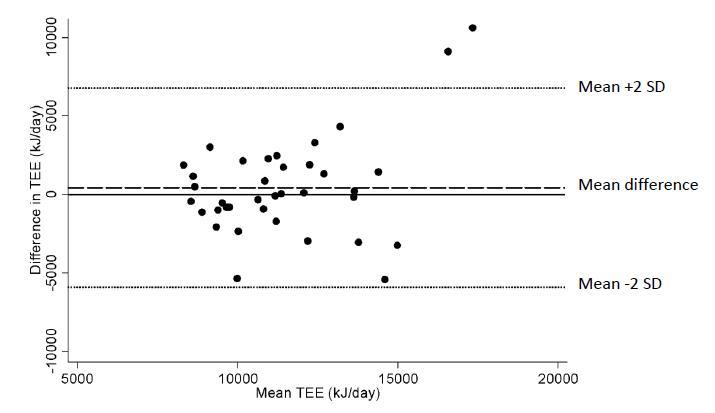
The median time to complete Active-Q was 6.1 minutes. The majority of participants (27/37, 73%) reported that the questionnaire was "easy" or "very easy" to answer. On average, Active-Q overestimated the total daily energy expenditure by 440 kJ compared with the DLW. The Spearman correlation between the two methods was r = 0.52 (P < .001). The intraclass correlation coefficient for total energy expenditure between the results of Active-Q completed on two occasions was 0.83 (95% CI 0.73-0.93).
Active-Q is a valid and reproducible method of assessing total energy expenditure. It is also a user-friendly method and suitable for Web-based data collection in large epidemiological studies.
互联网使用的增加为大型研究中的数据收集提供了新机会。我们新的基于网络的问卷Active-Q的目的是评估成年人的总体身体活动和不活动情况。Active-Q通过四个不同领域的问题来评估过去一年中的习惯性活动:(1)日常职业,(2)上下班交通,(3)休闲时间活动,以及(4)体育活动。
我们研究的目的是使用双标水(DLW)方法验证Active-Q的能量消耗估计值,并通过比较同一组在两个不同时间完成的问卷结果来评估Active-Q的可重复性。
在37名年龄在20至65岁之间的个体中评估Active-Q的有效性和可重复性。通过电子邮件将Active-Q分发给参与者。使用DLW连续11天评估参与者的总能量消耗。
完成Active-Q的中位时间为6.1分钟。大多数参与者(27/37,73%)报告称问卷“容易”或“非常容易”回答。与DLW相比,Active-Q平均高估每日总能量消耗440千焦。两种方法之间的Spearman相关性为r = 0.52(P <.001)。两次完成的Active-Q结果之间总能量消耗的组内相关系数为0.83(95%CI 0.73 - 0.93)。
Active-Q是一种评估总能量消耗的有效且可重复的方法。它也是一种用户友好的方法,适用于大型流行病学研究中的基于网络的数据收集。