Christensen Sara E, Möller Elisabeth, Bonn Stephanie E, Ploner Alexander, Wright Antony, Sjölander Arvid, Bälter Olle, Lissner Lauren, Bälter Katarina
Karolinska Institutet, Department of Medical Epidemiology and Biostatistics, Stockholm, Sweden.
J Med Internet Res. 2013 Jun 5;15(6):e109. doi: 10.2196/jmir.2458.
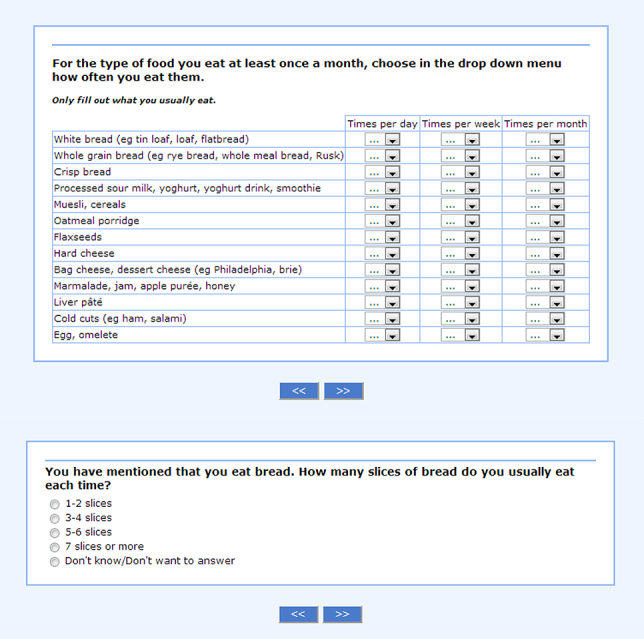
Meal-Q and its shorter version, MiniMeal-Q, are 2 new Web-based food frequency questionnaires. Their meal-based and interactive format was designed to promote ease of use and to minimize answering time, desirable improvements in large epidemiological studies.
We evaluated the validity of energy and macronutrient intake assessed with Meal-Q and MiniMeal-Q as well as the reproducibility of Meal-Q.
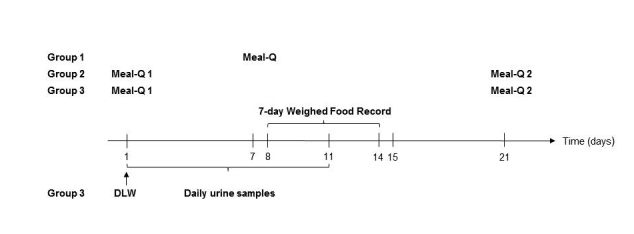
Healthy volunteers aged 20-63 years recruited from Stockholm County filled out the 174-item Meal-Q. The questionnaire was compared to 7-day weighed food records (WFR; n=163), for energy and macronutrient intake, and to doubly labeled water (DLW; n=39), for total energy expenditure. In addition, the 126-item MiniMeal-Q was evaluated in a simulated validation using truncated Meal-Q data. We also assessed the answering time and ease of use of both questionnaires.
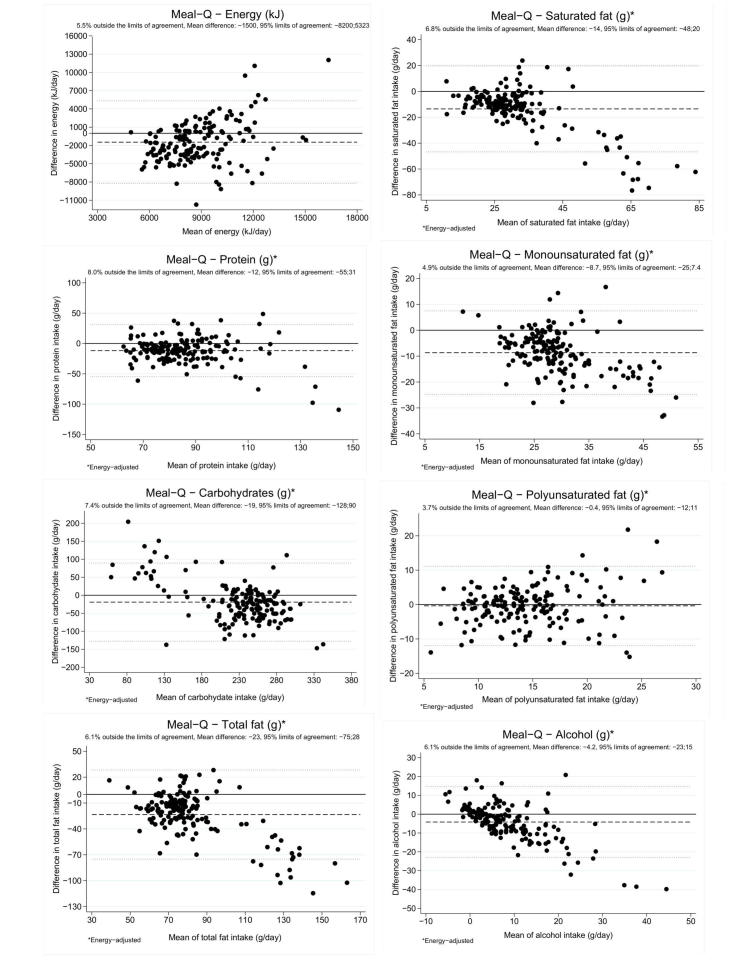
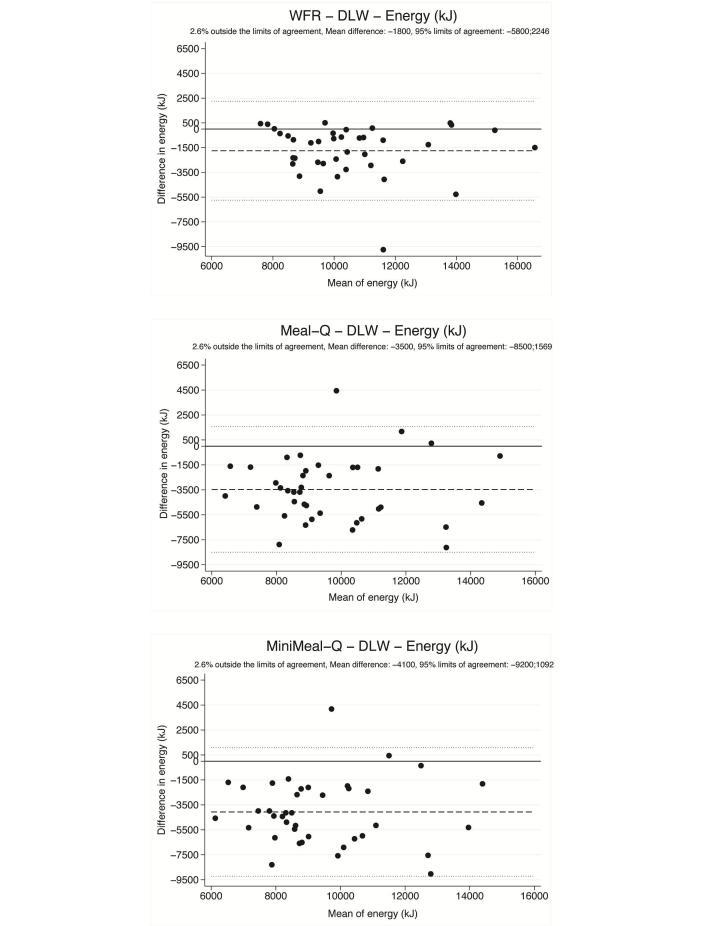
Bland-Altman plots showed a varying bias within the intake range for all validity comparisons. Cross-classification of quartiles placed 70%-86% in the same/adjacent quartile with WFR and 77% with DLW. Deattenuated and energy-adjusted Pearson correlation coefficients with the WFR ranged from r=0.33-0.74 for macronutrients and was r=0.18 for energy. Correlations with DLW were r=0.42 for Meal-Q and r=0.38 for MiniMeal-Q. Intraclass correlations for Meal-Q ranged from r=0.57-0.90. Median answering time was 17 minutes for Meal-Q and 7 minutes for MiniMeal-Q, and participants rated both questionnaires as easy to use.
Meal-Q and MiniMeal-Q are easy to use and have short answering times. The ranking agreement is good for most of the nutrients for both questionnaires and Meal-Q shows fair reproducibility.
Meal-Q及其简短版本MiniMeal-Q是两种新型的基于网络的食物频率问卷。它们基于餐食且具有交互性的形式旨在提高易用性并减少回答时间,这是大型流行病学研究中值得期待的改进。
我们评估了使用Meal-Q和MiniMeal-Q评估的能量和宏量营养素摄入量的有效性以及Meal-Q的可重复性。
从斯德哥尔摩县招募的20至63岁健康志愿者填写了包含174个条目的Meal-Q。该问卷在能量和宏量营养素摄入量方面与7天称重食物记录(WFR;n = 163)进行比较,并在总能量消耗方面与双标水法(DLW;n = 39)进行比较。此外,使用截断的Meal-Q数据在模拟验证中对包含126个条目的MiniMeal-Q进行了评估。我们还评估了两种问卷的回答时间和易用性。
布兰德-奥特曼图显示在所有有效性比较的摄入量范围内偏差各异。四分位数交叉分类显示,与WFR相比,70%-86%处于相同/相邻四分位数,与DLW相比为77%。与WFR的去衰减和能量调整后的皮尔逊相关系数,宏量营养素范围为r = 0.33 - 0.74,能量为r = 0.18。与DLW的相关性,Meal-Q为r = 0.42,MiniMeal-Q为r = 0.38。Meal-Q的组内相关性范围为r = 0.57 - 0.90。Meal-Q的中位回答时间为17分钟,MiniMeal-Q为7分钟,参与者将两种问卷都评为易于使用。
Meal-Q和MiniMeal-Q易于使用且回答时间短。两种问卷对于大多数营养素的排名一致性良好,且Meal-Q显示出较好的可重复性。