Life Sciences Institute, Center for Stem Cell Biology, University of Michigan, Ann Arbor, MI 48109, USA.
Mol Biol Cell. 2012 Apr;23(8):1524-32. doi: 10.1091/mbc.E11-12-0999. Epub 2012 Feb 22.
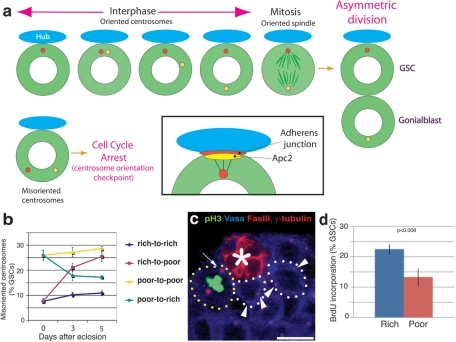
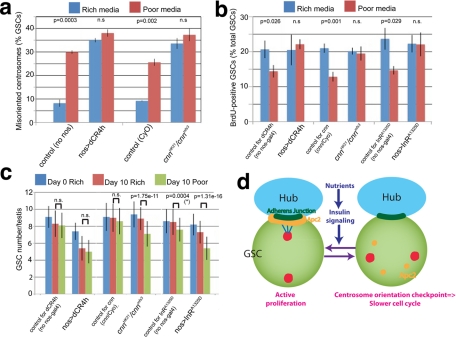
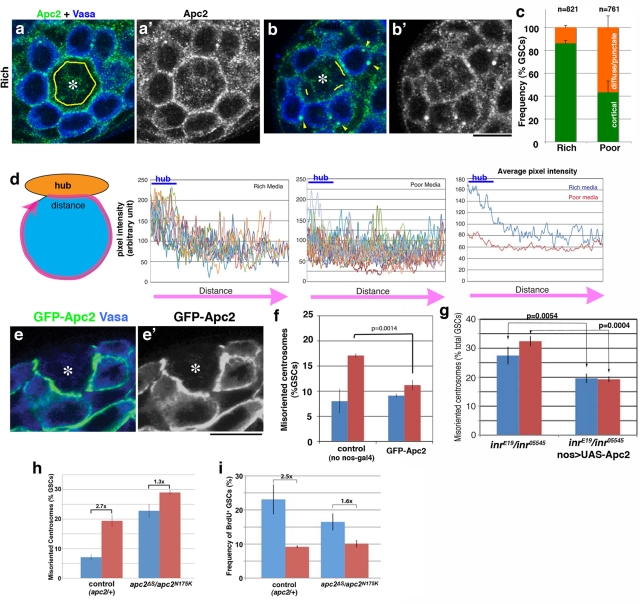
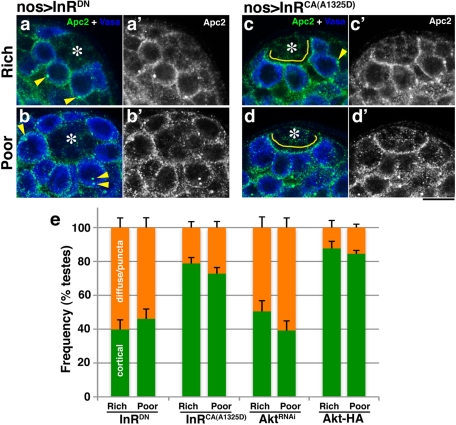
Drosophila male germline stem cells (GSCs) divide asymmetrically, balancing self-renewal and differentiation. Although asymmetric stem cell division balances between self-renewal and differentiation, it does not dictate how frequently differentiating cells must be produced. In male GSCs, asymmetric GSC division is achieved by stereotyped positioning of the centrosome with respect to the stem cell niche. Recently we showed that the centrosome orientation checkpoint monitors the correct centrosome orientation to ensure an asymmetric outcome of the GSC division. When GSC centrosomes are not correctly oriented with respect to the niche, GSC cell cycle is arrested/delayed until the correct centrosome orientation is reacquired. Here we show that induction of centrosome misorientation upon culture in poor nutrient conditions mediates slowing of GSC cell proliferation via activation of the centrosome orientation checkpoint. Consistently, inactivation of the centrosome orientation checkpoint leads to lack of cell cycle slowdown even under poor nutrient conditions. We propose that centrosome misorientation serves as a mediator that transduces nutrient information into stem cell proliferation, providing a previously unappreciated mechanism of stem cell regulation in response to nutrient conditions.
果蝇雄性生殖干细胞 (GSCs) 不对称分裂,平衡自我更新和分化。尽管不对称干细胞分裂在自我更新和分化之间取得平衡,但它并不能决定分化细胞必须多频繁地产生。在雄性 GSCs 中,不对称 GSC 分裂是通过中心体相对于干细胞龛的刻板定位来实现的。最近,我们发现中心体取向检查点监测着正确的中心体取向,以确保 GSC 分裂的不对称结果。当 GSC 中心体相对于龛位没有正确定位时,GSC 细胞周期会被阻止/延迟,直到正确的中心体取向被重新获得。在这里,我们表明在营养条件差的情况下培养诱导中心体错位会通过激活中心体取向检查点来减缓 GSC 细胞增殖。一致地,即使在营养条件差的情况下,中心体取向检查点的失活也会导致细胞周期没有减缓。我们提出,中心体错位作为一种介质,将营养信息转导到干细胞增殖中,为响应营养条件的干细胞调节提供了一个以前未被认识的机制。