Institut für Mikrobiologie, Technische Universität Braunschweig, Braunschweig, Germany.
PLoS Pathog. 2012 Feb;8(2):e1002518. doi: 10.1371/journal.ppat.1002518. Epub 2012 Feb 16.
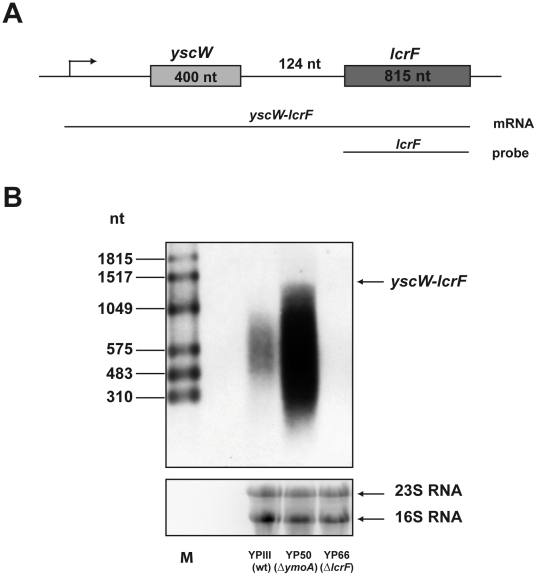
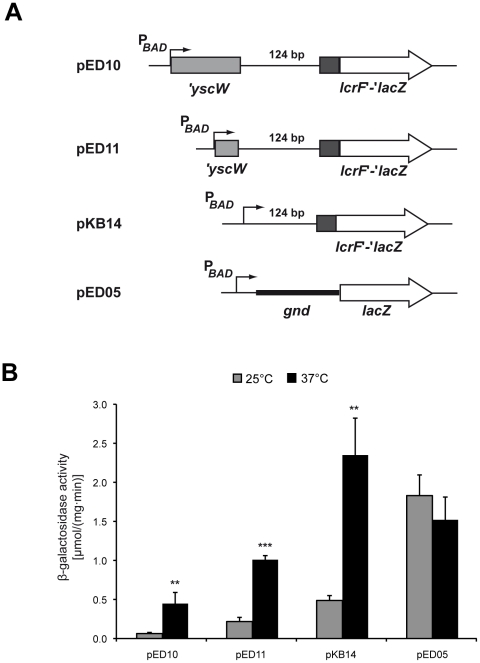
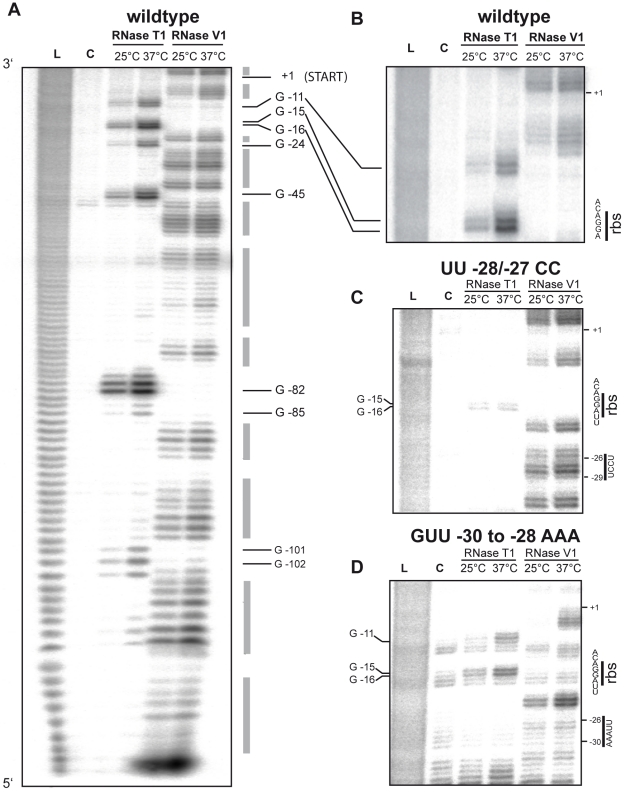
Expression of all Yersinia pathogenicity factors encoded on the virulence plasmid, including the yop effector and the ysc type III secretion genes, is controlled by the transcriptional activator LcrF in response to temperature. Here, we show that a protein- and RNA-dependent hierarchy of thermosensors induce LcrF synthesis at body temperature. Thermally regulated transcription of lcrF is modest and mediated by the thermo-sensitive modulator YmoA, which represses transcription from a single promoter located far upstream of the yscW-lcrF operon at moderate temperatures. The transcriptional response is complemented by a second layer of temperature-control induced by a unique cis-acting RNA element located within the intergenic region of the yscW-lcrF transcript. Structure probing demonstrated that this region forms a secondary structure composed of two stemloops at 25°C. The second hairpin sequesters the lcrF ribosomal binding site by a stretch of four uracils. Opening of this structure was favored at 37°C and permitted ribosome binding at host body temperature. Our study further provides experimental evidence for the biological relevance of an RNA thermometer in an animal model. Following oral infections in mice, we found that two different Y. pseudotuberculosis patient isolates expressing a stabilized thermometer variant were strongly reduced in their ability to disseminate into the Peyer's patches, liver and spleen and have fully lost their lethality. Intriguingly, Yersinia strains with a destabilized version of the thermosensor were attenuated or exhibited a similar, but not a higher mortality. This illustrates that the RNA thermometer is the decisive control element providing just the appropriate amounts of LcrF protein for optimal infection efficiency.
在温度的响应下,编码于毒力质粒上的所有耶尔森氏菌致病性因子(包括 yop 效应子和 ysc 型 III 分泌基因)的表达均受转录激活因子 LcrF 控制。在这里,我们表明,蛋白质和 RNA 依赖性热传感器层级在体温下诱导 LcrF 的合成。LcrF 的热调节转录适度,并由热敏感调节剂 YmoA 介导,该调节剂在中等温度下抑制位于 yscW-lcrF 操纵子上游很远的单个启动子的转录。转录反应通过位于 yscW-lcrF 转录本基因间区的独特顺式作用 RNA 元件的第二层温度控制来补充。结构探测表明,该区域在 25°C 下形成由两个茎环组成的二级结构。第二个发夹通过四个尿嘧啶的一段将 LcrF 核糖体结合位点隔开。在 37°C 下,这种结构易于打开,并允许核糖体在宿主体温下结合。我们的研究进一步为动物模型中 RNA 温度计的生物学相关性提供了实验证据。在小鼠的口服感染后,我们发现两种表达稳定温度计变体的不同假结核耶尔森氏菌患者分离株在向派尔氏斑、肝脏和脾脏扩散的能力以及完全丧失致死性方面受到强烈抑制。有趣的是,具有不稳定版本热传感器的耶尔森氏菌菌株被减弱或表现出相似但不更高的死亡率。这表明 RNA 温度计是决定性的控制元件,仅为最佳感染效率提供适量的 LcrF 蛋白。