Department of Microbiology and Environmental Toxicology, University of California, Santa Cruz, California, United States of America.
Department of Biomolecular Chemistry, University of Wisconsin-Madison, Madison, Wisconsin, United States of America.
PLoS Genet. 2022 Jul 28;18(7):e1010321. doi: 10.1371/journal.pgen.1010321. eCollection 2022 Jul.
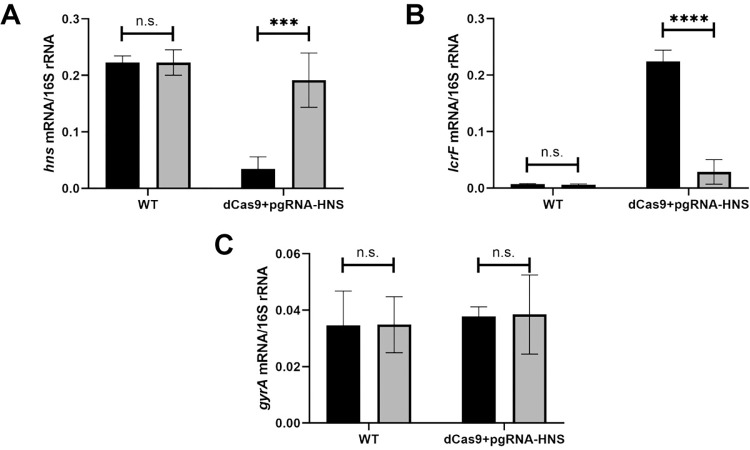
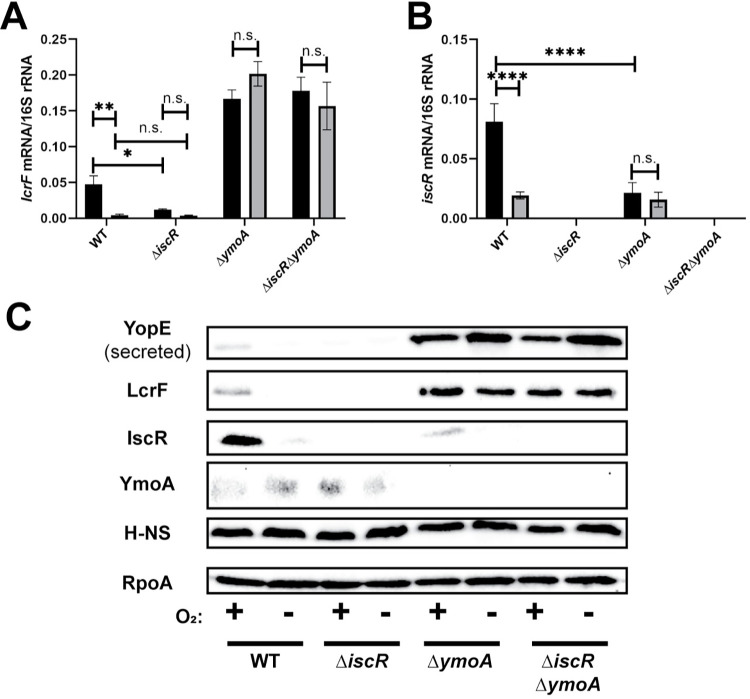
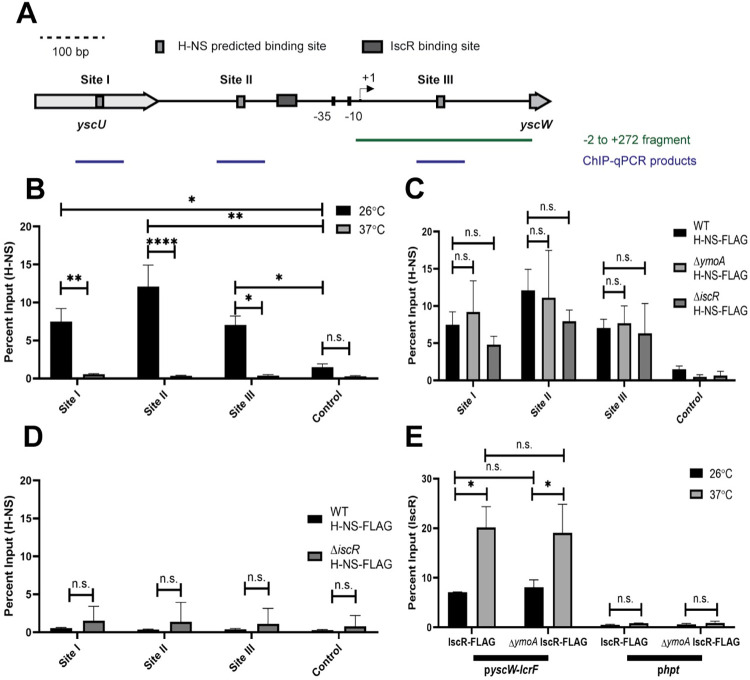
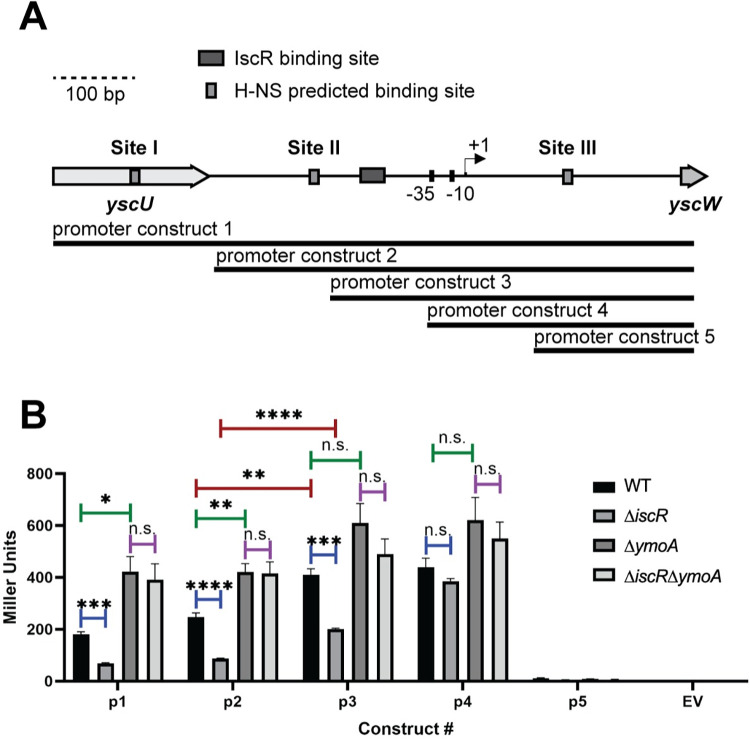
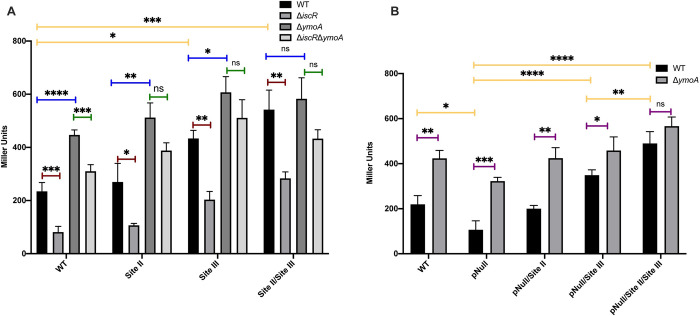
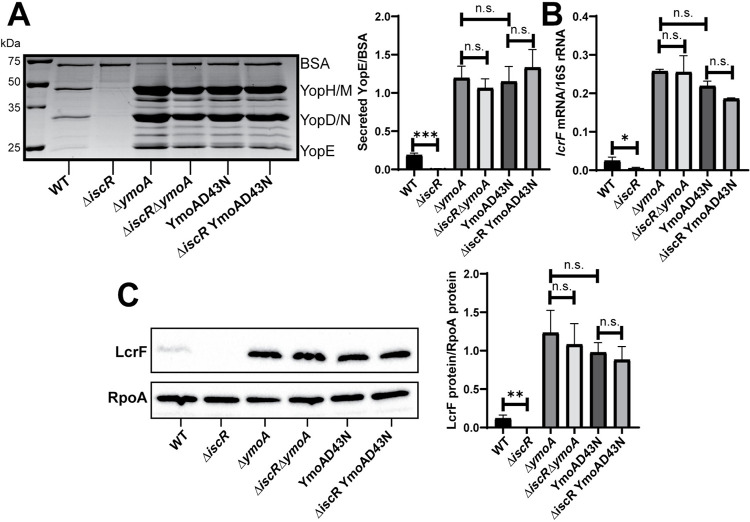
The type III secretion system (T3SS) is an appendage used by many bacterial pathogens, such as pathogenic Yersinia, to subvert host defenses. However, because the T3SS is energetically costly and immunogenic, it must be tightly regulated in response to environmental cues to enable survival in the host. Here we show that expression of the Yersinia Ysc T3SS master regulator, LcrF, is orchestrated by the opposing activities of the repressive H-NS/YmoA histone-like protein complex and induction by the iron and oxygen-regulated IscR transcription factor. While deletion of iscR or ymoA has been shown to decrease and increase LcrF expression and type III secretion, respectively, the role of H-NS in this system has not been definitively established because hns is an essential gene in Yersinia. Using CRISPRi knockdown of hns, we show that hns depletion causes derepression of lcrF. Furthermore, we find that while YmoA is dispensable for H-NS binding to the lcrF promoter, YmoA binding to H-NS is important for H-NS repressive activity. We bioinformatically identified three H-NS binding regions within the lcrF promoter and demonstrate binding of H-NS to these sites in vivo using chromatin immunoprecipitation. Using promoter truncation and binding site mutation analysis, we show that two of these H-NS binding regions are important for H-NS/YmoA-mediated repression of the lcrF promoter. Surprisingly, we find that IscR is dispensable for lcrF transcription in the absence of H-NS/YmoA. Indeed, IscR-dependent regulation of LcrF and type III secretion in response to changes in oxygen, such as those Yersinia is predicted to experience during host infection, only occurs in the presence of an H-NS/YmoA complex. These data suggest that, in the presence of host tissue cues that drive sufficient IscR expression, IscR can act as a roadblock to H-NS/YmoA-dependent repression of RNA polymerase at the lcrF promoter to turn on T3SS expression.
III 型分泌系统(T3SS)是许多细菌病原体(如致病性耶尔森氏菌)用来颠覆宿主防御的附属物。然而,由于 T3SS 能量消耗大且具有免疫原性,因此必须根据环境线索进行严格调节,以便在宿主中生存。在这里,我们表明,耶尔森氏菌 Ysc T3SS 主调控因子 LcrF 的表达是由抑制性 H-NS/YmoA 组蛋白样蛋白复合物的相反活性和铁和氧调节的 IscR 转录因子的诱导来协调的。虽然已经表明删除 iscR 或 ymoA 分别会降低和增加 LcrF 的表达和 III 型分泌,但 H-NS 在该系统中的作用尚未得到明确确定,因为 hns 是耶尔森氏菌中的必需基因。使用 CRISPRi 敲低 hns,我们表明 hns 耗尽会导致 lcrF 的去抑制。此外,我们发现,虽然 YmoA 对于 H-NS 结合到 lcrF 启动子是可有可无的,但 YmoA 结合到 H-NS 对于 H-NS 抑制活性很重要。我们在生物信息学上确定了 lcrF 启动子内的三个 H-NS 结合区域,并使用染色质免疫沉淀法在体内证明了 H-NS 与这些位点的结合。使用启动子截断和结合位点突变分析,我们表明这两个 H-NS 结合区域对于 H-NS/YmoA 介导的 lcrF 启动子抑制很重要。令人惊讶的是,我们发现,在没有 H-NS/YmoA 的情况下,IscR 对于 lcrF 转录是可有可无的。事实上,IscR 对 LcrF 和 III 型分泌的依赖调节,以响应氧气的变化,例如耶尔森氏菌在宿主感染期间预计会经历的变化,仅在存在 H-NS/YmoA 复合物的情况下发生。这些数据表明,在存在驱动足够 IscR 表达的宿主组织线索的情况下,IscR 可以作为 H-NS/YmoA 依赖性抑制 lcrF 启动子 RNA 聚合酶的路障,从而打开 T3SS 表达。