Harvard-Massachusetts Institute of Technology Division of Health Sciences and Technology, Department of Biological Engineering, Cambridge, Massachusetts, United States of America.
PLoS One. 2012;7(2):e27517. doi: 10.1371/journal.pone.0027517. Epub 2012 Feb 16.
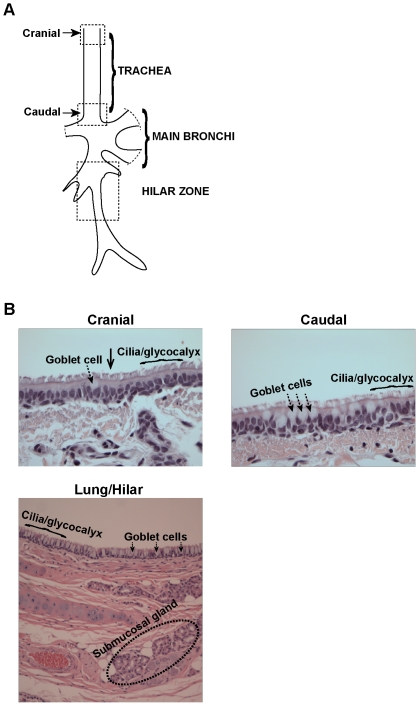
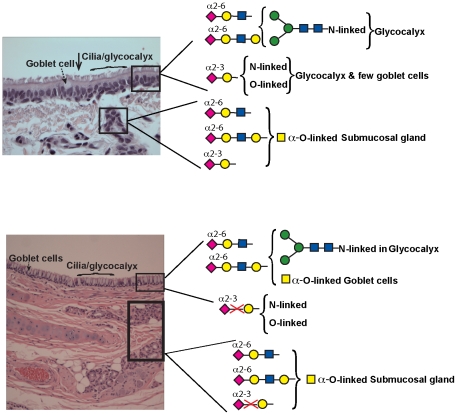
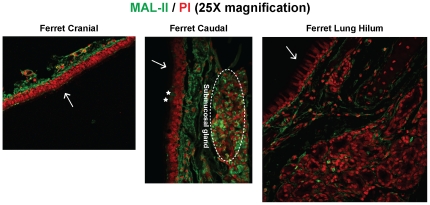
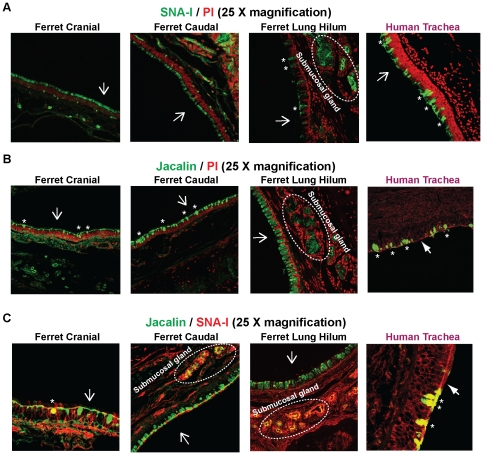
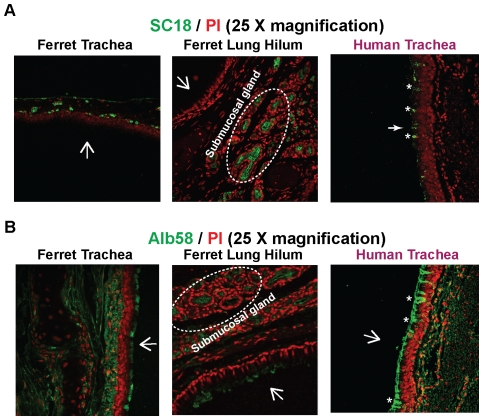
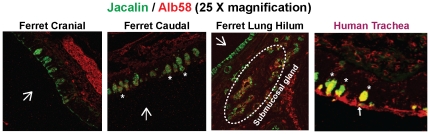
Ferrets are widely used as animal models for studying influenza A viral pathogenesis and transmissibility. Human-adapted influenza A viruses primarily target the upper respiratory tract in humans (infection of the lower respiratory tract is observed less frequently), while in ferrets, upon intranasal inoculation both upper and lower respiratory tract are targeted. Viral tropism is governed by distribution of complex sialylated glycan receptors in various cells/tissues of the host that are specifically recognized by influenza A virus hemagglutinin (HA), a glycoprotein on viral surface. It is generally known that upper respiratory tract of humans and ferrets predominantly express α2→6 sialylated glycan receptors. However much less is known about the fine structure of these glycan receptors and their distribution in different regions of the ferret respiratory tract. In this study, we characterize distribution of glycan receptors going beyond terminal sialic acid linkage in the cranial and caudal regions of the ferret trachea (upper respiratory tract) and lung hilar region (lower respiratory tract) by multiplexing use of various plant lectins and human-adapted HAs to stain these tissue sections. Our findings show that the sialylated glycan receptors recognized by human-adapted HAs are predominantly distributed in submucosal gland of lung hilar region as a part of O-linked glycans. Our study has implications in understanding influenza A viral pathogenesis in ferrets and also in employing ferrets as animal models for developing therapeutic strategies against influenza.
雪貂被广泛用作研究甲型流感病毒发病机制和传染性的动物模型。人类适应的甲型流感病毒主要靶向人类上呼吸道(下呼吸道感染较少见),而在雪貂中,经鼻腔接种后,上呼吸道和下呼吸道都会受到感染。病毒的嗜性由宿主各种细胞/组织中复杂的唾液酸化糖受体的分布决定,这些受体被甲型流感病毒血凝素(HA)特异性识别,HA 是病毒表面的一种糖蛋白。人们普遍认为,人类和雪貂的上呼吸道主要表达α2→6 唾液酸化糖受体。然而,关于这些糖受体的精细结构及其在雪貂呼吸道不同区域的分布,人们了解得较少。在这项研究中,我们通过组合使用多种植物凝集素和人类适应的 HA,对雪貂气管(上呼吸道)颅侧和尾侧以及肺门区域(下呼吸道)的糖受体进行了末端唾液酸连接以外的分布特征分析。我们的研究结果表明,人类适应的 HA 识别的唾液酸化糖受体主要分布在肺门区域的黏膜下腺,作为 O 连接糖的一部分。我们的研究结果对于理解甲型流感病毒在雪貂中的发病机制具有重要意义,也有助于将雪貂作为开发抗流感治疗策略的动物模型。