Department of Neurosurgery and Cellular and Molecular Physiology, Yale University School of Medicine, New Haven, Connecticut, United States of America.
PLoS One. 2012;7(2):e31960. doi: 10.1371/journal.pone.0031960. Epub 2012 Feb 16.
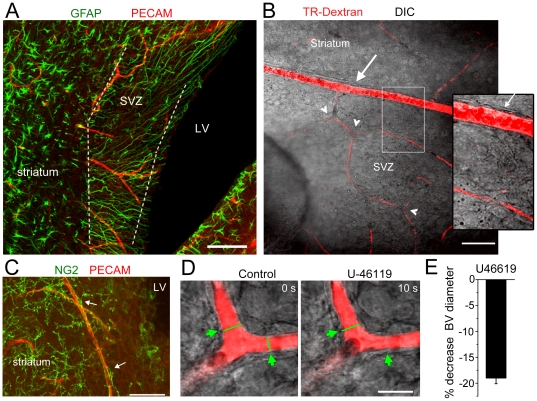
The postnatal subventricular zone (SVZ) contains proliferating neural progenitor cells in close proximity to blood vessels. Insults and drug treatments acutely stimulate cell proliferation in the SVZ, which was assessed by labeling cells entering S phase. Although G1-to-S progression is metabolically demanding on a minute-to-hour time scale, it remains unknown whether increased SVZ cell proliferation is accompanied by a local hemodynamic response. This neurovascular coupling provides energy substrates to active neuronal assemblies. Transcardial dye perfusion revealed the presence of capillaries throughout the SVZ that constrict upon applications of the thromboxane A(2) receptor agonist U-46119 in acute brain slice preparations. We then monitored in vivo blood flow using laser Doppler flowmetry via a microprobe located either in the SVZ or a mature network. U-46119 injections into the lateral ventricle decreased blood flow in the SVZ and the striatum, which are near the ventricle. A 1-hour ventricular injection of epidermal and basic fibroblast growth factor (EGF and bFGF) significantly increased the percentage of Sox2 transcription factor-positive cells in S phase 1.5 hours post-injection. This increase was accompanied by a sustained rise in blood flow in the SVZ but not in the striatum. Direct growth factor injections into the cortex did not alter local blood flow, ruling out direct effects on capillaries. These findings suggest that an acute increase in the number of G1-to-S cycling SVZ cells is accompanied by neurometabolic-vascular coupling, which may provide energy and nutrient for cell cycle progression.
产后侧脑室下区(SVZ)含有靠近血管的增殖性神经祖细胞。损伤和药物治疗会急性刺激 SVZ 中的细胞增殖,这可以通过标记进入 S 期的细胞来评估。虽然 G1 到 S 期的进展在分钟到小时的时间尺度上对代谢有很高的要求,但目前尚不清楚 SVZ 细胞增殖的增加是否伴随着局部血液动力学反应。这种神经血管偶联为活跃的神经元集合体提供能量底物。心脏染料灌注显示 SVZ 中存在毛细血管,这些毛细血管在急性脑切片制备中应用血栓素 A2 受体激动剂 U-46119 时会收缩。然后,我们通过位于 SVZ 或成熟网络中的微探头使用激光多普勒血流仪监测体内血流。向侧脑室注射 U-46119 会降低 SVZ 和纹状体的血流量,这些区域靠近脑室。表皮和碱性成纤维细胞生长因子(EGF 和 bFGF)的 1 小时心室注射显著增加了注射后 1.5 小时 Sox2 转录因子阳性细胞在 S 期的百分比。这种增加伴随着 SVZ 血流量的持续上升,但纹状体没有。直接将生长因子注射到皮质不会改变局部血流量,排除了对毛细血管的直接影响。这些发现表明,SVZ 中 G1 到 S 期循环细胞数量的急性增加伴随着神经代谢-血管偶联,这可能为细胞周期进展提供能量和营养。