Mukanga David, Tshimanga Mufuta, Wurapa Frederick, Binka Fred, Serwada David, Bazeyo William, Pariyo George, Wabwire-Mangen Fred, Gitta Sheba, Chungong Stella, Trostle Murray, Nsubuga Peter
African Field Epidemiology Network, Kampala, Uganda.
Pan Afr Med J. 2011;10 Supp 1(Suppl 1):2. Epub 2011 Dec 14.
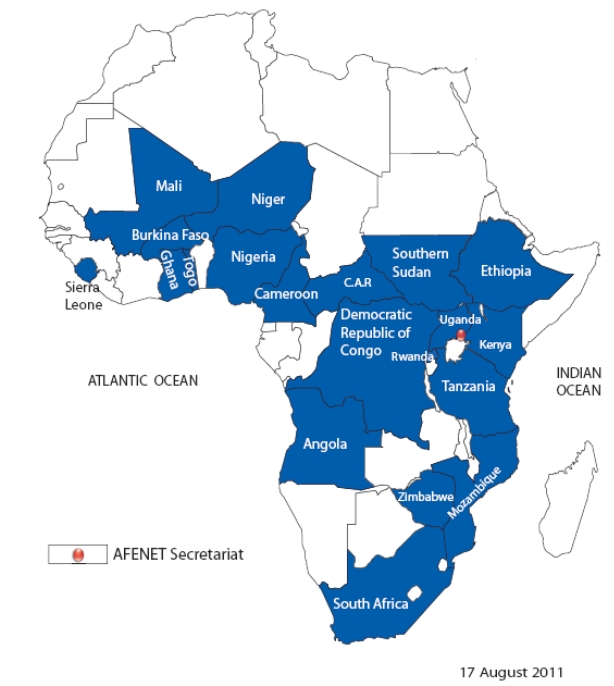
In an effort to contain the frequently devastating epidemics in sub-Saharan Africa, the World Health Organization (WHO) Regional Office for Africa launched the Integrated Disease Surveillance and Response (IDSR) strategy in an effort to strengthen surveillance and response. However, 36 sub-Saharan African countries have been described as experiencing a human resource crisis by the WHO. Given this human resource situation, the challenge remains for these countries to achieve, among others, the health-related Millennium Development Goals (MDGs). This paper describes the process through which the African Field Epidemiology Network (AFENET) was developed, as well as how AFENET has contributed to addressing the public health workforce crisis, and the development of human resource capacity to implement IDSR in Africa. AFENET was established between 2005 and 2006 as a network of Field Epidemiology Training Programs (FETPs) and Field Epidemiology and Laboratory Training Programs (FELTPs) in Africa. This resulted from an expressed need to develop a network that would advocate for the unique needs of African FETPs and FELTPs, provide service to its membership, and through which programs could develop joint projects to address the public health needs of their countries. A total of eight new programs have been developed in sub-Saharan Africa since 2006. Programs established after 2006 represent over 70% of current FETP and FELTP enrolment in Africa. In addition to growth in membership and programs, AFENET has recorded significant growth in external partnerships. Beginning with USAID, CDC and WHO in 2004-2006, a total of at least 26 partners have been added by 2011. Drawing from lessons learnt, AFENET is now a resource that can be relied upon to expand public health capacity in Africa in an efficient and practical manner. National, regional and global health actors can leverage it to meet health-related targets at all levels. The AFENET story is one that continues to be driven by a clearly recognized need within Africa to develop a network that would serve public health systems development, looking beyond the founders, and using the existing capacity of the founders and partners to help other countries build capacity for IDSR and the International Health Regulations (IHR, 2005).
为了控制撒哈拉以南非洲地区频繁爆发的灾难性流行病,世界卫生组织(WHO)非洲区域办事处发起了综合疾病监测与应对(IDSR)战略,以加强监测与应对工作。然而,据WHO称,36个撒哈拉以南非洲国家正面临人力资源危机。鉴于这种人力资源状况,这些国家要实现与健康相关的千年发展目标(MDGs)等仍面临挑战。本文描述了非洲现场流行病学网络(AFENET)的发展过程,以及AFENET如何为解决公共卫生劳动力危机、发展在非洲实施IDSR的人力资源能力做出贡献。AFENET于2005年至2006年间作为非洲现场流行病学培训项目(FETPs)和现场流行病学与实验室培训项目(FELTPs)的网络而成立。这源于一种明确的需求,即建立一个能够倡导非洲FETPs和FELTPs独特需求、为其成员提供服务,并通过该网络各项目能够开展联合项目以满足其国家公共卫生需求的网络。自2006年以来,撒哈拉以南非洲地区共开发了8个新项目。2006年后设立的项目占非洲目前FETP和FELTP招生人数的70%以上。除了成员数量和项目的增长,AFENET的外部伙伴关系也有显著增长。从2004 - 2006年的美国国际开发署、美国疾病控制与预防中心和WHO开始,到2011年至少又增加了26个伙伴。吸取经验教训后,AFENET现在已成为一种可依赖的资源,能够以高效和切实可行的方式扩大非洲的公共卫生能力。国家、区域和全球卫生行为体可以利用它来实现各级与健康相关的目标。AFENET的故事仍在继续,其动力来自非洲明确认识到的一种需求,即建立一个为公共卫生系统发展服务的网络,超越其创立者,并利用创立者和伙伴现有的能力帮助其他国家建设实施IDSR和《国际卫生条例》(2005年)的能力。