School of Politics and International Studies (POLIS), University of Leeds, Leeds, LS2 9JT, UK.
Institute of Population Health Sciences, Centre for Clinical Trials & Methodology, Queen Mary University London, London, E1 2AD, UK.
Global Health. 2022 May 15;18(1):51. doi: 10.1186/s12992-022-00840-6.
Practical links between health systems and health security are historically prevalent, but the conceptual links between these fields remain under explored, with little on health system strengthening. The need to address this gap gains relevance in light of the COVID-19 pandemic as it demonstrated a crucial relationship between health system capacities and effective health security response. Acknowledging the importance of developing stronger and more resilient health systems globally for health emergency preparedness, the WHO developed a Health Systems for Health Security framework that aims to promote a common understanding of what health systems for health security entails whilst identifying key capacities required.
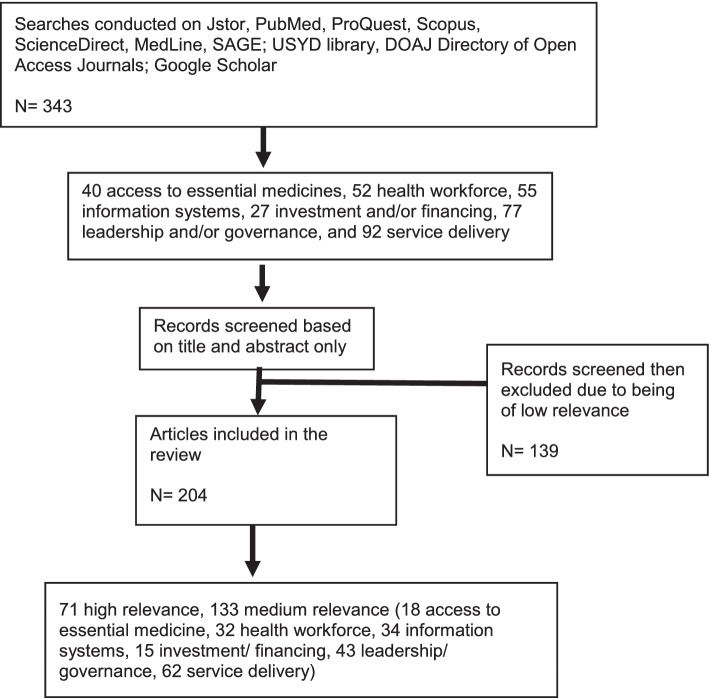
METHODS/ RESULTS: To further explore and analyse the conceptual and practical links between health systems and health security within the peer reviewed literature, a rapid scoping review was carried out to provide an overview of the type, extent and quantity of research available. Studies were included if they had been peer-reviewed and were published in English (seven databases 2000 to 2020). 343 articles were identified, of those 204 discussed health systems and health security (high and medium relevance), 101 discussed just health systems and 47 discussed only health security (low relevance). Within the high and medium relevance articles, several concepts emerged, including the prioritization of health security over health systems, the tendency to treat health security as exceptionalism focusing on acute health emergencies, and a conceptualisation of security as 'state security' not 'human security' or population health.
Examples of literature exploring links between health systems and health security are provided. We also present recommendations for further research, offering several investments and/or programmes that could reliably lead to maximal gains from both a health system and a health security perspective, and why these should be explored further. This paper could help researchers and funders when deciding upon the scope, nature and design of future research in this area. Additionally, the paper legitimises the necessity of the Health Systems for Health Security framework, with the findings of this paper providing useful insights and evidentiary examples for effective implementation of the framework.
健康系统与健康保障之间存在着实际联系,这在历史上是普遍存在的,但这两个领域之间的概念联系仍未得到充分探索,尤其是在加强健康系统方面。鉴于 COVID-19 大流行,解决这一差距的必要性变得更加重要,因为它表明了健康系统能力与有效健康保障应对之间的关键关系。认识到为卫生应急准备而在全球范围内发展更强大和更具弹性的卫生系统的重要性,世卫组织制定了卫生系统促进健康保障框架,旨在促进对卫生保障所需的卫生系统的共同理解,同时确定所需的关键能力。
方法/结果:为了进一步探索和分析同行评议文献中卫生系统与健康保障之间的概念和实际联系,进行了快速范围审查,以提供现有研究的类型、范围和数量概述。如果研究经过同行评审并以英文发表(2000 年至 2020 年的七个数据库),则将其纳入研究。确定了 343 篇文章,其中 204 篇讨论了卫生系统和健康保障(高和中相关性),101 篇仅讨论了卫生系统,47 篇仅讨论了健康保障(低相关性)。在高和中相关性文章中,出现了几个概念,包括将健康保障置于卫生系统之上的优先级、将健康保障视为关注急性卫生紧急情况的例外主义的倾向,以及将安全概念化为“国家安全”而不是“人类安全”或人口健康。
本文提供了一些探索卫生系统和健康保障之间联系的文献示例。我们还提出了进一步研究的建议,提供了几个投资和/或方案,这些投资和/或方案可以从卫生系统和健康保障的角度可靠地带来最大收益,以及为什么应该进一步探索这些投资和/或方案。本文可以帮助研究人员和资助者在决定该领域未来研究的范围、性质和设计时提供参考。此外,本文使卫生系统促进健康保障框架合法化,本文的研究结果为该框架的有效实施提供了有用的见解和证据实例。