Department of Nursing, Chosun University College of Medicine, Gwangju, Korea.
Korean Circ J. 2012 Jan;42(1):16-22. doi: 10.4070/kcj.2012.42.1.16. Epub 2012 Jan 31.
Identifying symptom clusters of acute myocardial infarction (AMI) and their clinical significance may be useful in guiding treatment seeking behaviors and in planning treatment strategy. The aim of this study was to identify clusters of acute symptoms and their associated factors that manifested in patients with first-time AMI, and to compare clinical outcomes among cluster groups within 1-year of follow-up.
A total of 391 AMI patients were interviewed individually using a structured questionnaire for acute and associated symptoms between March 2008 and June 2009 in Korea.
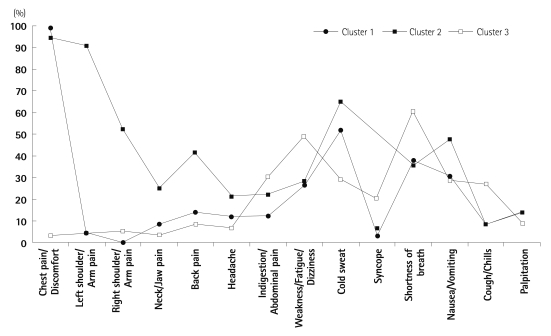
Among 14 acute symptoms, three distinct clusters were identified by Latent Class Cluster Analysis: typical chest symptom (57.0%), multiple symptom (27.9%), and atypical symptom (15.1%) clusters. The cluster with atypical symptoms was characterized by the least chest pain (3.4%) and moderate frequencies (31-61%) of gastrointestinal symptoms, weakness or fatigue, and shortness of breath; they were more likely to be older, diabetic and to have worse clinical markers at hospital presentation compared with those with other clusters. Cox proportional hazards regression analysis showed that, when age and gender were adjusted for, the atypical symptom cluster significantly predicted a higher risk of 1-year mortality compared to the typical chest pain cluster (hazard ratio 3.288, 95% confidence interval 1.087-9.943, p=0.035).
Clusters of symptoms can be utilized in guiding a rapid identification of symptom patterns and in detecting higher risk patients. Intensive treatment should be considered for older and diabetic patients with atypical presentation.
识别急性心肌梗死(AMI)的症状群及其临床意义可能有助于指导治疗寻求行为和制定治疗策略。本研究的目的是识别首次发生 AMI 患者的急性症状群及其相关因素,并比较随访 1 年内各症状群组的临床结局。
2008 年 3 月至 2009 年 6 月期间,在韩国,采用结构化问卷对 391 例 AMI 患者进行个体访谈,以调查急性症状及相关症状。
在 14 种急性症状中,通过潜在类别聚类分析确定了三个不同的症状群:典型胸痛症状群(57.0%)、多种症状群(27.9%)和非典型症状群(15.1%)。非典型症状群的特点是胸痛最少(3.4%),胃肠道症状、虚弱或疲劳、呼吸急促的发生频率中等(31-61%);与其他症状群相比,该症状群的患者年龄较大、患有糖尿病且入院时的临床标志物较差。Cox 比例风险回归分析表明,在校正年龄和性别后,非典型症状群与典型胸痛症状群相比,1 年死亡率的风险显著更高(危险比 3.288,95%置信区间 1.087-9.943,p=0.035)。
症状群可用于指导快速识别症状模式和检测高危患者。对于非典型表现的老年和糖尿病患者,应考虑强化治疗。