Department of Veterinary Medicine, University of Cambridge, Cambridge, United Kingdom.
PLoS One. 2012;7(2):e29655. doi: 10.1371/journal.pone.0029655. Epub 2012 Feb 17.
A case-control investigation was undertaken to determine management and health related factors associated with pleurisy in slaughter pigs in England and Wales.
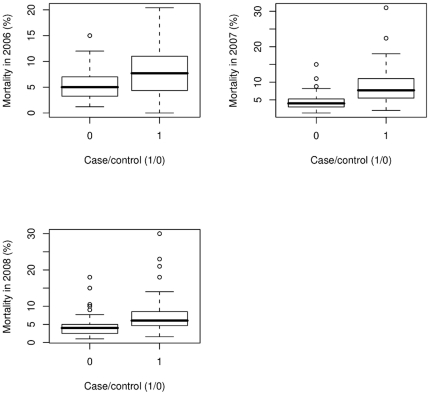
The British Pig Executive Pig Health Scheme database of abattoir pathology was used to identify 121 case (>10% prevalence of pleurisy on 3 or more assessment dates in the preceding 24 months) and 121 control units (≤5% prevalence of pleurisy on 3 or more assessment dates in the preceding 24 months). Farm data were collected by postal questionnaire. Data from respondents (70 cases and 51 controls) were analysed using simple logistic regression models with Bonferroni corrections. Limited multivariate analyses were also performed to check the robustness of the overall conclusions.
Management factors associated with increased odds of pleurisy included no all-in all-out pig flow (OR 9.3, 95% confidence interval [CI]: 3.3-29), rearing of pigs with an age difference of >1 month in the same airspace (OR 6.5 [2.8-17]) and repeated mixing (OR 2.2 [1.4-3.8]) or moving (OR 2.2 [1.5-3.4]) of pigs during the rearing phase. Those associated with decreased odds of pleurisy included filling wean-to-finish or grower-to-finish systems with piglets from ≤3 sources (OR 0.18 [0.07-0.41]) compared to farrow-to-finish systems, cleaning and disinfecting of grower (ORs 0.28 [0.13-0.61] and 0.29 [0.13-0.61]) and finisher (ORs 0.24 [0.11-0.51] and 0.2 [0.09-0.44]) accommodation between groups, and extended down time of grower and finisher accommodation (OR 0.84 [0.75-0.93] and 0.86 [0.77-0.94] respectively for each additional day of downtime). This study demonstrated the value of national-level abattoir pathology data collection systems for case control analyses and generated guidance for on-farm interventions to help reduce the prevalence of pleurisy in slaughter pigs.
本病例对照研究旨在确定与英国和威尔士屠宰猪胸膜炎相关的管理和健康因素。
利用英国养猪业执行猪健康计划屠宰场病理学数据库,确定 121 个病例(24 个月内 3 次或以上评估时胸膜炎患病率超过 10%)和 121 个对照单位(24 个月内 3 次或以上评估时胸膜炎患病率低于 5%)。通过邮寄问卷收集农场数据。对来自 70 个病例和 51 个对照的应答者数据进行简单逻辑回归模型分析,并进行 Bonferroni 校正。还进行了有限的多变量分析,以检查总体结论的稳健性。
与胸膜炎患病几率增加相关的管理因素包括无全进全出猪流(比值比 9.3,95%置信区间:3.3-29)、同一空间内年龄相差超过 1 个月的猪只混养(比值比 6.5 [2.8-17])和重复混合(比值比 2.2 [1.4-3.8])或育肥阶段猪只移动(比值比 2.2 [1.5-3.4])。与胸膜炎患病几率降低相关的管理因素包括与肥育至出栏或生长至出栏系统相比,采用来自≤3 个来源的仔猪填满后备至出栏或生长至出栏系统(比值比 0.18 [0.07-0.41])、生长和育肥舍(比值比 0.28 [0.13-0.61]和 0.29 [0.13-0.61])以及肥育和育肥舍(比值比 0.24 [0.11-0.51]和 0.2 [0.09-0.44])的清洗和消毒、生长和育肥舍的延长停机时间(每增加一天停机时间,比值比分别为 0.84 [0.75-0.93]和 0.86 [0.77-0.94])。本研究证明了国家屠宰场病理学数据收集系统在病例对照分析中的价值,并为农场干预提供了指导,以帮助降低屠宰猪胸膜炎的患病率。