Department of Neurology, Clinical Neurosciences Research Laboratory, Hospital Clínico Universitario, University of Santiago de Compostela, Santiago de Compostela, Spain.
PLoS One. 2012;7(2):e30700. doi: 10.1371/journal.pone.0030700. Epub 2012 Feb 17.
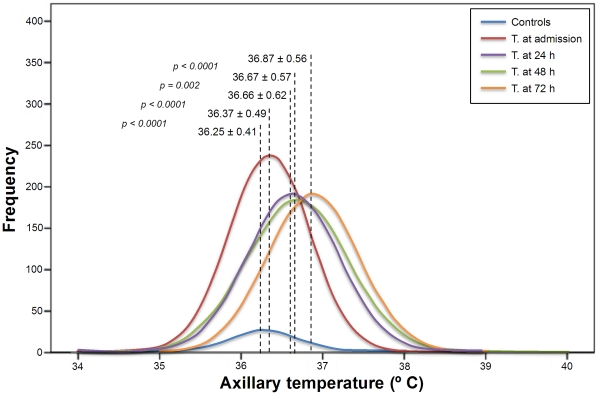
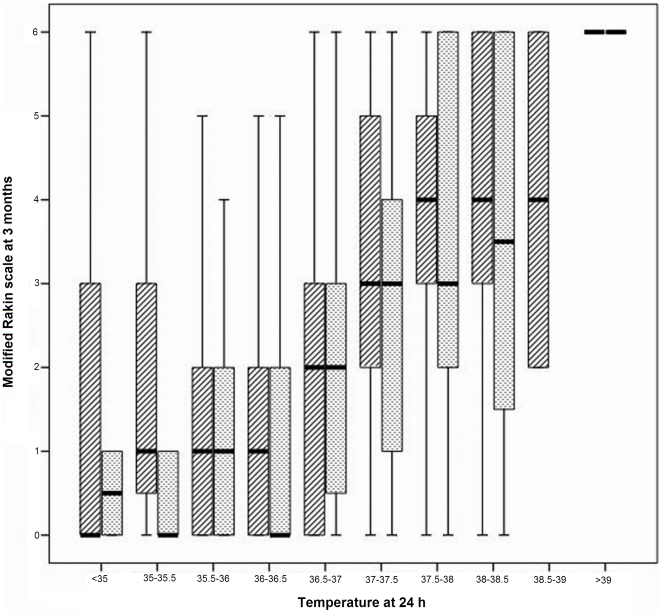
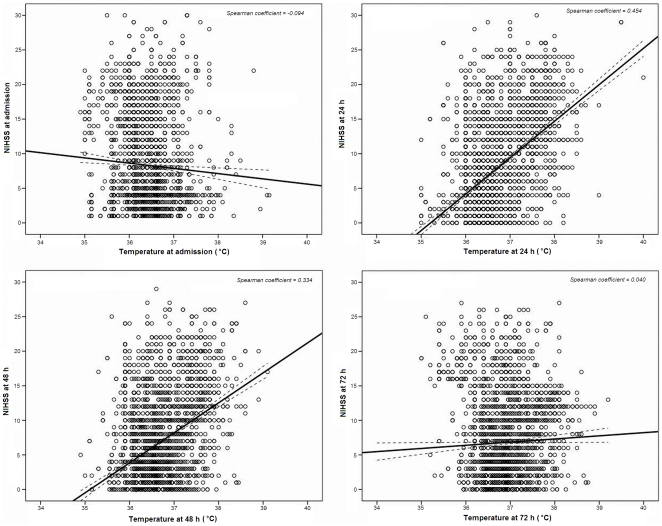
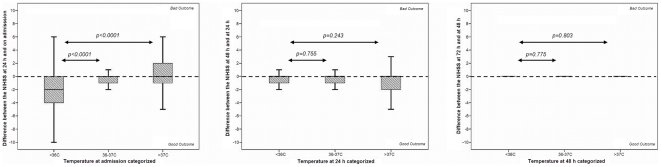
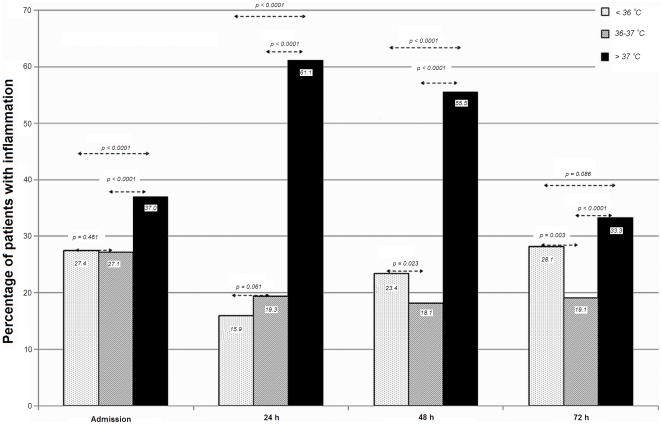
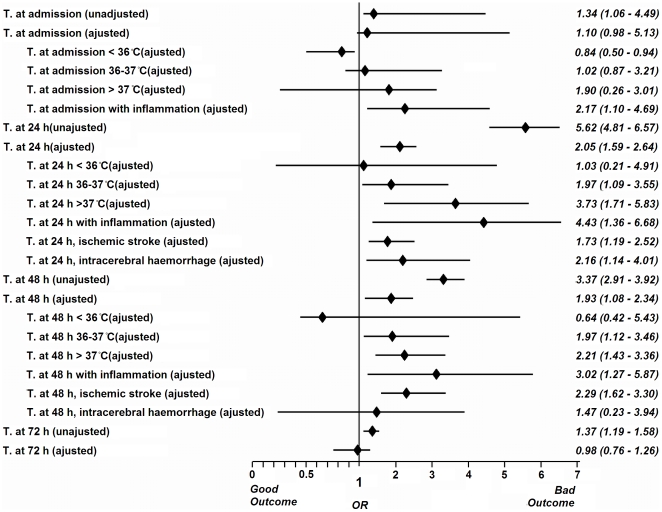
The control of temperature during the acute phase of stroke may be a new therapeutic target that can be applied in all stroke patients, however therapeutic window or timecourse of the temperature effect is not well established. Our aim is to study the association between changes in body temperature in the first 72 hours and outcome in patients with ischemic (IS) and hemorrhagic (ICH) stroke. We prospectively studied 2931 consecutive patients (2468 with IS and 463 with ICH). Temperature was obtained at admission, and at 24, 48 and 72 hours after admission. Temperature was categorized as low (<36°C), normal (36-37°C) and high (>37°C). As the main variable, we studied functional outcome at 3 months determined by modified Rankin Scale.Temperature in stroke patients is higher than in controls, and increases gradually in the first 72 hours after stroke. A positive correlation between temperature and stroke severity determined by NIHSS was found at 24 and 48 hours, but not at admission or 72 hours. In a logistic regression model, high temperature was associated with poor outcome at 24 hours (OR 2.05, 95% CI 1.59-2.64, p<0.0001) and 48 hours (OR 1.93, 95% CI 1.08-2.34, p = 0.007), but not at admission or 72 hours.Temperature increases in patients with stroke in the first 72 hours, with the harmful effect of high temperature occurring in the first 48 hours. The neuroprotective effect of low temperature occurs within the first 24 hours from stroke onset.
体温在脑卒中急性期的控制可能是一个新的治疗靶点,可以应用于所有脑卒中患者,但体温的治疗窗口或时间进程尚未得到很好的确定。我们的目的是研究发病后前 72 小时内体温变化与缺血性脑卒中(IS)和出血性脑卒中(ICH)患者结局的关系。我们前瞻性研究了 2931 例连续患者(2468 例 IS 和 463 例 ICH)。入院时、入院后 24、48 和 72 小时测量体温。体温分为低(<36°C)、正常(36-37°C)和高(>37°C)。作为主要变量,我们研究了通过改良 Rankin 量表评估的 3 个月时的功能结局。脑卒中患者的体温高于对照组,且在脑卒中后前 72 小时逐渐升高。入院时或 72 小时未发现体温与 NIHSS 确定的卒中严重程度之间存在正相关,但在入院后 24 和 48 小时存在正相关。在逻辑回归模型中,高温与入院后 24 小时(OR 2.05,95%CI 1.59-2.64,p<0.0001)和 48 小时(OR 1.93,95%CI 1.08-2.34,p=0.007)时的不良结局相关,但与入院时或 72 小时无关。脑卒中患者在发病后前 72 小时内体温升高,高温的有害作用发生在发病后 48 小时内。低温的神经保护作用发生在脑卒中发病后 24 小时内。