Institute for Molecular Plant Sciences, School of Biology, University of Edinburgh, Edinburgh, United Kingdom.
PLoS One. 2012;7(2):e30715. doi: 10.1371/journal.pone.0030715. Epub 2012 Feb 17.
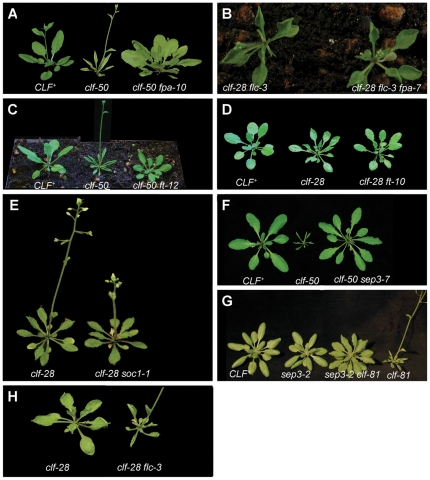
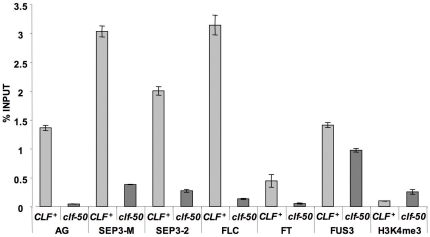
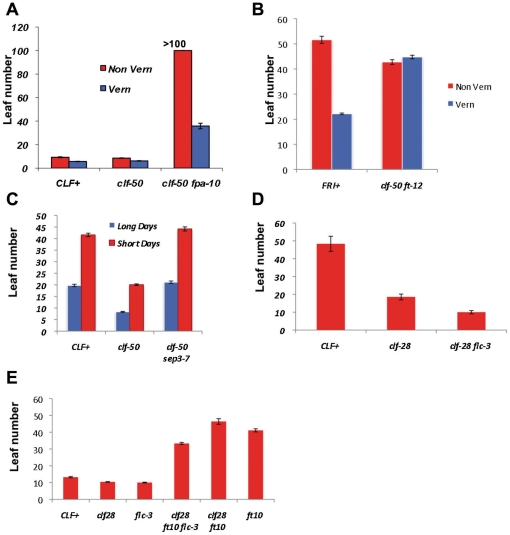
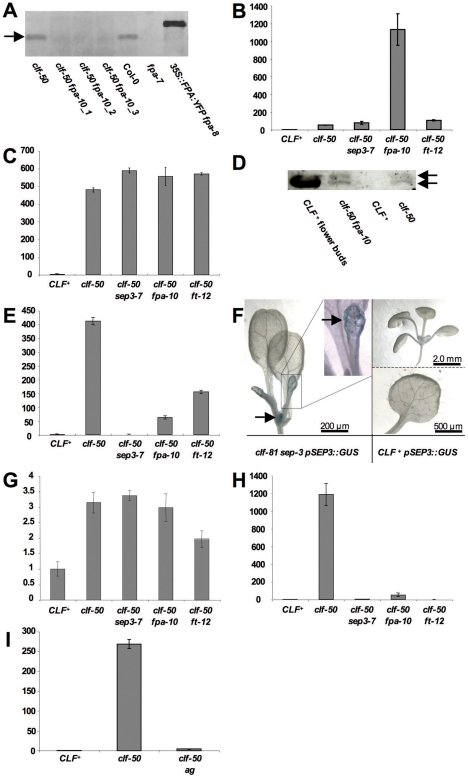
In Arabidopsis, mutations in the Pc-G gene CURLY LEAF (CLF) give early flowering plants with curled leaves. This phenotype is caused by mis-expression of the floral homeotic gene AGAMOUS (AG) in leaves, so that ag mutations largely suppress the clf phenotype. Here, we identify three mutations that suppress clf despite maintaining high AG expression. We show that the suppressors correspond to mutations in FPA and FT, two genes promoting flowering, and in SEPALLATA3 (SEP3) which encodes a co-factor for AG protein. The suppression of the clf phenotype is correlated with low SEP3 expression in all case and reveals that SEP3 has a role in promoting flowering in addition to its role in controlling floral organ identity. Genetic analysis of clf ft mutants indicates that CLF promotes flowering by reducing expression of FLC, a repressor of flowering. We conclude that SEP3 is the key target mediating the clf phenotype, and that the antagonistic effects of CLF target genes masks a role for CLF in promoting flowering.
在拟南芥中,Pc-G 基因卷曲叶(CLF)的突变导致早期开花植物的叶片卷曲。这种表型是由于在叶片中错误表达了花同源基因 AGAMOUS(AG),因此 ag 突变在很大程度上抑制了 clf 表型。在这里,我们鉴定了三个突变,尽管维持高 AG 表达,但仍能抑制 clf。我们表明,这些抑制剂对应于促进开花的两个基因 FPA 和 FT 以及 SEPALLATA3(SEP3)的突变,SEP3 编码 AG 蛋白的辅助因子。在所有情况下,clf 表型的抑制都与 SEP3 表达水平降低相关,这表明 SEP3 在控制花器官身份之外,还在促进开花中发挥作用。clf ft 突变体的遗传分析表明,CLF 通过降低开花抑制物 FLC 的表达来促进开花。我们得出结论,SEP3 是介导 clf 表型的关键靶点,而 CLF 靶基因的拮抗作用掩盖了 CLF 在促进开花中的作用。