Department of Nephrology, Xijing Hospital, Fourth Military Medical University, Xi'an, People's Republic China.
PLoS One. 2012;7(2):e30771. doi: 10.1371/journal.pone.0030771. Epub 2012 Feb 17.
Hypoxia-induced renal tubular cell epithelial-mesenchymal transition (EMT) is an important event leading to renal fibrosis. MicroRNAs (miRNAs) are small non-coding RNA molecules that bind to their mRNA targets, thereby leading to translational repression. The role of miRNA in hypoxia-induced EMT is largely unknown.
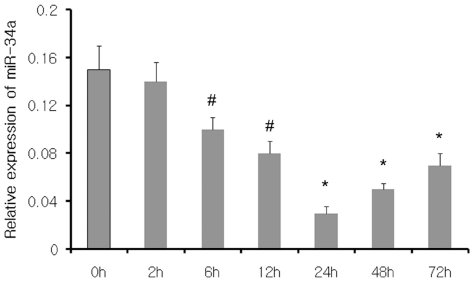
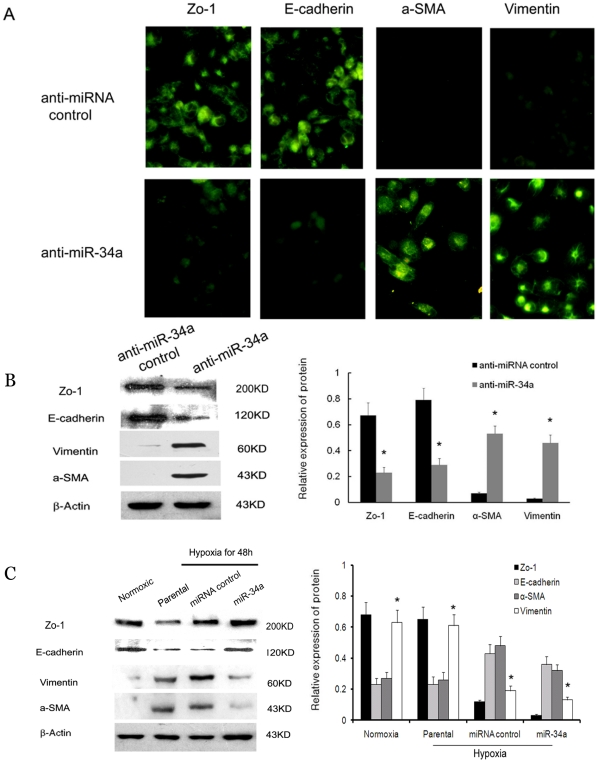
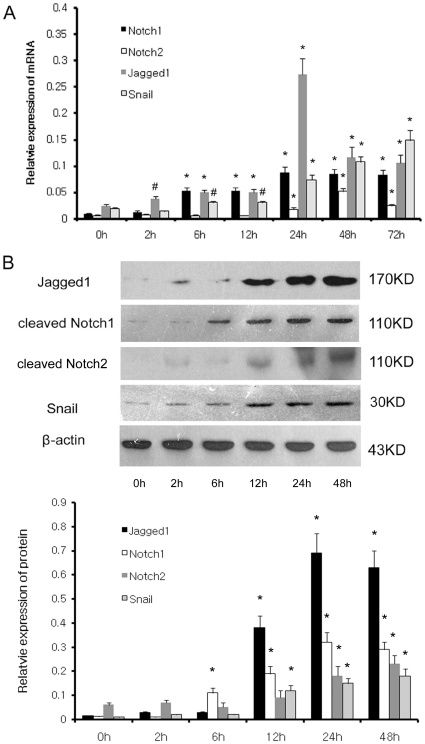
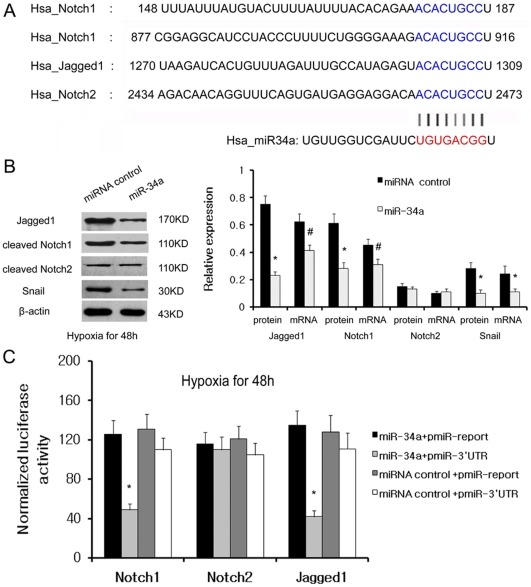
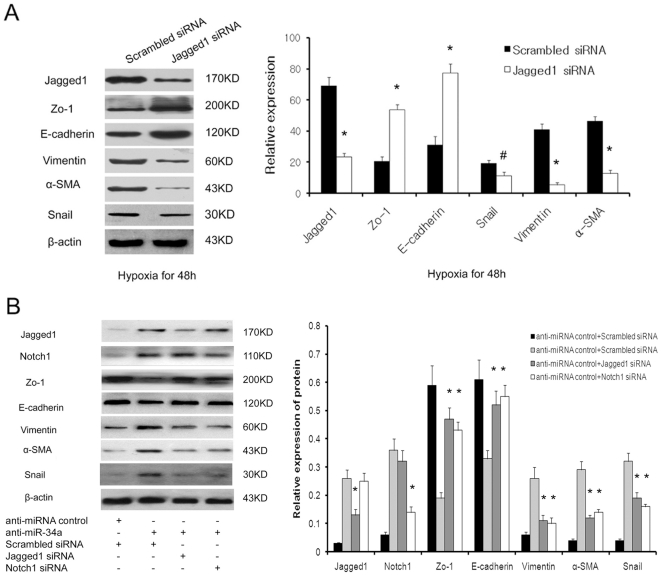
METHODOLOGY/PRINCIPAL FINDINGS: miRNA profiling was performed for the identification of differentially expressed miRNAs in HK-2 cells under normal and low oxygen, and the results were then verified by quantitative real time RT-PCR (qRT-PCR). The function of miRNAs in hypoxia-induced renal tubular cell EMT was assessed by the transfection of specific miRNA inhibitors and mimics. Luciferase reporter gene assays and western blot analysis were performed to validate the target genes of miR-34a. siRNA against Jagged1 was designed to investigate the role of the miR-34a-Notch pathway in hypoxia induced renal tubular cell EMT. miRNA-34a was identified as being downregulated in hypoxic renal tubular epithelial cells. Inhibition of miR-34a expression in HK-2 cells, which highly express endogenous miR-34a, promoted a mesenchymal phenotype accompanied by reduced expression of the epithelial marker Z0-1, E-cadherin and increased expression of the mesenchymal markers α-SMA and vimentin. Conversely, miR-34a mimics effectively prevented hypoxia-induced EMT. Transfection of miRNA-34a in HK-2 cells under hypoxia abolished hypoxia-induced expression of Notch1 and Jagged1 as well as Notch downstream signals, such as snail. Western blot analysis and luciferase reporter gene assays showed direct evidence for miR-34a targeting Notch1 and Jagged1. siRNAs against Jagged1 or Notch1 effectively prevented miR-34a inhibitor-induced tubular epithelial cell EMT.
CONCLUSIONS/SIGNIFICANCE: Our study provides evidence that the hypoxia-induced decrease of miR-34a expression could promote EMT in renal tubular epithelial cells by directly targeting Notch1 and Jagged1, and subsequently, Notch downstream signaling.
缺氧诱导的肾小管上皮-间充质转化(EMT)是导致肾纤维化的重要事件。微小 RNA(miRNA)是一种小的非编码 RNA 分子,可与它们的 mRNA 靶标结合,从而导致翻译抑制。miRNA 在缺氧诱导的 EMT 中的作用在很大程度上是未知的。
方法/主要发现:通过对正常和低氧条件下 HK-2 细胞中差异表达 miRNA 的 miRNA 谱分析,然后通过定量实时 RT-PCR(qRT-PCR)进行验证。通过转染特异性 miRNA 抑制剂和模拟物来评估 miRNA 在缺氧诱导的肾小管细胞 EMT 中的作用。进行荧光素酶报告基因检测和 Western blot 分析以验证 miR-34a 的靶基因。设计针对 Jagged1 的 siRNA 以研究 miR-34a-Notch 通路在缺氧诱导的肾小管细胞 EMT 中的作用。miR-34a 在缺氧肾小管上皮细胞中被鉴定为下调。在高表达内源性 miR-34a 的 HK-2 细胞中抑制 miR-34a 表达促进了间充质表型,伴随着上皮标记物 Z0-1、E-钙粘蛋白的表达减少和间充质标记物 α-SMA 和波形蛋白的表达增加。相反,miR-34a 模拟物有效阻止了缺氧诱导的 EMT。在缺氧条件下转染 miRNA-34a 的 HK-2 细胞消除了 Notch1 和 Jagged1 以及 Notch 下游信号(如 snail)的缺氧诱导表达。Western blot 分析和荧光素酶报告基因检测为 miR-34a 靶向 Notch1 和 Jagged1 提供了直接证据。针对 Jagged1 或 Notch1 的 siRNA 有效阻止了 miR-34a 抑制剂诱导的肾小管上皮细胞 EMT。
结论/意义:我们的研究提供了证据,表明缺氧诱导的 miR-34a 表达减少可通过直接靶向 Notch1 和 Jagged1 以及随后的 Notch 下游信号促进肾小管上皮细胞 EMT。