Division for Infectious Diseases, Department of Medicine, New Jersey Medical School-University of Medicine and Dentistry of New Jersey, Newark, New Jersey, United States of America.
PLoS One. 2012;7(2):e31126. doi: 10.1371/journal.pone.0031126. Epub 2012 Feb 17.
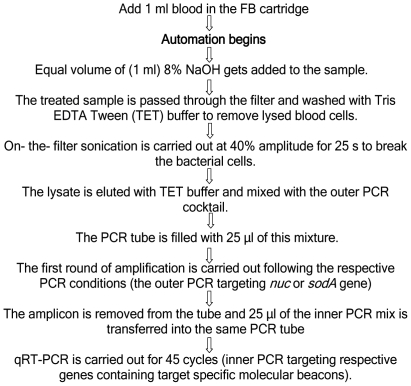
Rapid detection of bloodstream infections (BSIs) can be lifesaving. We investigated the sample processing and assay parameters necessary for highly-sensitive detection of bloodstream bacteria, using Staphylococcus aureus as a model pathogen and an automated fluidic sample processing-polymerase chain reaction (PCR) platform as a model diagnostic system.
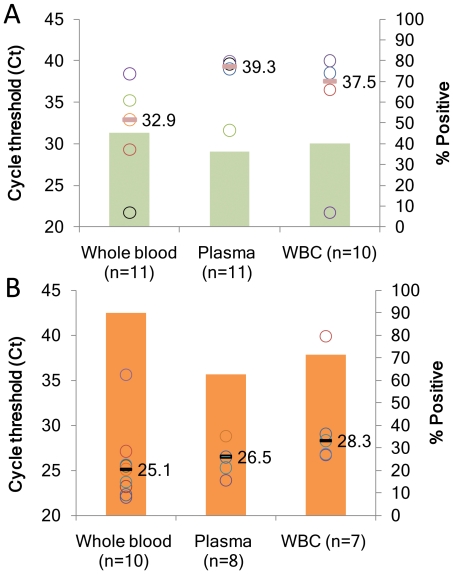
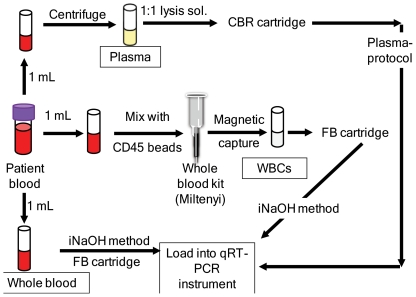
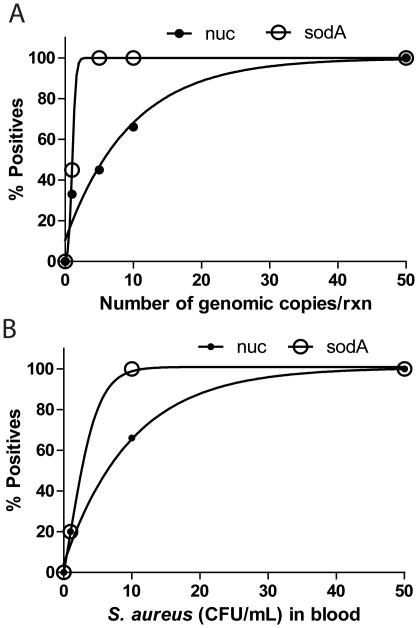
METHODOLOGY/PRINCIPAL FINDINGS: We compared a short 128 bp amplicon hemi-nested PCR and a relatively shorter 79 bp amplicon nested PCR targeting the S. aureus nuc and sodA genes, respectively. The sodA nested assay showed an enhanced limit of detection (LOD) of 5 genomic copies per reaction or 10 colony forming units (CFU) per ml blood over 50 copies per reaction or 50 CFU/ml for the nuc assay. To establish optimal extraction protocols, we investigated the relative abundance of the bacteria in different components of the blood (white blood cells (WBCs), plasma or whole blood), using the above assays. The blood samples were obtained from the patients who were culture positive for S. aureus. Whole blood resulted in maximum PCR positives with sodA assay (90% positive) as opposed to cell-associated bacteria (in WBCs) (71% samples positive) or free bacterial DNA in plasma (62.5% samples positive). Both the assays were further tested for direct detection of S. aureus in patient whole blood samples that were contemporaneous culture positive. S. aureus was detected in 40/45 of culture-positive patients (sensitivity 89%, 95% CI 0.75-0.96) and 0/59 negative controls with the sodA assay (specificity 100%, 95% CI 0.92-1).
We have demonstrated a highly sensitive two-hour assay for detection of sepsis causing bacteria like S. aureus directly in 1 ml of whole blood, without the need for blood culture.
快速检测血流感染(BSI)可以挽救生命。我们以金黄色葡萄球菌为模型病原体,以自动化流体样本处理-聚合酶链反应(PCR)平台为模型诊断系统,研究了用于高度敏感检测血流细菌的样本处理和分析参数。
方法/主要发现:我们比较了短的 128 bp 扩增子半巢式 PCR 和相对较短的 79 bp 扩增子巢式 PCR,分别针对金黄色葡萄球菌 nuc 和 sodA 基因。sodA 巢式检测的检测限(LOD)提高,反应中 5 个基因组拷贝或每毫升血液 10 个菌落形成单位(CFU),而 nuc 检测的反应中 50 个拷贝或 50 CFU/ml。为了建立最佳提取方案,我们使用上述检测方法,研究了血液中不同成分(白细胞(WBC)、血浆或全血)中细菌的相对丰度。这些血液样本来自金黄色葡萄球菌培养阳性的患者。sodA 检测全血的 PCR 阳性率最高(90%阳性),而细胞相关细菌(在 WBC 中)(71%样本阳性)或血浆中游离细菌 DNA(62.5%样本阳性)则较低。这两种检测方法都进一步用于检测同时培养阳性的患者全血样本中金黄色葡萄球菌的直接检测。sodA 检测在 45 例培养阳性患者中有 40 例(敏感性 89%,95%CI 0.75-0.96)和 59 例阴性对照中均未检出(特异性 100%,95%CI 0.92-1)。
我们已经证明了一种高度敏感的两小时检测方法,可直接从 1 毫升全血中检测导致败血症的细菌,如金黄色葡萄球菌,而无需血液培养。