Institute for Health and Wellbeing, University of Glasgow, Glasgow G12 8RZ, UK.
BMC Public Health. 2012 Feb 24;12:143. doi: 10.1186/1471-2458-12-143.
The prevalence of obesity is rising in Scotland and globally. Overall, obesity is associated with increased morbidity, mortality and reduced health-related quality of life. Studies suggest that "healthy obesity" (obesity without metabolic comorbidity) may not be associated with morbidity or mortality. Its impact on health-related quality of life is unknown.
We extracted data from the Scottish Health Survey on self-reported health-related quality of life, body mass index (BMI), demographic information and comorbidity. SF-12 responses were converted into an overall health utility score. Linear regression analyses were used to explore the association between BMI and health utility, stratified by the presence or absence of metabolic comorbidity (diabetes, hypertension, hypercholesterolemia or cardiovascular disease), and adjusted for potential confounders (age, sex and deprivation quintile).
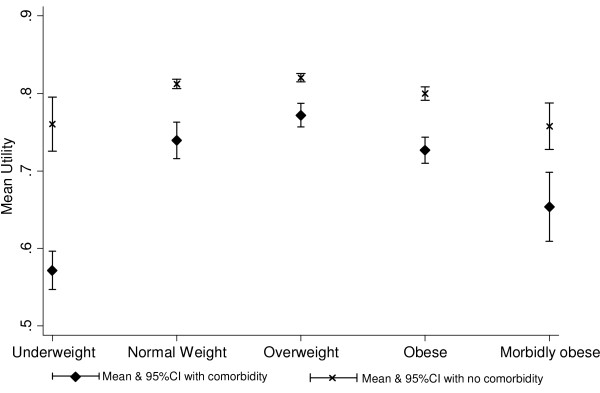
Of the 5,608 individuals, 3,744 (66.8%) were either overweight or obese and 921 (16.4%) had metabolic comorbidity. There was an inverted U-shaped relationship whereby health utility was highest among overweight individuals and fell with increasing BMI. There was a significant interaction with metabolic comorbidity (p = 0.007). Individuals with metabolic comorbidty had lower utility scores and a steeper decline in utility with increasing BMI (morbidly obese, adjusted coefficient: -0.064, 95% CI -0.115, -0.012, p = 0.015 for metabolic comorbidity versus -0.042, 95% CI -0.067, -0.018, p = 0.001 for no metabolic comorbidity).
The adverse impact of obesity on health-related quality of life is greater among individuals with metabolic comorbidity. However, increased BMI is associated with reduced health-related quality of life even in the absence of metabolic comorbidity, casting doubt on the notion of "healthy obesity".
苏格兰和全球的肥胖患病率正在上升。总的来说,肥胖与发病率、死亡率增加以及健康相关生活质量降低有关。研究表明,“健康肥胖”(没有代谢并发症的肥胖)可能与发病率或死亡率无关。它对健康相关生活质量的影响尚不清楚。
我们从苏格兰健康调查中提取了关于自我报告的健康相关生活质量、体重指数(BMI)、人口统计学信息和合并症的数据。SF-12 应答转换为总体健康效用评分。线性回归分析用于探索 BMI 与健康效用之间的关联,按是否存在代谢合并症(糖尿病、高血压、高胆固醇血症或心血管疾病)进行分层,并调整潜在混杂因素(年龄、性别和贫困五分位数)。
在 5608 人中,3744 人(66.8%)超重或肥胖,921 人(16.4%)有代谢合并症。存在一个倒 U 形关系,超重者的健康效用最高,随着 BMI 的增加而下降。与代谢合并症存在显著的交互作用(p = 0.007)。患有代谢合并症的个体的效用评分较低,并且随着 BMI 的增加,效用的下降更为陡峭(病态肥胖,调整系数:-0.064,95%CI-0.115,-0.012,p = 0.015 用于代谢合并症与-0.042,95%CI-0.067,-0.018,p = 0.001 用于无代谢合并症)。
肥胖对健康相关生活质量的不利影响在患有代谢合并症的个体中更大。然而,即使在没有代谢合并症的情况下,BMI 的增加也与健康相关生活质量的降低有关,这对“健康肥胖”的概念提出了质疑。