Human Cancer Genetics Program and Department of Molecular Virology, Immunology and Medical Genetics, The Ohio State University Comprehensive Cancer Center, Columbus, OH 43210, USA.
Genome Res. 2012 May;22(5):870-84. doi: 10.1101/gr.130740.111. Epub 2012 Feb 23.
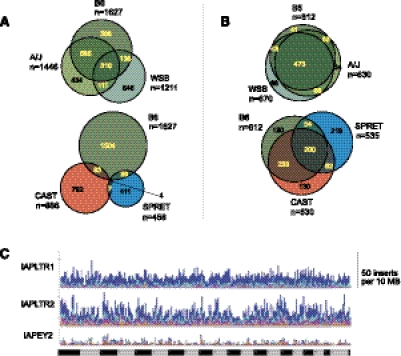
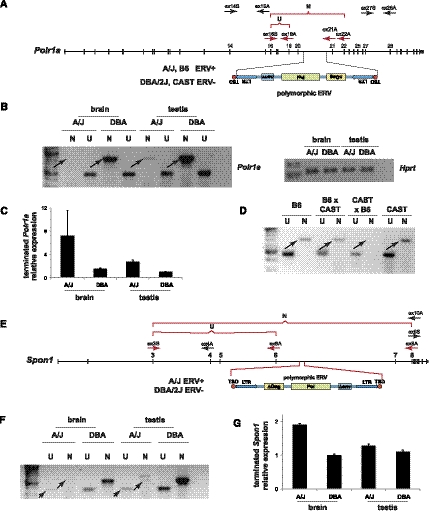
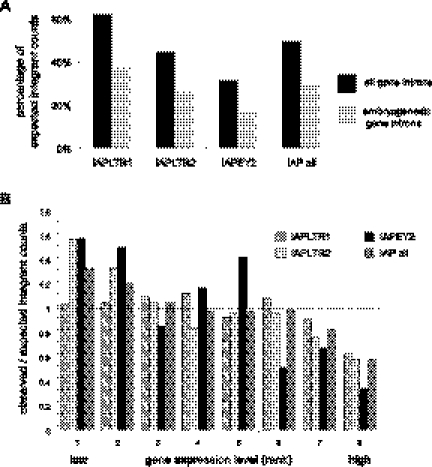
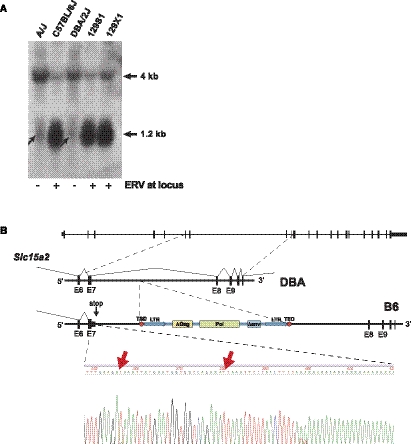
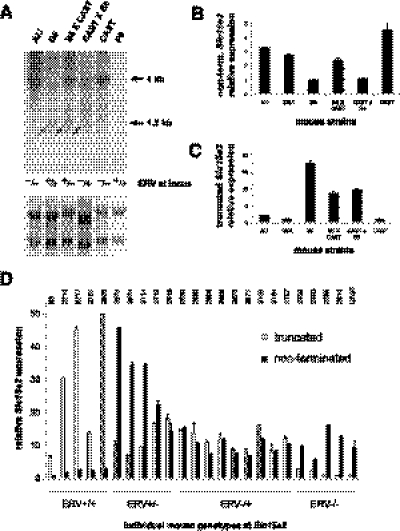
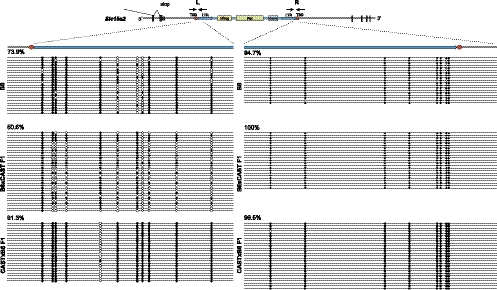
Endogenous retrotransposons have caused extensive genomic variation within mammalian species, but the functional implications of such mobilization are mostly unknown. We mapped thousands of endogenous retrovirus (ERV) germline integrants in highly divergent, previously unsequenced mouse lineages, facilitating a comparison of gene expression in the presence or absence of local insertions. Polymorphic ERVs occur relatively infrequently in gene introns and are particularly depleted from genes involved in embryogenesis or that are highly expressed in embryonic stem cells. Their genomic distribution implies ongoing negative selection due to deleterious effects on gene expression and function. A polymorphic, intronic ERV at Slc15a2 triggers up to 49-fold increases in premature transcriptional termination and up to 39-fold reductions in full-length transcripts in adult mouse tissues, thereby disrupting protein expression and functional activity. Prematurely truncated transcripts also occur at Polr1a, Spon1, and up to ∼5% of other genes when intronic ERV polymorphisms are present. Analysis of expression quantitative trait loci (eQTLs) in recombinant BxD mouse strains demonstrated very strong genetic associations between the polymorphic ERV in cis and disrupted transcript levels. Premature polyadenylation is triggered at genomic distances up to >12.5 kb upstream of the ERV, both in cis and between alleles. The parent of origin of the ERV is associated with variable expression of nonterminated transcripts and differential DNA methylation at its 5'-long terminal repeat. This study defines an unexpectedly strong functional impact of ERVs in disrupting gene transcription at a distance and demonstrates that ongoing retrotransposition can contribute significantly to natural phenotypic diversity.
内源性逆转录转座子在哺乳动物物种内引起了广泛的基因组变异,但这种移动的功能意义大多未知。我们在高度分化的、以前未测序的小鼠谱系中绘制了数千个内源性逆转录病毒(ERV)种系整合体,这使得我们可以比较在存在或不存在局部插入的情况下基因的表达情况。多态性 ERV 在基因内含子中相对较少发生,并且特别缺乏参与胚胎发生的基因或在胚胎干细胞中高度表达的基因。它们的基因组分布表明由于对基因表达和功能的有害影响,正在进行负选择。Slc15a2 中的一个多态性内含子 ERV 可引发高达 49 倍的转录提前终止和高达 39 倍的全长转录本减少,从而破坏蛋白质表达和功能活性。当内含子 ERV 多态性存在时,Polr1a、Spon1 和多达约 5%的其他基因也会出现过早截断的转录本。对重组 BxD 小鼠品系的表达数量性状基因座(eQTL)的分析表明,顺式和转录本水平中断的多态性 ERV 之间存在非常强的遗传关联。在顺式和等位基因之间,在 ERV 上游高达 12.5kb 的基因组距离上,都会触发过早的多聚腺苷酸化。ERV 的亲本来源与非终止转录本的可变表达和其 5'-长末端重复的差异 DNA 甲基化有关。本研究定义了 ERV 在远距离破坏基因转录方面的出人意料的强大功能影响,并表明正在进行的逆转座可以显著促进自然表型多样性。