Rajavashisth Tripathi B, Shaheen Magda, Norris Keith C, Pan Deyu, Sinha Satyesh K, Ortega Juan, Friedman Theodore C
Division of Endocrinology, Metabolism, and Molecular Medicine, Los Angeles, California, USA.
BMJ Open. 2012 Feb 24;2(1):e000494. doi: 10.1136/bmjopen-2011-000494. Print 2012.
To determine the association between diabetes mellitus (DM) and marijuana use.
Cross-sectional study.
Data from the National Health and Nutrition Examination Survey (NHANES III, 1988-1994) conducted by the National Center for Health Statistics of the Centers for Disease Control and Prevention.
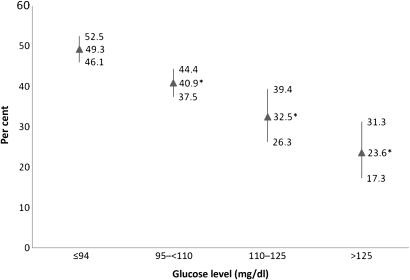
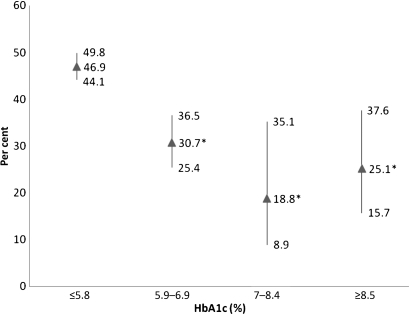
The study included participants of the NHANES III, a nationally representative sample of the US population. The total analytic sample was 10 896 adults. The study included four groups (n=10 896): non-marijuana users (61.0%), past marijuana users (30.7%), light (one to four times/month) (5.0%) and heavy (more than five times/month) current marijuana users (3.3%). DM was defined based on self-report or abnormal glycaemic parameters. We analysed data related to demographics, body mass index, smoking status, alcohol use, total serum cholesterol, high-density lipoprotein, triglyceride, serum 25-hydroxy vitamin D, plasma haemoglobin A1c, fasting plasma glucose level and the serum levels of C reactive protein and four additional inflammatory markers as related to marijuana use.
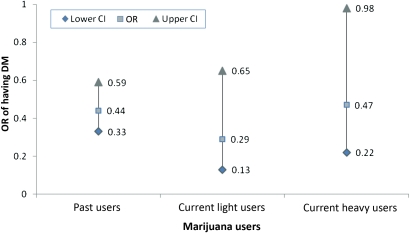
OR for DM associated with marijuana use adjusted for potential confounding variables (ie, odds of DM in marijuana users compared with non-marijuana users).
Marijuana users had a lower age-adjusted prevalence of DM compared to non-marijuana users (OR 0.42, 95% CI 0.33 to 0.55; p<0.0001). The prevalence of elevated C reactive protein (>0.5 mg/dl) was significantly higher (p<0.0001) among non-marijuana users (18.9%) than among past (12.7%) or current light (15.8%) or heavy (9.2%) users. In a robust multivariate model controlling for socio-demographic factors, laboratory values and comorbidity, the lower odds of DM among marijuana users was significant (adjusted OR 0.36, 95% CI 0.24 to 0.55; p<0.0001).
Marijuana use was independently associated with a lower prevalence of DM. Further studies are needed to show a direct effect of marijuana on DM.
确定糖尿病(DM)与大麻使用之间的关联。
横断面研究。
数据来自疾病控制与预防中心国家卫生统计中心开展的美国国家健康与营养检查调查(第三次全国健康和营养检查调查,1988 - 1994年)。
该研究纳入了第三次全国健康和营养检查调查的参与者,这是一个具有全国代表性的美国人群样本。总分析样本为10896名成年人。该研究包括四组(n = 10896):非大麻使用者(61.0%)、既往大麻使用者(30.7%)、轻度(每月1至4次)(5.0%)和重度(每月超过5次)当前大麻使用者(3.3%)。DM根据自我报告或血糖参数异常来定义。我们分析了与人口统计学、体重指数、吸烟状况、饮酒情况、总血清胆固醇、高密度脂蛋白、甘油三酯、血清25 - 羟基维生素D、血浆糖化血红蛋白A1c、空腹血糖水平以及与大麻使用相关的C反应蛋白和另外四种炎症标志物的血清水平有关的数据。
校正潜在混杂变量后与大麻使用相关的DM的比值比(即大麻使用者中DM的几率与非大麻使用者相比)。
与非大麻使用者相比,大麻使用者经年龄校正后的DM患病率较低(比值比0.42,95%置信区间0.33至0.55;p < 0.0001)。非大麻使用者中C反应蛋白升高(>0.5mg/dl)的患病率(18.9%)显著高于既往使用者(12.7%)、当前轻度使用者(15.8%)或重度使用者(9.2%)(p < 0.0001)。在一个控制了社会人口学因素、实验室值和合并症的稳健多变量模型中,大麻使用者中DM几率较低是显著的(校正后比值比0.36,95%置信区间0.24至0.55;p < 0.0001)。
大麻使用与较低的DM患病率独立相关。需要进一步研究来证明大麻对DM的直接影响。