School of Health and Population Sciences, University of Birmingham, Edgbaston, Birmingham B15 2TT, UK.
BMC Pregnancy Childbirth. 2012 Feb 29;12:11. doi: 10.1186/1471-2393-12-11.
Maternal, neonatal and child health outcomes are worse in families from black and ethnic minority groups and disadvantaged backgrounds. There is little evidence on whether lay support improves maternal and infant outcomes among women with complex social needs within a disadvantaged multi-ethnic population in the United Kingdom (UK).
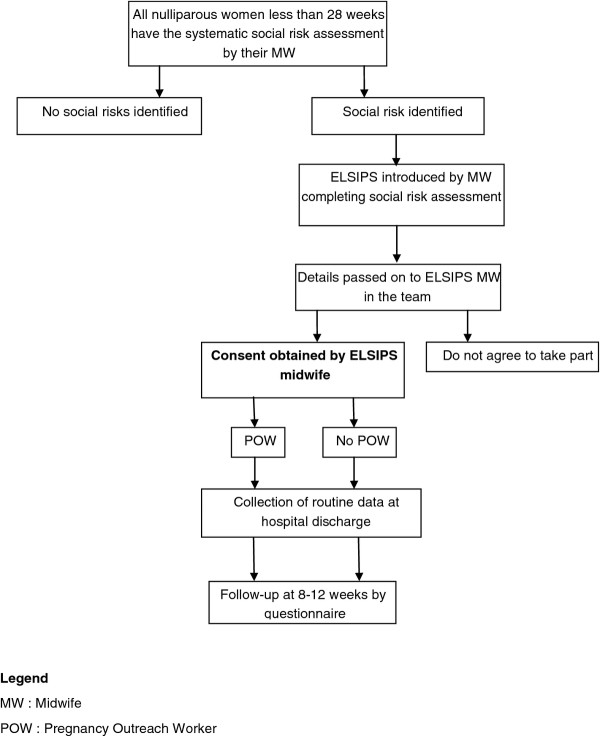
METHOD/DESIGN: The aim of this study is to evaluate a lay Pregnancy Outreach Worker (POW) service for nulliparous women identified as having social risk within a maternity service that is systematically assessing social risks alongside the usual obstetric and medical risks. The study design is a randomised controlled trial (RCT) in nulliparous women assessed as having social risk comparing standard maternity care with the addition of referral to the POW support service. The POWs work alongside community midwifery teams and offer individualised support to women to encourage engagement with services (health and social care) from randomisation (before 28 weeks gestation) until 6 weeks after birth. The primary outcomes have been chosen on the basis that they are linked to maternal and infant health. The two primary outcomes are engagement with antenatal care, assessed by the number of antenatal visits; and maternal depression, assessed using the Edinburgh Postnatal Depression Scale at 8-12 weeks after birth. Secondary outcomes include maternal and neonatal morbidity and mortality, routine child health assessments, including immunisation uptake and breastfeeding at 6 weeks. Other psychological outcomes (self efficacy) and mother-to-infant bonding will also be collected using validated tools.A sample size of 1316 will provide 90% power (at the 5% significance level) to detect increased engagement with antenatal services of 1.5 visits and a reduction of 1.5 in the average EPDS score for women with two or more social risk factors, with power in excess of this for women with any social risk factor. Analysis will be by intention to treat. Qualitative research will explore the POWs' daily work in context. This will complement the findings of the RCT through a triangulation of quantitative and qualitative data on the process of the intervention, and identify other contextual factors that affect the implementation of the intervention.
The trial will provide high quality evidence as to whether or not lay support (POW) offered to women identified with social risk factors improves engagement with maternity services and reduces numbers of women with depression. MREC NUMBER: 10/H1207/23
ISRCTN: ISRCTN35027323.
在来自黑人和少数族裔群体以及弱势群体的家庭中,母婴和儿童健康结果更差。在英国(英国)弱势多民族人群中,针对具有复杂社会需求的妇女,初级卫生保健人员的支持是否能改善母婴结局,这方面证据很少。
方法/设计:本研究旨在评估初级卫生保健人员对在产科服务中被确定为具有社会风险的初产妇的支持服务,该服务系统地评估社会风险,同时评估常规产科和医疗风险。该研究设计是一项随机对照试验(RCT),纳入被评估为具有社会风险的初产妇,比较标准产科护理与转介至初级卫生保健人员支持服务的效果。初级卫生保健人员与社区助产士团队合作,为妇女提供个性化支持,以鼓励她们从随机分组(孕 28 周前)到产后 6 周期间参与健康和社会保健服务。主要结局是基于与母婴健康相关的因素选择的。两个主要结局是通过产前检查次数评估的产前保健参与度;以及产后 8-12 周使用爱丁堡产后抑郁量表评估的产妇抑郁程度。次要结局包括产妇和新生儿发病率和死亡率、常规儿童健康评估,包括 6 周时的免疫接种率和母乳喂养情况。还将使用经过验证的工具收集其他心理结局(自我效能)和母婴联系。1316 例样本量将提供 90%的效力(在 5%的显著性水平),以检测出具有 2 个或更多社会风险因素的妇女产前服务参与度增加 1.5 次,以及平均 EPDS 评分降低 1.5 分,对于具有任何社会风险因素的妇女,效力超过此值。分析将采用意向治疗。定性研究将在背景下探讨初级卫生保健人员的日常工作。这将通过对干预过程的定量和定性数据进行三角测量,补充 RCT 的发现,并确定影响干预实施的其他背景因素。
该试验将提供高质量的证据,证明向被确定为具有社会风险因素的妇女提供初级卫生保健人员(初级卫生保健人员)支持是否能提高对产科服务的参与度并减少抑郁妇女的数量。MREC 编号:10/H1207/23
ISRCTN:ISRCTN35027323。