González-Domenech Carmen Maria, Belda Eugeni, Patiño-Navarrete Rafael, Moya Andrés, Peretó Juli, Latorre Amparo
BMC Microbiol. 2012 Jan 18;12 Suppl 1(Suppl 1):S5. doi: 10.1186/1471-2180-12-S1-S5.
Cockroaches are terrestrial insects that strikingly eliminate waste nitrogen as ammonia instead of uric acid. Blattabacterium cuenoti (Mercier 1906) strains Bge and Pam are the obligate primary endosymbionts of the cockroaches Blattella germanica and Periplaneta americana, respectively. The genomes of both bacterial endosymbionts have recently been sequenced, making possible a genome-scale constraint-based reconstruction of their metabolic networks. The mathematical expression of a metabolic network and the subsequent quantitative studies of phenotypic features by Flux Balance Analysis (FBA) represent an efficient functional approach to these uncultivable bacteria.
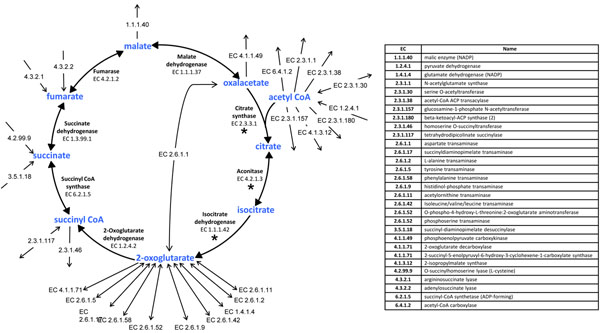
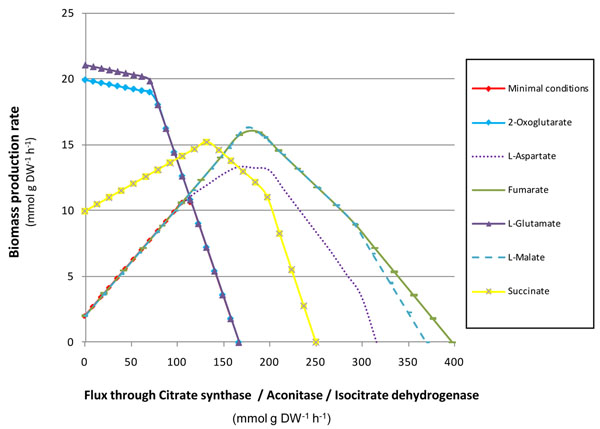
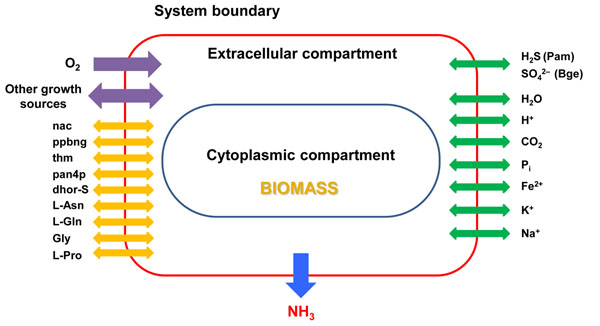
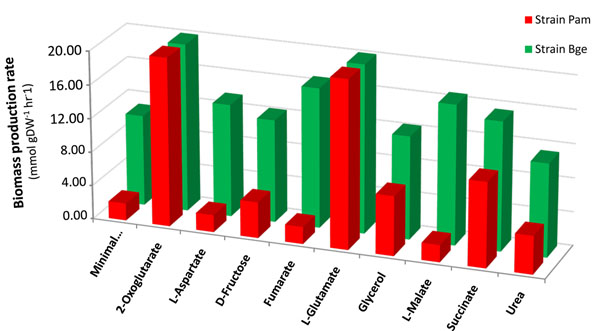
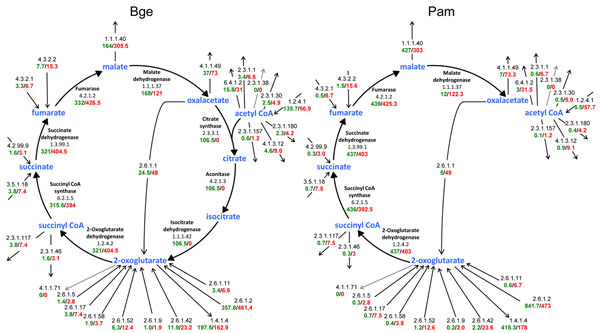
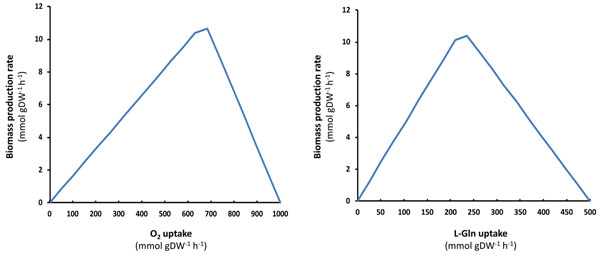
We report the metabolic models of Blattabacterium strains Bge (iCG238) and Pam (iCG230), comprising 296 and 289 biochemical reactions, associated with 238 and 230 genes, and 364 and 358 metabolites, respectively. Both models reflect both the striking similarities and the singularities of these microorganisms. FBA was used to analyze the properties, potential and limits of the models, assuming some environmental constraints such as aerobic conditions and the net production of ammonia from these bacterial systems, as has been experimentally observed. In addition, in silico simulations with the iCG238 model have enabled a set of carbon and nitrogen sources to be defined, which would also support a viable phenotype in terms of biomass production in the strain Pam, which lacks the first three steps of the tricarboxylic acid cycle. FBA reveals a metabolic condition that renders these enzymatic steps dispensable, thus offering a possible evolutionary explanation for their elimination. We also confirm, by computational simulations, the fragility of the metabolic networks and their host dependence.
The minimized Blattabacterium metabolic networks are surprisingly similar in strains Bge and Pam, after 140 million years of evolution of these endosymbionts in separate cockroach lineages. FBA performed on the reconstructed networks from the two bacteria helps to refine the functional analysis of the genomes enabling us to postulate how slightly different host metabolic contexts drove their parallel evolution.
蟑螂是陆生昆虫,它们以氨而非尿酸的形式显著地排出废氮。克氏拟杆菌(Mercier,1906)菌株Bge和Pam分别是德国小蠊和美洲大蠊的专性初级内共生菌。最近对这两种细菌内共生体的基因组进行了测序,使得基于基因组规模约束的代谢网络重建成为可能。代谢网络的数学表达式以及随后通过通量平衡分析(FBA)对表型特征进行的定量研究,代表了一种针对这些不可培养细菌的有效功能研究方法。
我们报告了克氏拟杆菌菌株Bge(iCG238)和Pam(iCG230)的代谢模型,分别包含296和289个生化反应,与238和230个基因以及364和358种代谢物相关联。这两个模型既反映了这些微生物的显著相似性,也反映了它们的独特性。FBA被用于分析模型的特性、潜力和局限性,假设了一些环境约束条件,如好氧条件以及这些细菌系统中氨的净产生,这已通过实验观察到。此外,使用iCG238模型进行的计算机模拟能够定义一组碳源和氮源,这些碳源和氮源在缺乏三羧酸循环前三步的Pam菌株中,就生物量生产而言也能支持一种可行的表型。FBA揭示了一种代谢状况,使得这些酶促步骤变得可有可无,从而为它们的缺失提供了一种可能的进化解释。我们还通过计算机模拟证实了代谢网络的脆弱性及其对宿主的依赖性。
在这两种内共生菌于不同蟑螂谱系中经过1.4亿年的进化后,克氏拟杆菌的最小化代谢网络在菌株Bge和Pam中惊人地相似。对这两种细菌重建网络进行的FBA有助于完善基因组的功能分析,使我们能够推测略有不同的宿主代谢背景是如何推动它们平行进化的。