The UC Berkeley & UCSF Graduate Program in Bioengineering, University of California, Berkeley, CA 94720, USA.
Nucleic Acids Res. 2012 Jul;40(12):5775-86. doi: 10.1093/nar/gks168. Epub 2012 Mar 1.
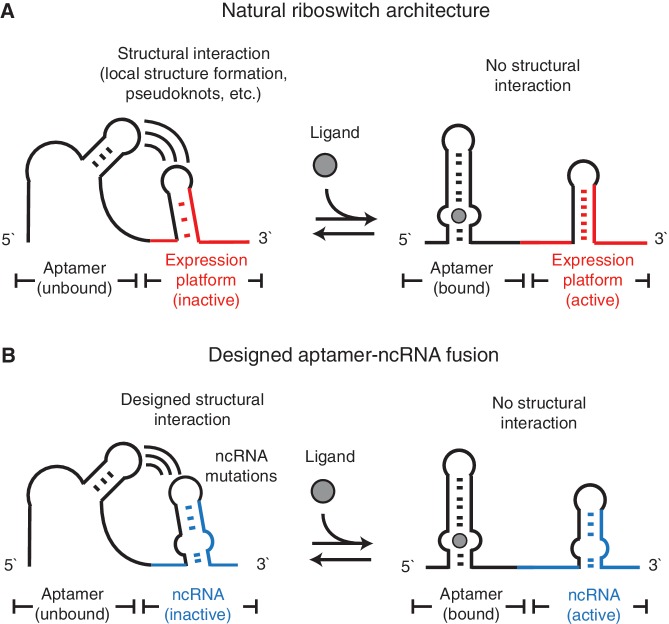
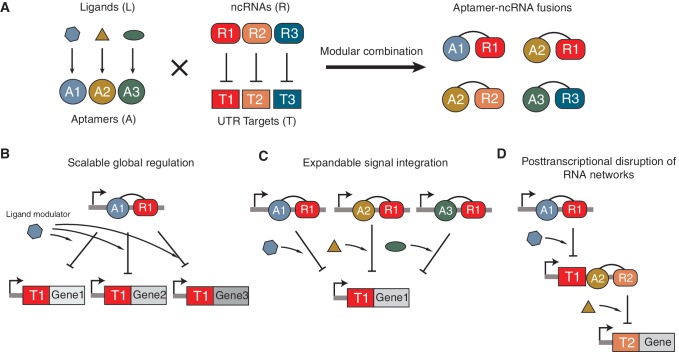
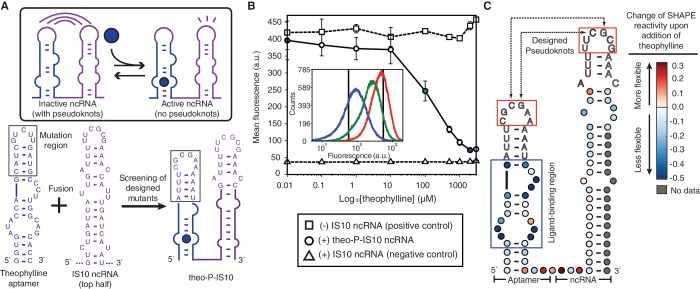
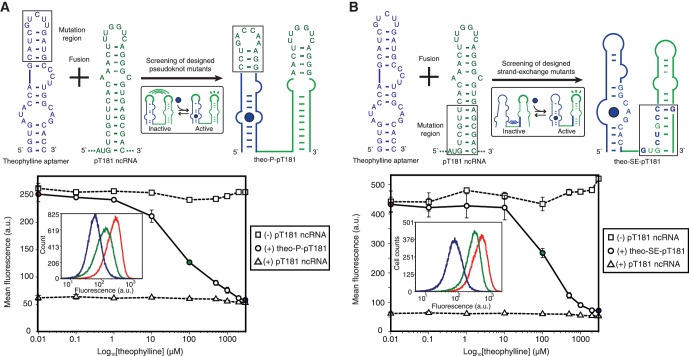
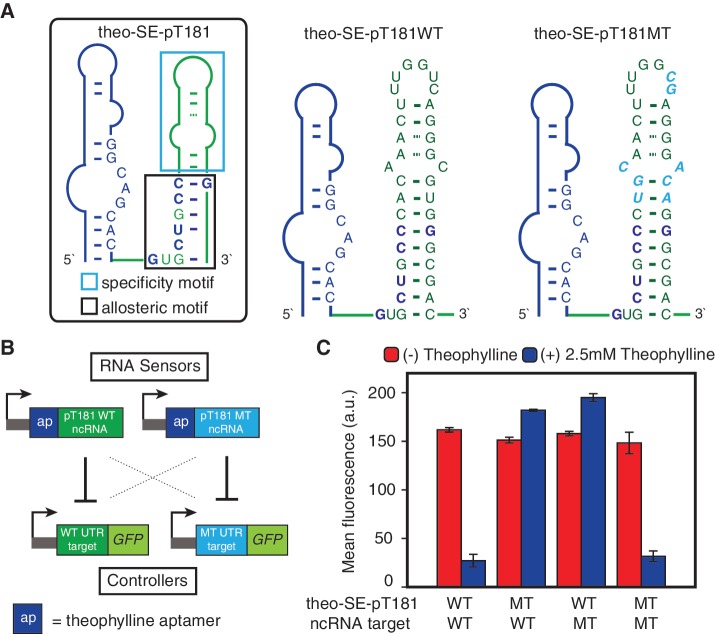
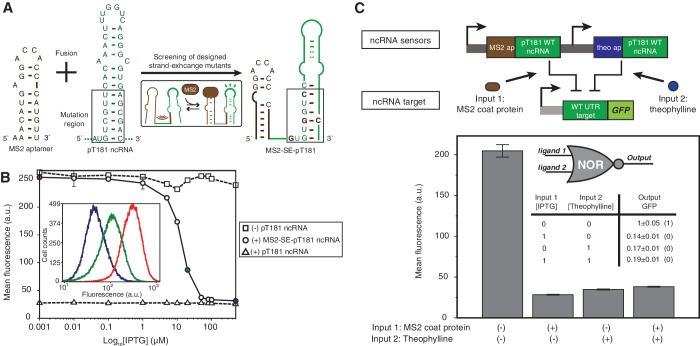
Non-coding RNAs (ncRNAs) are versatile regulators in cellular networks. While most trans-acting ncRNAs possess well-defined mechanisms that can regulate transcription or translation, they generally lack the ability to directly sense cellular signals. In this work, we describe a set of design principles for fusing ncRNAs to RNA aptamers to engineer allosteric RNA fusion molecules that modulate the activity of ncRNAs in a ligand-inducible way in Escherichia coli. We apply these principles to ncRNA regulators that can regulate translation (IS10 ncRNA) and transcription (pT181 ncRNA), and demonstrate that our design strategy exhibits high modularity between the aptamer ligand-sensing motif and the ncRNA target-recognition motif, which allows us to reconfigure these two motifs to engineer orthogonally acting fusion molecules that respond to different ligands and regulate different targets in the same cell. Finally, we show that the same ncRNA fused with different sensing domains results in a sensory-level NOR gate that integrates multiple input signals to perform genetic logic. These ligand-sensing ncRNA regulators provide useful tools to modulate the activity of structurally related families of ncRNAs, and building upon the growing body of RNA synthetic biology, our ability to design aptamer-ncRNA fusion molecules offers new ways to engineer ligand-sensing regulatory circuits.
非编码 RNA(ncRNAs)是细胞网络中多功能的调控因子。虽然大多数反式作用 ncRNAs 具有明确的机制,可以调控转录或翻译,但它们通常缺乏直接感知细胞信号的能力。在这项工作中,我们描述了一组将 ncRNAs 与 RNA 适体融合的设计原则,用于构建变构 RNA 融合分子,以配体诱导的方式调节大肠杆菌中 ncRNAs 的活性。我们将这些原则应用于可以调节翻译(IS10 ncRNA)和转录(pT181 ncRNA)的 ncRNA 调节剂,并证明我们的设计策略在适体配体感应模体和 ncRNA 靶标识别模体之间具有高度的模块性,这使我们能够重新配置这两个模体,以工程具有正交作用的融合分子,它们可以响应不同的配体并在同一细胞中调节不同的靶标。最后,我们表明,相同的 ncRNA 与不同的感应结构域融合会导致一个感觉级 NOR 门,该门整合多个输入信号以执行遗传逻辑。这些配体感应 ncRNA 调节剂为调节结构相关家族的 ncRNAs 的活性提供了有用的工具,并且基于日益增长的 RNA 合成生物学,我们设计适体-ncRNA 融合分子的能力为工程配体感应调控回路提供了新的途径。