Animal Genomics Laboratory, UCD School of Agriculture and Food Science, University College Dublin, Belfield, Dublin, Ireland.
PLoS One. 2012;7(2):e32034. doi: 10.1371/journal.pone.0032034. Epub 2012 Feb 22.
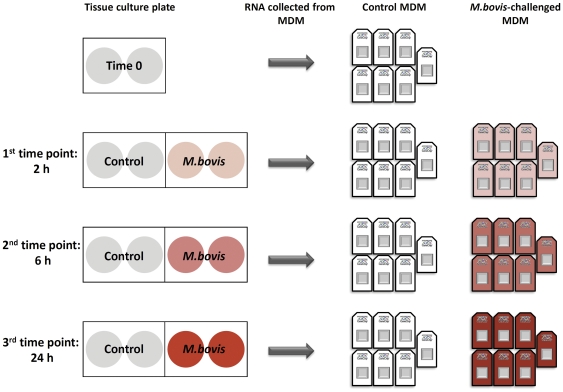
Mycobacterium bovis, the causative agent of bovine tuberculosis, is a major cause of mortality in global cattle populations. Macrophages are among the first cell types to encounter M. bovis following exposure and the response elicited by these cells is pivotal in determining the outcome of infection. Here, a functional genomics approach was undertaken to investigate global gene expression profiles in bovine monocyte-derived macrophages (MDM) purified from seven age-matched non-related females, in response to in vitro challenge with M. bovis (multiplicity of infection 2:1). Total cellular RNA was extracted from non-challenged control and M. bovis-challenged MDM for all animals at intervals of 2 hours, 6 hours and 24 hours post-challenge and prepared for global gene expression analysis using the Affymetrix® GeneChip® Bovine Genome Array.
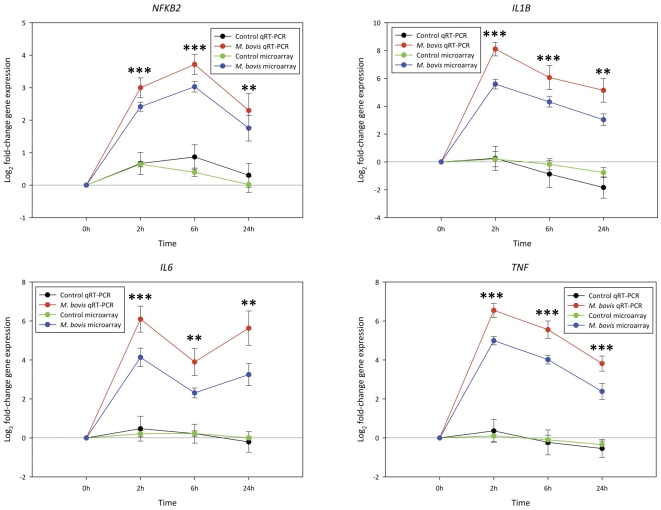
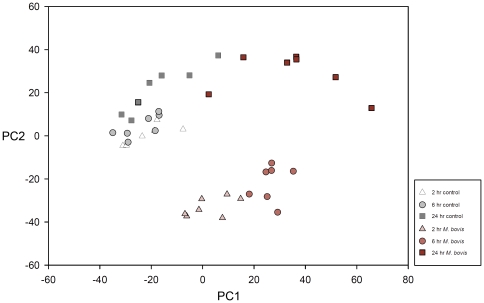
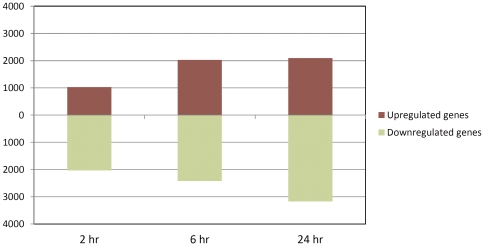
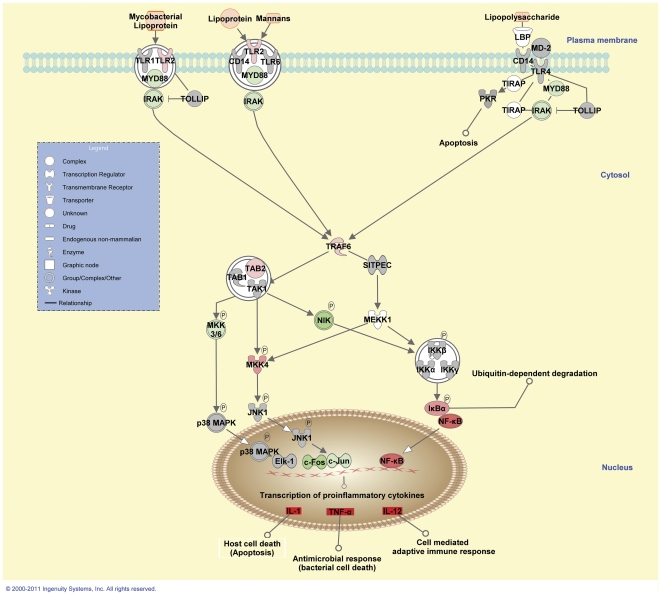
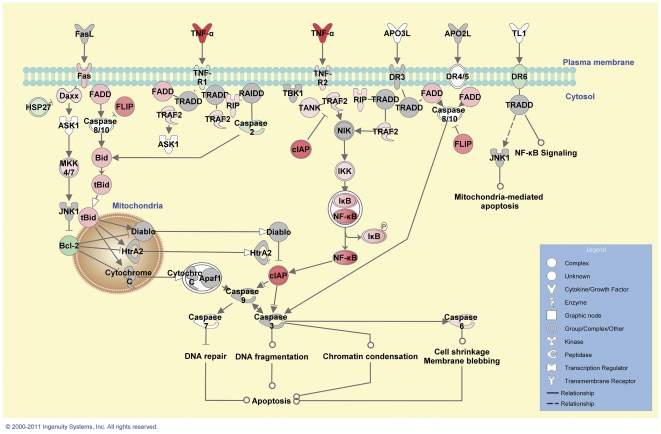
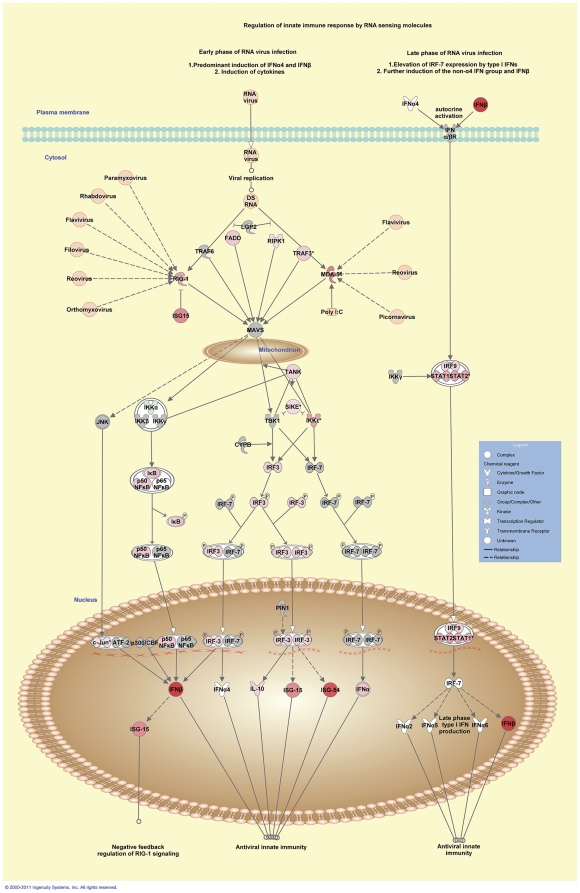
Comparison of M. bovis-challenged MDM gene expression profiles with those from the non-challenged MDM controls at each time point identified 3,064 differentially expressed genes 2 hours post-challenge, with 4,451 and 5,267 differentially expressed genes detected at the 6 hour and 24 hour time points, respectively (adjusted P-value threshold ≤ 0.05). Notably, the number of downregulated genes exceeded the number of upregulated genes in the M. bovis-challenged MDM across all time points; however, the fold-change in expression for the upregulated genes was markedly higher than that for the downregulated genes. Systems analysis revealed enrichment for genes involved in: (1) the inflammatory response; (2) cell signalling pathways, including Toll-like receptors and intracellular pathogen recognition receptors; and (3) apoptosis.
The increased number of downregulated genes is consistent with previous studies showing that M. bovis infection is associated with the repression of host gene expression. The results also support roles for MyD88-independent signalling and intracellular PRRs in mediating the host response to M. bovis.
牛分枝杆菌是牛结核病的病原体,是全球牛群死亡的主要原因。巨噬细胞是接触牛分枝杆菌后最早遇到的细胞类型之一,这些细胞的反应对于确定感染的结果至关重要。在这里,我们采用功能基因组学方法研究了从 7 只年龄匹配的非相关雌性牛中分离出的单核细胞衍生的巨噬细胞(MDM)在体外受到牛分枝杆菌(感染复数 2:1)挑战后的全基因表达谱。从所有动物的非挑战对照和牛分枝杆菌挑战 MDM 中提取总细胞 RNA,在挑战后 2 小时、6 小时和 24 小时的时间点进行,使用 Affymetrix®GeneChip®Bovine Genome Array 进行全基因表达分析。
将牛分枝杆菌挑战的 MDM 基因表达谱与每个时间点的非挑战 MDM 对照进行比较,发现 2 小时后有 3064 个差异表达基因,6 小时和 24 小时分别检测到 4451 个和 5267 个差异表达基因(调整后的 P 值阈值≤0.05)。值得注意的是,在所有时间点,牛分枝杆菌挑战的 MDM 中下调基因的数量超过上调基因的数量;然而,上调基因的表达变化倍数明显高于下调基因。系统分析显示,参与以下途径的基因富集:(1)炎症反应;(2)细胞信号通路,包括 Toll 样受体和细胞内病原体识别受体;和(3)细胞凋亡。
上调基因数量的增加与先前研究一致,表明牛分枝杆菌感染与宿主基因表达的抑制有关。研究结果还支持 MyD88 非依赖性信号和细胞内 PRR 在介导宿主对牛分枝杆菌的反应中的作用。