Department of Molecular Biosciences, University of Kansas, Lawrence, Kansas 66045.
G3 (Bethesda). 2011 Oct;1(5):343-51. doi: 10.1534/g3.111.000661. Epub 2011 Oct 1.
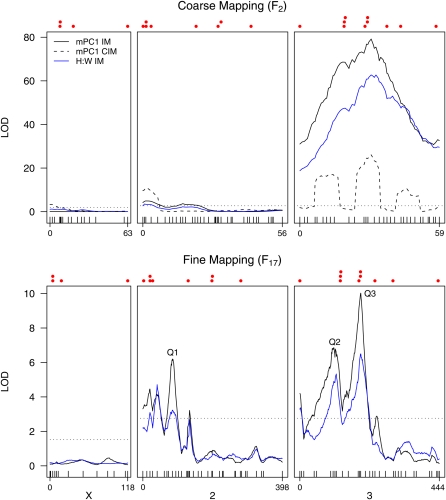
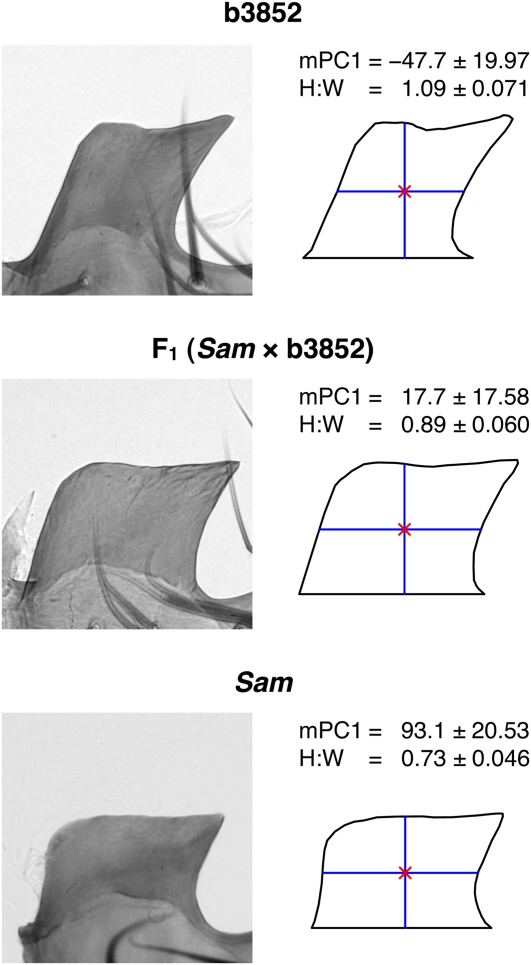
The observation that male genitalia diverge more rapidly than other morphological traits during evolution is taxonomically widespread and likely due to some form of sexual selection. One way to elucidate the evolutionary forces acting on these traits is to detail the genetic architecture of variation both within and between species, a program of research that is considerably more tractable in a model system. Drosophila melanogaster and its sibling species, D. simulans, D. mauritiana, and D. sechellia, are morphologically distinguishable only by the shape of the posterior lobe, a male-specific elaboration of the genital arch. We extend earlier studies identifying quantitative trait loci (QTL) responsible for lobe divergence across species and report the first genetic dissection of lobe shape variation within a species. Using an advanced intercross mapping design, we identify three autosomal QTL contributing to the difference in lobe shape between a pair of D. melanogaster inbred lines. The QTL each contribute 4.6-10.7% to shape variation, and two show a significant epistatic interaction. Interestingly, these intraspecific QTL map to the same locations as interspecific lobe QTL, implying some shared genetic control of the trait within and between species. As a first step toward a mechanistic understanding of natural lobe shape variation, we find an association between our QTL data and a set of genes that show sex-biased expression in the developing genital imaginal disc (the precursor of the adult genitalia). These genes are good candidates to harbor naturally segregating polymorphisms contributing to posterior lobe shape.
在进化过程中,雄性生殖器的变异速度比其他形态特征更快,这一观察结果在分类学上广泛存在,可能是由于某种形式的性选择。阐明作用于这些特征的进化力量的一种方法是详细描述物种内和物种间变异的遗传结构,这一研究计划在模型系统中更容易进行。黑腹果蝇及其姊妹种,D. simulans、D. mauritiana 和 D. sechellia,仅在后叶的形状上有所区别,后叶是生殖器弓的雄性特化结构。我们扩展了先前确定负责物种间叶分化的数量性状基因座 (QTL) 的研究,并报告了首次对物种内叶形状变异进行遗传剖析的研究。使用先进的互交作图设计,我们确定了三个常染色体 QTL 对一对黑腹果蝇近交系之间叶形状差异的贡献。每个 QTL 对形状变异的贡献为 4.6-10.7%,其中两个表现出显著的上位性相互作用。有趣的是,这些种内 QTL 与种间叶 QTL 映射到相同的位置,这表明该性状在种内和种间存在一些共同的遗传控制。作为对自然叶形状变异的机制理解的第一步,我们发现我们的 QTL 数据与一组在发育中的生殖器原基盘中表现出性别偏性表达的基因之间存在关联(成年生殖器的前体)。这些基因是携带自然分离的多态性的良好候选基因,这些多态性可能导致后叶形状的差异。