University of Graz, Department of Clinical Psychology, Austria.
Biol Psychol. 2012 Apr;90(1):97-104. doi: 10.1016/j.biopsycho.2012.02.008. Epub 2012 Mar 1.
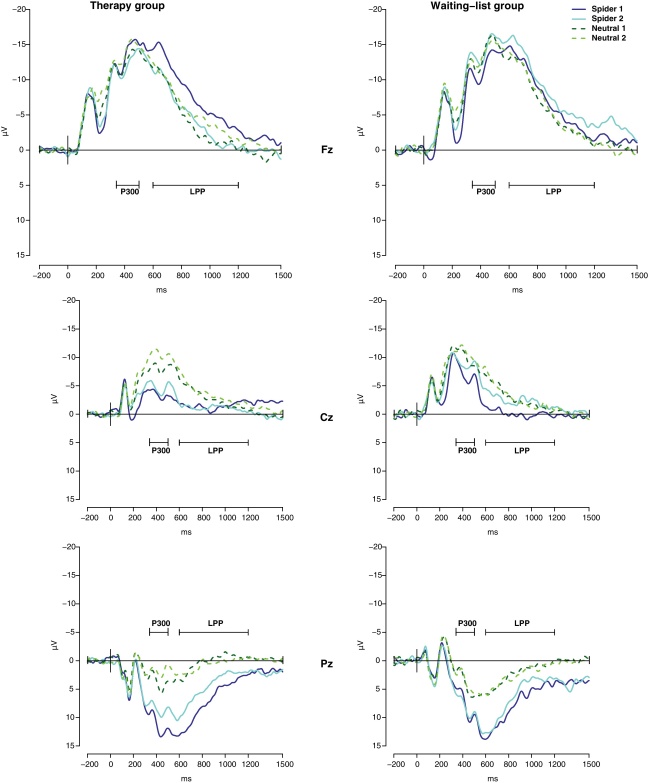
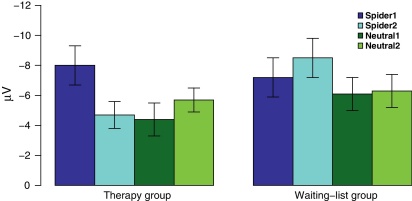
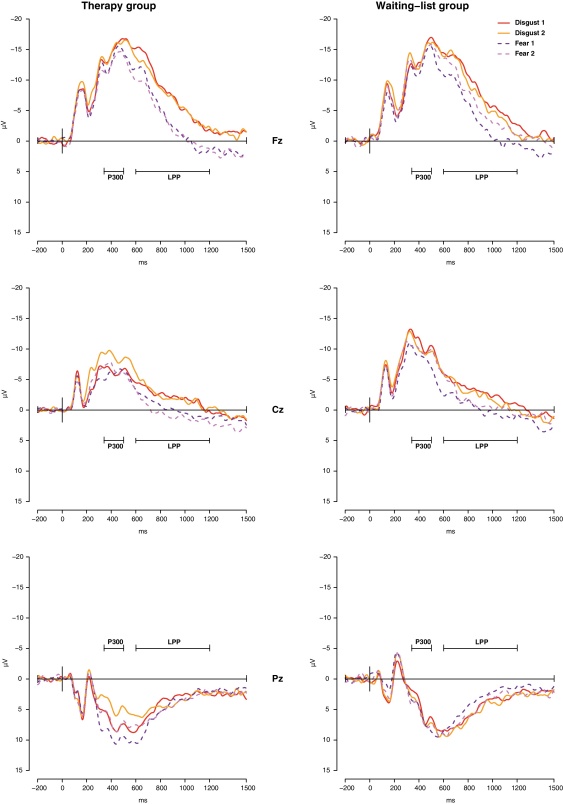
Neurobiological studies have demonstrated that psychotherapy is able to alter brain function in adults, however little exists on this topic with respect to children. This waiting-list controlled investigation focused on therapy-related changes of the P300 and the late positive potential (LPP) in 8- to 13-year-old spider phobic girls. Thirty-two patients were presented with phobia-relevant, generally disgust-inducing, fear-inducing, and affectively neutral pictures while an electroencephalogram was recorded. Participants received one session of up to 4h of cognitive-behavioral exposure therapy. Treated children showed enhanced amplitudes of the LPP at frontal sites in response to spider pictures. This result is interpreted to reflect an improvement in controlled attentional engagement and is in line with already existing data for adult females. Moreover, the girls showed a therapy-specific reduction in overall disgust proneness, as well as in experienced arousal and disgust when viewing disgust pictures. Thus, exposure therapy seems to have broad effects in children.
神经生物学研究表明,心理治疗能够改变成年人的大脑功能,但关于儿童的这方面的研究却很少。这项等待名单对照研究关注的是 8 至 13 岁蜘蛛恐惧症女孩的 P300 和晚期正性电位(LPP)与治疗相关的变化。当记录脑电图时,向 32 名患者展示了与恐惧症相关的、通常会引起厌恶感、引起恐惧感和情感中性的图片。参与者接受了一次长达 4 小时的认知行为暴露治疗。接受治疗的儿童在对蜘蛛图片的反应中,额叶部位的 LPP 振幅增强。这一结果被解释为注意力控制能力的提高,与已经存在的成年女性数据一致。此外,女孩们在观看厌恶图片时,整体厌恶倾向、体验到的唤醒和厌恶程度都出现了特定于治疗的降低。因此,暴露疗法似乎对儿童有广泛的影响。