Department of Biochemistry and Molecular Biology, Mayo Clinic, Rochester, Minnesota 55905, USA.
J Cell Biochem. 2012 Jul;113(7):2201-7. doi: 10.1002/jcb.24116.
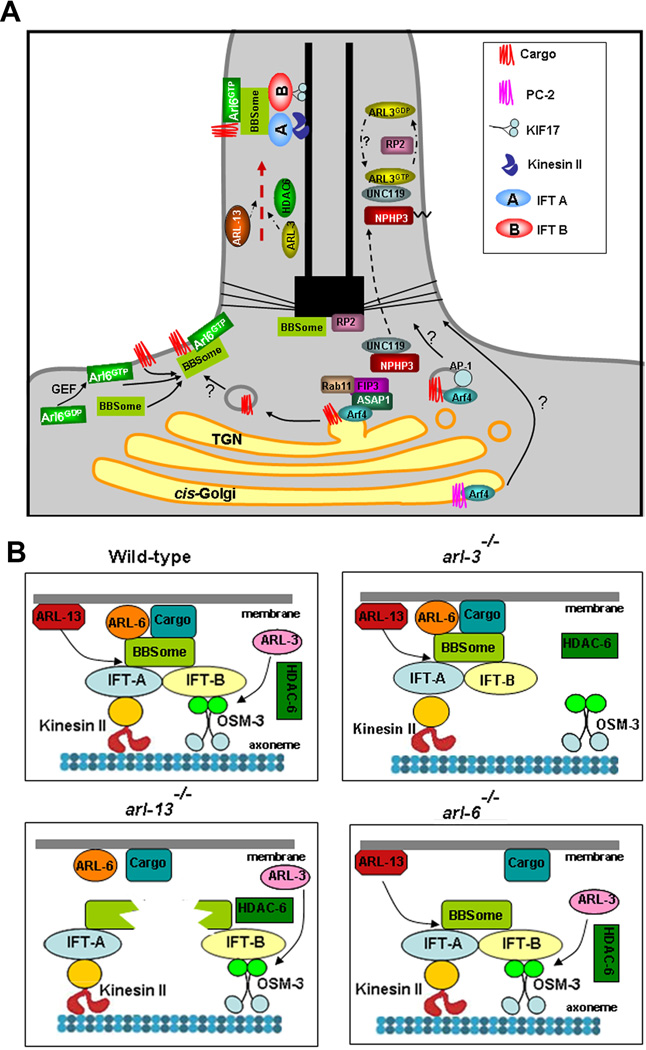
Once overlooked as an evolutionary vestige, the primary cilium has recently been the focus of intensive studies. Mounting data show that this organelle is a hub for various signaling pathways during vertebrate embryonic development and pattern formation. However, how cilia form and how cilia execute the sensory function still remain poorly understood. Cilia dysfunction is correlated with a wide spectrum of human diseases, now termed ciliopathies. Various small GTPases, including the members in Arf/Arl, Rab, and Ran subfamilies, have been implicated in cilia formation and/or function. Here we review and discuss the role of one particular group of small GTPase, Arf/Arl, in the context of cilia and ciliopathy.
曾经被忽视为进化遗迹的纤毛,最近成为了密集研究的焦点。越来越多的证据表明,在脊椎动物胚胎发育和形态发生过程中,该细胞器是各种信号通路的中心。然而,纤毛如何形成以及纤毛如何执行感觉功能仍然知之甚少。纤毛病与广泛的人类疾病相关,现在称为纤毛病。包括 Arf/Arl、Rab 和 Ran 亚家族成员在内的各种小 GTPase 已被牵连到纤毛的形成和/或功能中。在这里,我们将回顾和讨论一小组特定的小 GTPase——Arf/Arl 在纤毛和纤毛病中的作用。