Department of Biomedical Engineering, Cornell University, Ithaca, New York, United States of America.
PLoS One. 2012;7(2):e32572. doi: 10.1371/journal.pone.0032572. Epub 2012 Feb 28.
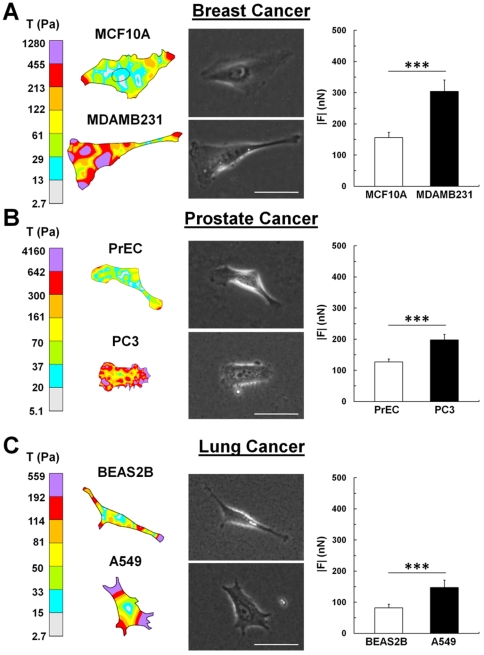
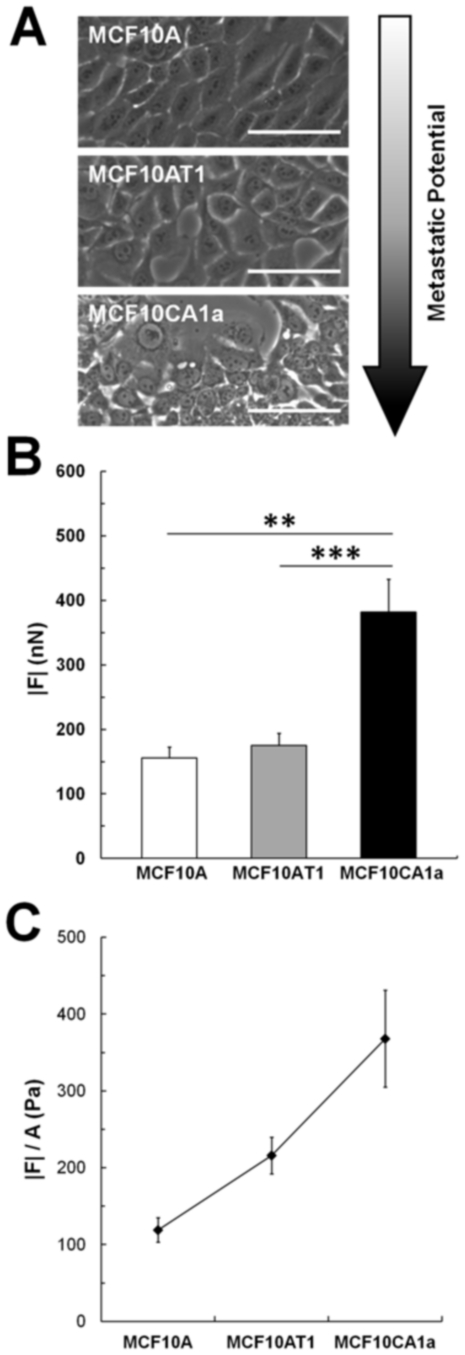
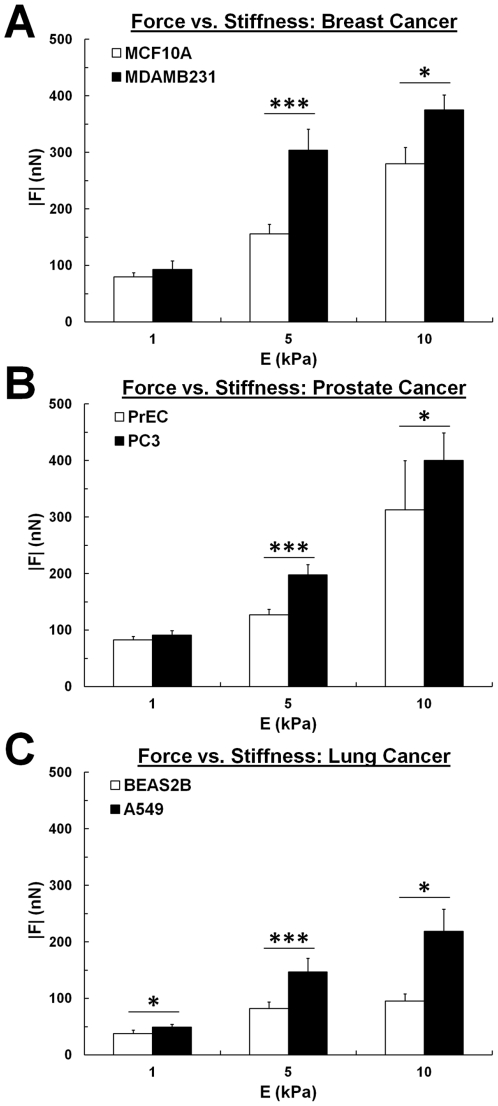
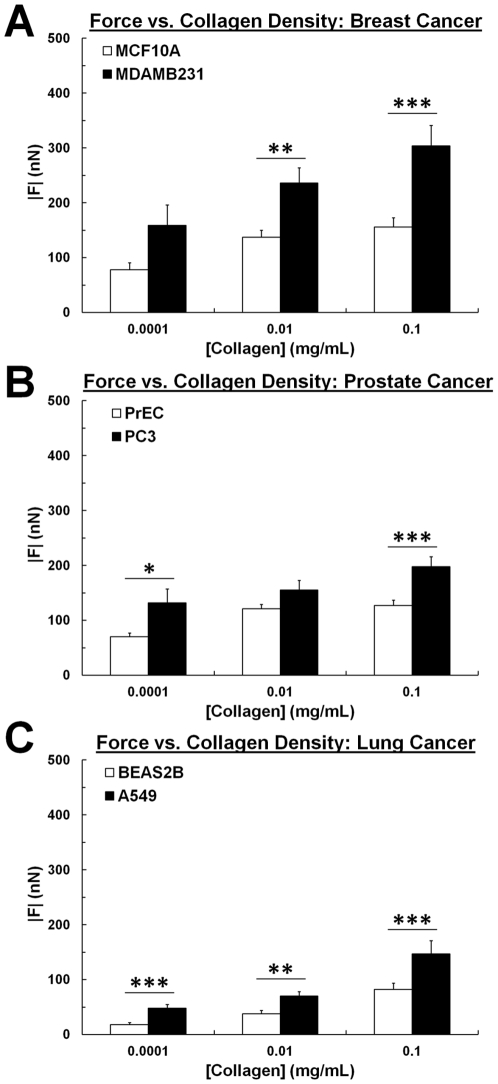
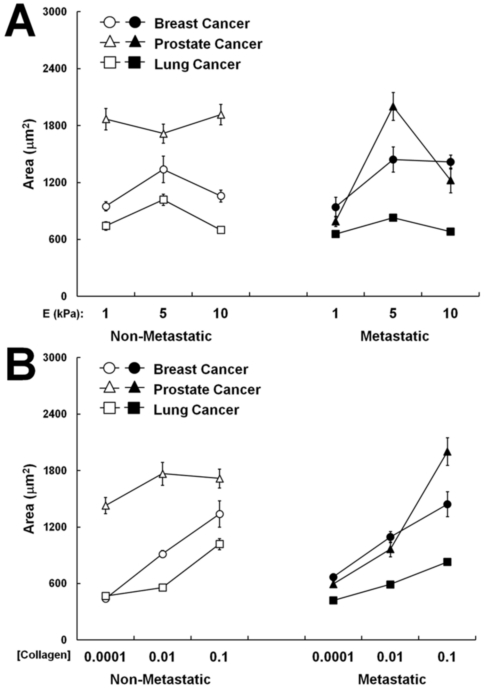
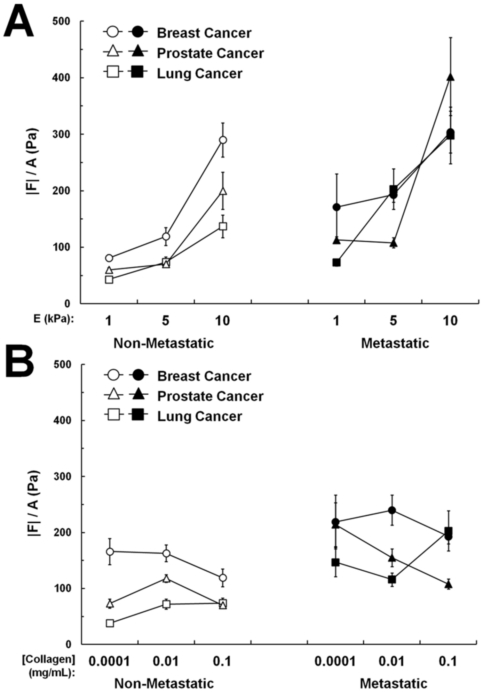
Cancer cells exist in a mechanically and chemically heterogeneous microenvironment which undergoes dynamic changes throughout neoplastic progression. During metastasis, cells from a primary tumor acquire characteristics that enable them to escape from the primary tumor and migrate through the heterogeneous stromal environment to establish secondary tumors. Despite being linked to poor prognosis, there are no direct clinical tests available to diagnose the likelihood of metastasis. Moreover, the physical mechanisms employed by metastatic cancer cells to migrate are poorly understood. Because metastasis of most solid tumors requires cells to exert force to reorganize and navigate through dense stroma, we investigated differences in cellular force generation between metastatic and non-metastatic cells. Using traction force microscopy, we found that in human metastatic breast, prostate and lung cancer cell lines, traction stresses were significantly increased compared to non-metastatic counterparts. This trend was recapitulated in the isogenic MCF10AT series of breast cancer cells. Our data also indicate that increased matrix stiffness and collagen density promote increased traction forces, and that metastatic cells generate higher forces than non-metastatic cells across all matrix properties studied. Additionally, we found that cell spreading for these cell lines has a direct relationship with collagen density, but a biphasic relationship with substrate stiffness, indicating that cell area alone does not dictate the magnitude of traction stress generation. Together, these data suggest that cellular contractile force may play an important role in metastasis, and that the physical properties of the stromal environment may regulate cellular force generation. These findings are critical for understanding the physical mechanisms of metastasis and the role of the extracellular microenvironment in metastatic progression.
癌细胞存在于一个机械和化学异质的微环境中,这个微环境在肿瘤进展过程中会发生动态变化。在转移过程中,来自原发性肿瘤的细胞获得了使它们能够从原发性肿瘤逃逸并通过异质基质环境迁移以建立继发性肿瘤的特征。尽管与预后不良有关,但目前没有直接的临床测试可用于诊断转移的可能性。此外,转移性癌细胞迁移所采用的物理机制还了解甚少。由于大多数实体瘤的转移需要细胞施加力来重组并在密集的基质中导航,因此我们研究了转移性和非转移性细胞之间细胞力产生的差异。使用牵引力显微镜,我们发现与非转移性细胞相比,人转移性乳腺癌、前列腺癌和肺癌细胞系中的牵引力明显增加。在乳腺癌的同基因 MCF10AT 系列细胞中也重现了这一趋势。我们的数据还表明,增加基质刚度和胶原蛋白密度会促进牵引力的增加,并且转移性细胞在所有研究的基质特性上产生的力都高于非转移性细胞。此外,我们发现这些细胞系的细胞铺展与胶原蛋白密度呈直接关系,而与基质刚度呈双相关系,这表明细胞面积本身并不能决定牵引力的大小。总之,这些数据表明细胞收缩力可能在转移中起重要作用,并且基质环境的物理特性可能调节细胞力的产生。这些发现对于理解转移的物理机制以及细胞外微环境在转移进展中的作用至关重要。