Committee on Immunology, Howard Hughes Medical Institute, University of Chicago, Chicago, IL 60637, USA.
J Immunol. 2012 Apr 1;188(7):3053-61. doi: 10.4049/jimmunol.1102414. Epub 2012 Mar 5.
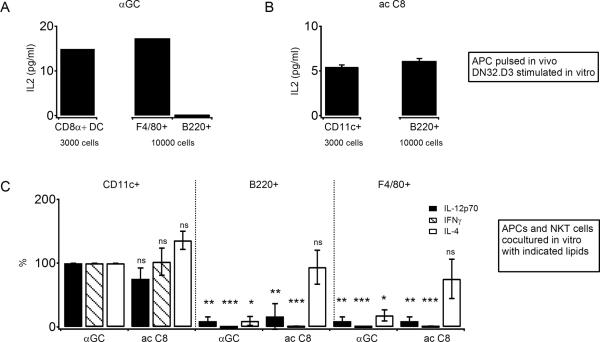
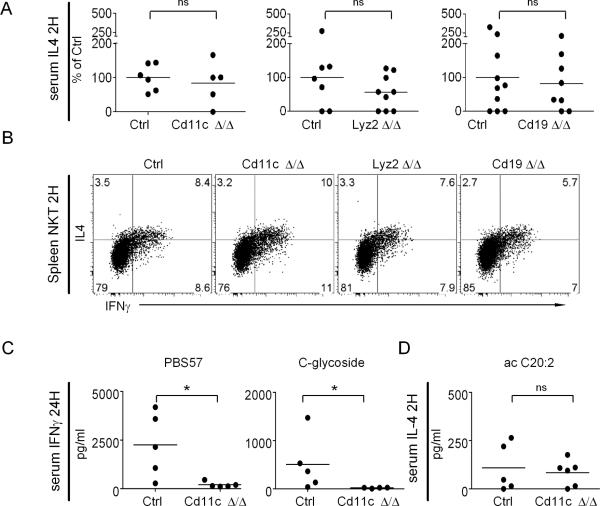
α-Galactosylceramide represents a new class of vaccine adjuvants and immunomodulators that stimulate NKT cells to secrete Th1 and Th2 cytokines. Synthetic variants with short or unsaturated acyl chains exhibit a striking Th2 bias in vivo but no evidence of defect in TCR signaling or stimulation of NKT cells in vitro. Using cd1d1(fl/fl) mice, we demonstrated that distinct APC types explained the cytokine bias in vivo. Whereas NKT stimulation by α-Galactosylceramide required CD1d expression by dendritic cells (DCs), presentation of the Th2 variants was promiscuous and unaffected by DC-specific ablation of CD1d. This DC-independent stimulation failed to activate the feedback loop between DC IL-12 and NK cell IFN-γ, explaining the Th2 bias. Conversely, forced presentation of the Th2 variants by DC induced high IL-12. Thus, lipid structural variations that do not alter TCR recognition can activate distinct Th1 or Th2 cellular networks by changing APC targeting in vivo.
α-半乳糖神经酰胺是一类新型疫苗佐剂和免疫调节剂,可刺激 NKT 细胞分泌 Th1 和 Th2 细胞因子。具有短链或不饱和酰基的合成变体在体内表现出明显的 Th2 偏向,但没有证据表明 TCR 信号转导缺陷或体外 NKT 细胞的刺激。使用 cd1d1(fl/fl) 小鼠,我们证明了不同的 APC 类型解释了体内细胞因子的偏向。虽然 α-半乳糖神经酰胺对 NKT 的刺激需要树突状细胞 (DC) 表达 CD1d,但 Th2 变体的呈递是混杂的,不受 DC 特异性 CD1d 消融的影响。这种 DC 不依赖的刺激未能激活 DC IL-12 和 NK 细胞 IFN-γ 之间的反馈回路,这解释了 Th2 偏向。相反,通过 DC 强制呈递 Th2 变体诱导高 IL-12。因此,不改变 TCR 识别的脂质结构变化可以通过改变体内 APC 的靶向性来激活不同的 Th1 或 Th2 细胞网络。