Skaggs Institute for Chemical Biology, The Scripps Research Institute, 10550 North Torrey Pines Road, La Jolla, California 92037, USA.
J Am Chem Soc. 2012 Apr 18;134(15):6732-40. doi: 10.1021/ja3001858. Epub 2012 Apr 6.
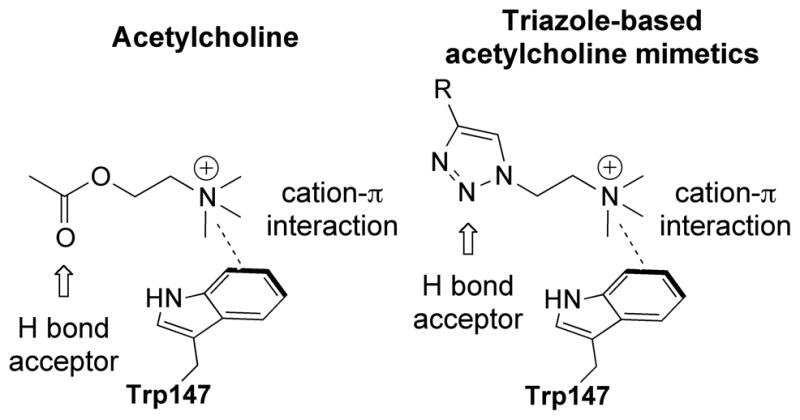
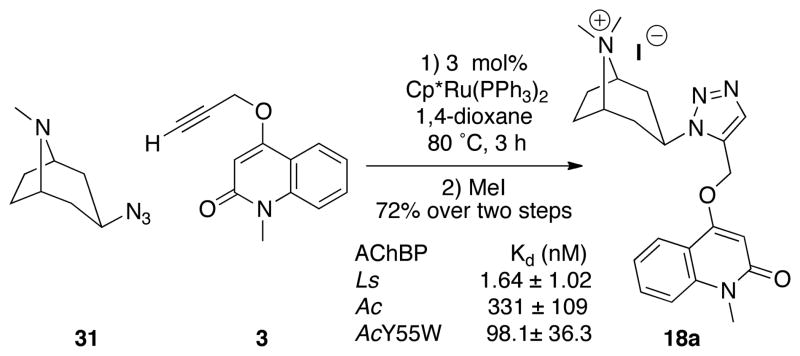
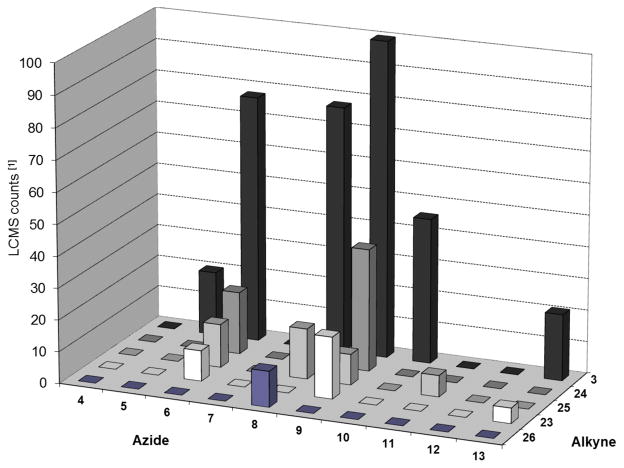
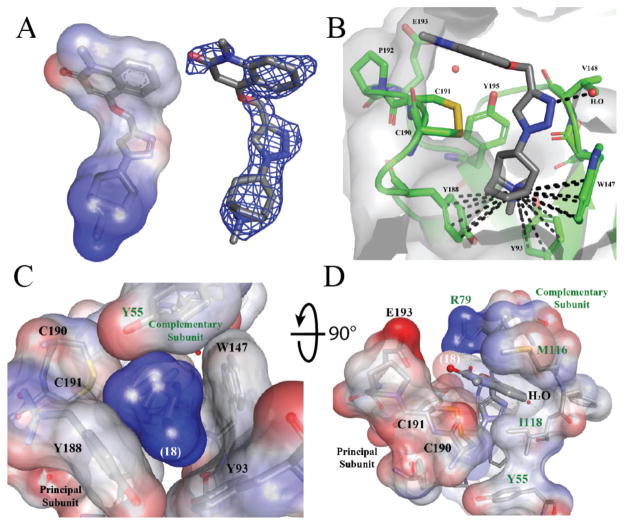
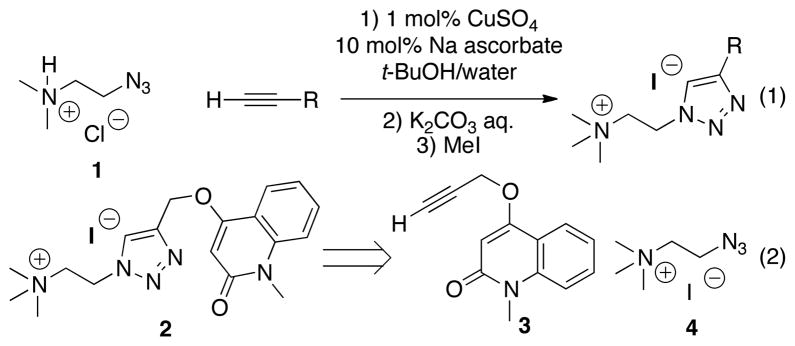
Nicotinic acetylcholine receptors (nAChRs), which are responsible for mediating key physiological functions, are ubiquitous in the central and peripheral nervous systems. As members of the Cys loop ligand-gated ion channel family, neuronal nAChRs are pentameric, composed of various permutations of α (α2 to α10) and β (β2 to β4) subunits forming functional heteromeric or homomeric receptors. Diversity in nAChR subunit composition complicates the development of selective ligands for specific subtypes, since the five binding sites reside at the subunit interfaces. The acetylcholine binding protein (AChBP), a soluble extracellular domain homologue secreted by mollusks, serves as a general structural surrogate for the nAChRs. In this work, homomeric AChBPs from Lymnaea and Aplysia snails were used as in situ templates for the generation of novel and potent ligands that selectively bind to these proteins. The cycloaddition reaction between building-block azides and alkynes to form stable 1,2,3-triazoles was used to generate the leads. The extent of triazole formation on the AChBP template correlated with the affinity of the triazole product for the nicotinic ligand binding site. Instead of the in situ protein-templated azide-alkyne cycloaddition reaction occurring at a localized, sequestered enzyme active center as previously shown, we demonstrate that the in situ reaction can take place at the subunit interfaces of an oligomeric protein and can thus be used as a tool for identifying novel candidate nAChR ligands. The crystal structure of one of the in situ-formed triazole-AChBP complexes shows binding poses and molecular determinants of interactions predicted from structures of known agonists and antagonists. Hence, the click chemistry approach with an in situ template of a receptor provides a novel synthetic avenue for generating candidate agonists and antagonists for ligand-gated ion channels.
烟碱型乙酰胆碱受体(nAChRs)负责介导关键的生理功能,它们广泛存在于中枢和外周神经系统中。作为 Cys 环配体门控离子通道家族的成员,神经元 nAChRs 是五聚体的,由各种α(α2 至α10)和β(β2 至β4)亚基的排列组合形成功能性异源或同源受体。nAChR 亚基组成的多样性使得开发针对特定亚型的选择性配体变得复杂,因为五个结合位点位于亚基界面上。乙酰胆碱结合蛋白(AChBP)是一种由软体动物分泌的可溶性细胞外结构域同源物,可作为 nAChRs 的通用结构替代物。在这项工作中,来自石鳖和海兔的同源 AChBPs 被用作原位模板,用于生成能够选择性结合这些蛋白的新型有效配体。砌块叠氮化物和炔烃之间的环加成反应形成稳定的 1,2,3-三唑,用于生成先导化合物。三唑在 AChBP 模板上的形成程度与三唑产物对烟碱配体结合位点的亲和力相关。我们证明,与以前显示的局部隔离的酶活性中心发生的原位蛋白模板化的叠氮-炔环加成反应不同,该反应可以在寡聚蛋白的亚基界面上发生,因此可以用作识别新型候选 nAChR 配体的工具。一个原位形成的三唑-AChBP 复合物的晶体结构显示了结合构象和从已知激动剂和拮抗剂的结构预测的相互作用的分子决定因素。因此,使用受体的原位模板的点击化学方法为生成配体门控离子通道的候选激动剂和拮抗剂提供了一种新的合成途径。