School of Medicine and Population Health, University of Newcastle, Newcastle, Australia 2308.
BMC Fam Pract. 2012 Mar 7;13:12. doi: 10.1186/1471-2296-13-12.
Dementia is increasing in prevalence as the population ages. An earlier rather than later diagnosis allows persons with dementia and their families to plan ahead and access appropriate management. However, most diagnoses are made by general practitioners (GPs) later in the course of the disease and are associated with management that is poorly adherent to recommended guidelines. This trial examines the effectiveness of a peer led dementia educational intervention for GPs.
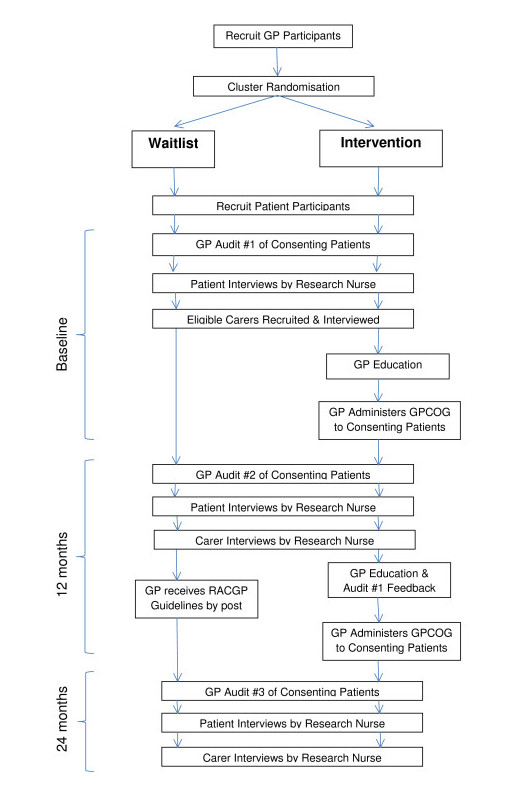
The study is a cluster randomised trial, conducted across three states and five sites. All GPs will complete an audit of their consenting patients aged 75 years or more at three time points - baseline, 12 and 24 months. GPs allocated to the intervention group will receive two educational sessions from a peer GP or nurse, and will administer the GPCOG to consenting patients at baseline and 12 months. The first education session will provide information about dementia and the second will provide individualised feedback on audit results. GPs in the waitlist group will receive the RACGP Guidelines by post following the 12 month audit
Primary outcomes are carer and consumer quality of life and depression. Secondary outcomes include: rates of GP identification of dementia compared to a more detailed gold standard assessment conducted in the patient's home; GP identification of differential diagnoses including reversible causes of cognitive impairment; and GP referral to specialists, Alzheimers' Australia and support services. A "case finding" and a "screening" group will be compared and the psychometrics of the GPCOG will be examined.
Approximately 2,000 subjects aged 75 years and over will be recruited through approximately 160 GPs, to yield approximately 200 subjects with dementia (reducing to 168 by 24 months).
The trial outlined in this paper has been peer reviewed and supported by the Australian National Health and Medical Research Council. At the time of submission of this paper 2,034 subjects have been recruited and the intervention delivered to 114 GPs.
Australia and New Zealand Clinical Trials Register (ANZCTR): ACTRN12607000117415.
随着人口老龄化,痴呆症的患病率不断增加。早期诊断而非晚期诊断,可使痴呆症患者及其家属提前做好规划并获得适当的治疗。然而,大多数诊断是由全科医生(GP)在疾病后期做出的,并且治疗的依从性较差,不符合推荐的指南。本试验旨在评估一种由同伴主导的针对全科医生的痴呆症教育干预的有效性。
本研究是一项在三个州和五个地点开展的集群随机试验。所有全科医生将在三个时间点(基线、12 个月和 24 个月)对其年龄在 75 岁及以上的同意患者进行审核。分配到干预组的全科医生将接受来自同伴全科医生或护士的两次教育课程,并在基线和 12 个月时对同意患者进行 GPCOG 测试。第一次教育课程将提供有关痴呆症的信息,第二次课程将提供审核结果的个性化反馈。等候组的全科医生将在 12 个月审核后通过邮寄收到 RACGP 指南。
主要结局是照顾者和消费者的生活质量和抑郁情况。次要结局包括:与在患者家中进行的更详细的金标准评估相比,全科医生识别痴呆症的比例;全科医生识别包括认知障碍可逆原因在内的鉴别诊断的比例;以及全科医生向专科医生、澳大利亚阿尔茨海默病协会和支持服务机构的转诊情况。将对“病例发现”和“筛查”组进行比较,并检查 GPCOG 的心理测量学。
通过大约 160 名全科医生招募 2000 名年龄在 75 岁及以上的患者,预计将有 200 名左右的患者患有痴呆症(到 24 个月时减少到 168 名)。
本文概述的试验已经过同行评审,并得到了澳大利亚国家卫生和医学研究委员会的支持。在提交本文时,已经招募了 2034 名受试者,并向 114 名全科医生提供了干预措施。
澳大利亚和新西兰临床试验注册(ANZCTR):ACTRN12607000117415。